Eye Test in Ludhiana: What a Full Checkup Includes

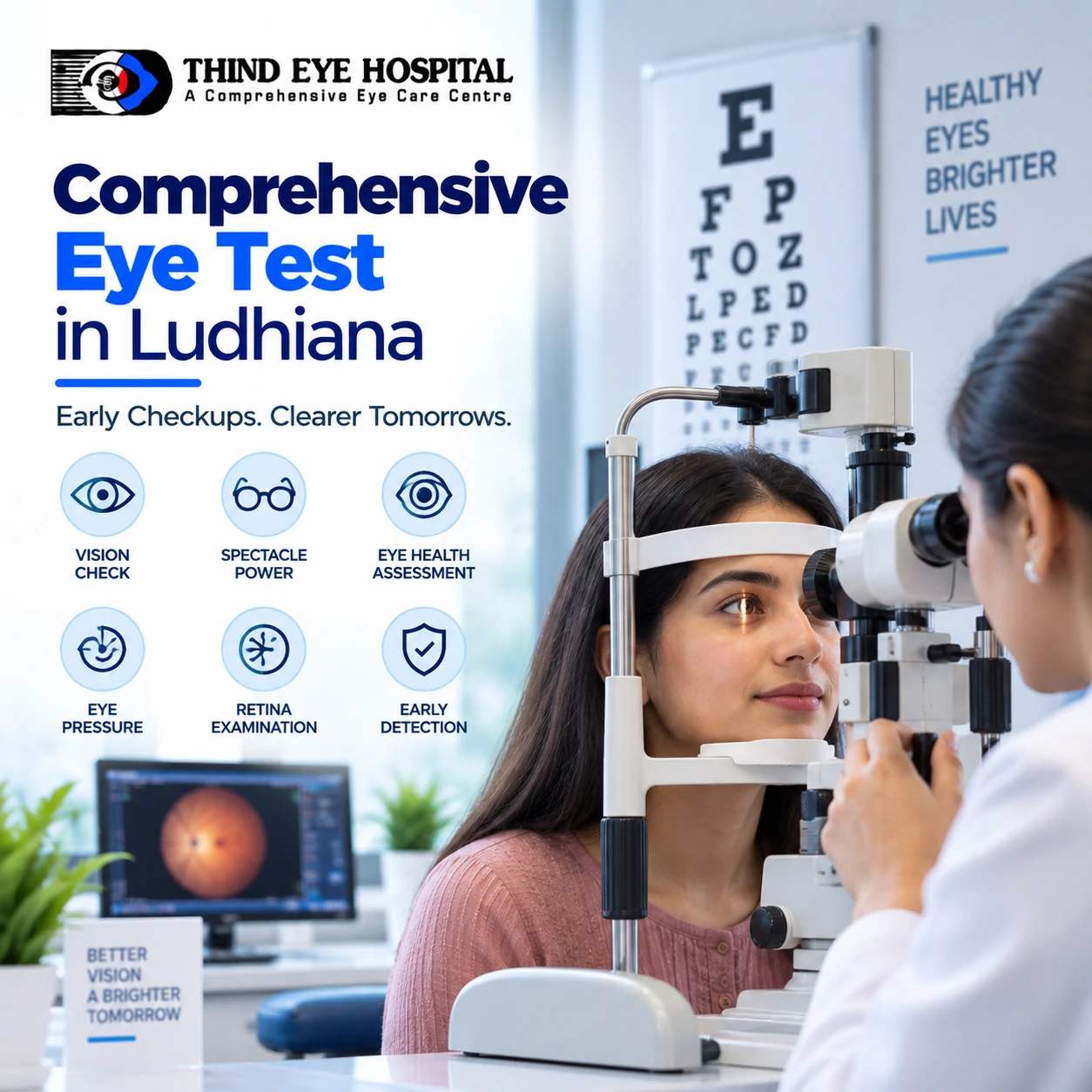
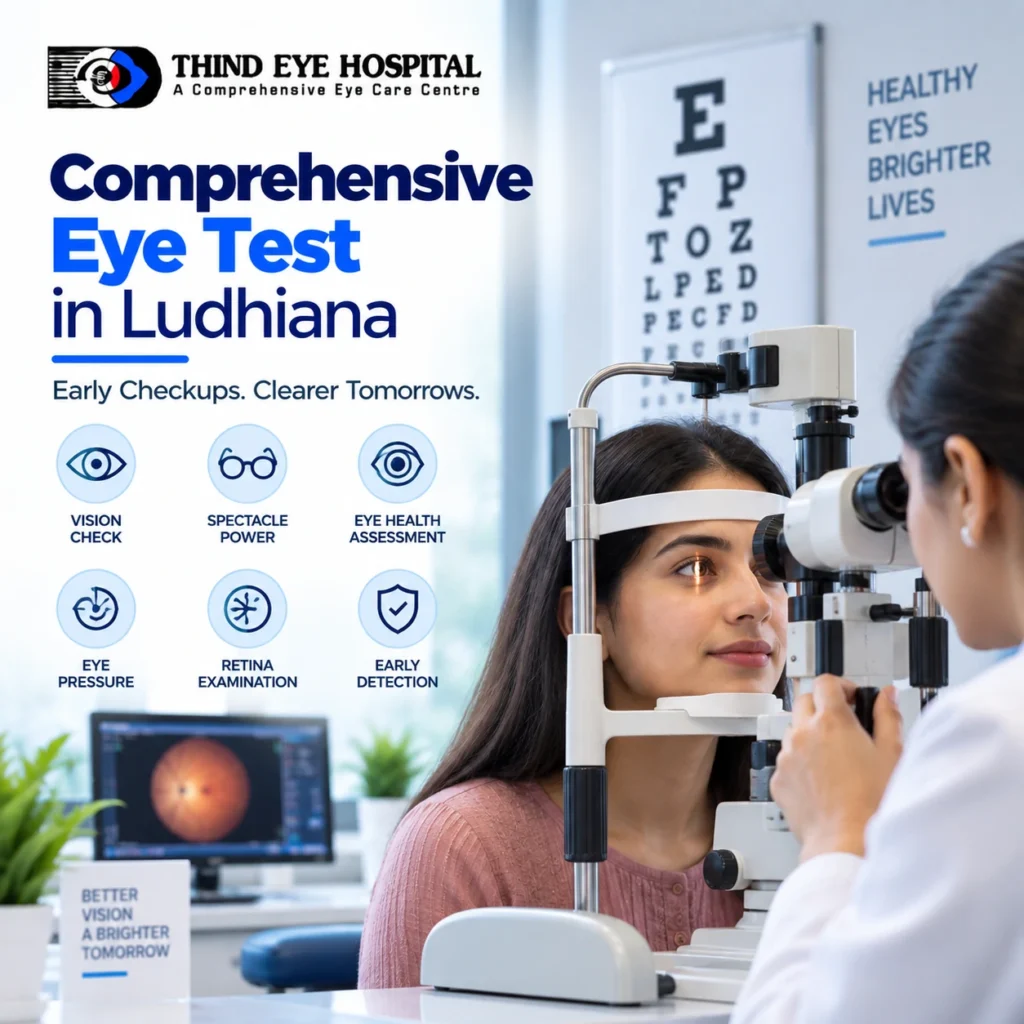
An eye test in Ludhiana is more than checking your spectacle power. A comprehensive eye examination includes visual acuity, refraction, examination of the front of the eye, intraocular pressure and, where indicated, a dilated retinal examination. Regular testing helps identify changes early, even when your vision seems normal.
Eye Test in Ludhiana What a Full Checkup Includes


What Does an Eye Test in Ludhiana Include?

A full eye test in Ludhiana checks different parts of your vision and eye health. Your examination may include:

  • Visual acuity: Checks how clearly you see at different distances.
  • Refraction: Measures your spectacle power and helps identify the correction you need.
  • Front-of-eye examination: Checks the visible structures at the front of your eye.
  • Intraocular pressure: Measures pressure inside the eye.
  • Dilated retinal examination: Examines the retina when dilation is indicated.

This is why an eye checkup Ludhiana appointment should not be treated as only a spectacle power test.

An optometrist is a trained eye-care professional who performs vision testing. An ophthalmologist is a medical doctor who examines and treats eye conditions and performs eye surgery.

For a broader understanding of vision changes, read about the signs you need glasses.

Who Should Have an Eye Test in Ludhiana?

You should not wait for blurred vision before arranging an eye test in Ludhiana. Regular examinations are useful even when your eyesight appears normal.

Adults with no symptoms and no risk factors are generally advised to have a comprehensive eye examination every one to two years. From age 40, examinations are generally advised more often because the risk of glaucoma and other conditions rises.

If you have diabetes

People with diabetes need a dilated retinal examination at least once a year. This applies even when your vision seems normal. Your eye specialist may advise an earlier examination when needed.

If glaucoma runs in your family

A family history of glaucoma calls for regular eye examinations from an earlier age. Glaucoma is often symptomless until it becomes advanced.

If you are in your forties

Presbyopia is the age-related loss of near focus. It typically begins in the forties and is a normal change rather than a disease.

Why a Full Eye Checkup Matters in Ludhiana

A complete eye test in Ludhiana looks beyond your spectacle number. Some eye changes do not cause noticeable symptoms in their early stages.

Your examination also gives the ophthalmologist a clearer picture of your eye health. This is particularly relevant if you have diabetes, a family history of glaucoma or age-related changes in near vision.

The American Academy of Ophthalmology provides patient information on comprehensive eye care and vision health. You can also refer to the National Programme for Control of Blindness and Visual Impairment for information on eye-care services in India.

For patients in Ludhiana, Thind Eye Hospital provides access to a multi superspeciality eye hospital within the city. The hospital was founded in 1991 by Dr. Jaswant Singh Thind and has more than 39 years of expertise in eye care.

What Can Affect Your Eye Health?

Your daily habits also matter between eye examinations.

Screen use and eye strain

Prolonged screen use is associated with dry eye and eye strain because your blink rate falls. Regular breaks, adequate lighting and the correct working distance help reduce symptoms.

If you spend much of your day working on a computer or phone, mention any discomfort during your eye test in Ludhiana.

Sun exposure

Ultraviolet exposure is linked to cataract and pterygium, a growth on the surface of the eye. Sunglasses with proper UV protection matter in the Punjab climate.

These habits do not replace an examination. A regular eye test near me Ludhiana search can help you find a convenient location for routine eye care.

Meet Your Eye Specialist at Thind Eye Hospital Ludhiana

At the Ludhiana branch, Dr. Alia Yamin, Consultant Ophthalmologist, Cataract, Medical Retina and Dry Eye, consults daily. Her listed speciality areas include cataract, refractive surgery, medical retina and dry eye management.

The hospital’s Ludhiana branch is located at B-35, 958, M/5, Wood Stock Tower, Ferozepur Road, Ludhiana 141012, Punjab, opposite Wave Mall.

Thind Eye Hospital is a multi superspeciality eye hospital with branches in Jalandhar, Ludhiana, Hoshiarpur and Pathankot. The hospital also conducts community eye care camps for rural populations and school eye health checkup programmes for children.

You can learn more about the eye hospital in Ludhiana or read the profile of Dr. Alia Yamin.

What to Expect During a Dilated Eye Examination

A dilated retinal examination is performed when indicated. Dilating drops make it easier to examine the retina.

The drops blur near vision and increase light sensitivity for several hours. It is therefore helpful to arrange transport home after a dilated examination.

If you are booking an eye test in Ludhiana, tell the clinic about any concerns you have before the examination. Bring relevant previous eye records if you have them.

If you are ready to arrange an eye checkup Ludhiana appointment, you can book an appointment online.

Book Your Eye Test in Ludhiana

If you are looking for an eye test in Ludhiana, Thind Eye Hospital’s Ludhiana branch is open Monday to Sunday, 8:00 am to 8:00 pm.

The branch is at Wood Stock Tower, Ferozepur Road, opposite Wave Mall. You can call +91 95940 50391 to book a consultation or ask about the examination process.

A regular eye test in Ludhiana is a practical part of looking after your vision, even when you have no obvious symptoms. For more information or to arrange your visit, contact the Ludhiana branch.

“This article provides general information about eye health and eye care services. It is not medical advice and does not replace a consultation with a qualified ophthalmologist. Symptoms vary between individuals. Please consult a licensed eye specialist before acting on any information here.”
FAQs

Blade-Free Cataract Surgery in Jalandhar

Laser cataract surgery in Jalandhar is a modern approach to cataract surgery that uses laser technology as part of the procedure. It is considered after an eye examination confirms cataract and assesses your eye health, measurements and visual needs. Thind Eye Hospital introduced 100% blade-free cataract surgery with laser in 2013.

Blade-Free Cataract Surgery in Jalandhar


What Is Cataract and When Is Surgery Needed?

A cataract is clouding of the eye’s natural lens. It usually develops gradually and is most commonly related to ageing.

Common symptoms include:

  • Cloudy or blurred vision
  • Glare and haloes around lights
  • Poor night vision
  • Faded colours
  • Frequent changes in spectacle power

Cataract cannot be reversed with drops, exercises or diet. Surgery is the only definitive treatment.

Modern cataract surgery removes the clouded natural lens and replaces it with an intraocular lens, or IOL. The two common surgical techniques are phacoemulsification and small incision cataract surgery, also called SICS.

For patients considering laser cataract surgery in Jalandhar, an examination is the starting point. The surgeon needs to assess the eye before recommending the appropriate surgical approach.

Laser Cataract Surgery in Jalandhar: How Does It Work?

Laser cataract surgery in Jalandhar refers to cataract surgery using laser technology as part of the surgical process. It is different from laser vision correction procedures such as LASIK, which are used to correct refractive errors.

Thind Eye Hospital introduced 100% blade-free cataract surgery with laser in 2013. The hospital had also introduced 100% topical anaesthesia cataract surgery without injections in 1997.

Cataract surgery is usually performed as a day care procedure under topical or local anaesthesia. General anaesthesia is rarely needed in adults.

There is no upper age limit for cataract surgery. Fitness for surgery depends on the health of the eye and your general medical condition, rather than age alone.

Blade Free Cataract Jalandhar: What Lens Options Are Available?

After cataract removal, the cloudy natural lens is replaced with an IOL. Several IOL options are available.

Monofocal lenses

Monofocal IOLs provide correction for a selected viewing distance.

Toric lenses

Toric IOLs are designed for patients with astigmatism, an irregular focusing error caused by the shape of the eye.

Multifocal and extended depth of focus lenses

These lenses provide different approaches to vision at multiple distances.

The choice of IOL depends on your eye measurements and visual needs. Your examination and consultation help determine which option is appropriate.

This decision is an important part of planning femto cataract Jalandhar treatment because the surgical procedure and lens selection address different aspects of cataract care.

What Happens Before Cataract Surgery?

A cataract consultation begins with an eye assessment and measurements needed for surgical planning.

Your doctor evaluates the eye and reviews your visual symptoms. The assessment also helps determine the appropriate IOL and surgical approach.

A comprehensive eye examination assesses more than spectacle power. It includes visual acuity, refraction, examination of the front of the eye, intraocular pressure and, where indicated, a dilated retinal examination.

You should also tell your doctor about your general medical condition and any medicines you take. This information is relevant because surgical fitness depends partly on your overall medical condition.

For patients researching laser cataract surgery in Jalandhar, understanding this assessment stage is important. Surgery is planned after the eye has been properly examined.

What Is Cataract Surgery Recovery Time?

Most patients notice improved vision within a few days after cataract surgery. Vision continues to settle over about four to six weeks.

Your recovery instructions will include specific advice for the period after surgery. Follow the restrictions and treatment plan given by your eye surgeon.

You can also read more about cataract surgery recovery time before your procedure.

A condition called posterior capsule opacification can occur months or years after cataract surgery. It is treated with a short outpatient Nd:YAG laser capsulotomy rather than repeat cataract surgery.

Knowing these possible stages helps you understand what to expect from laser cataract surgery in Jalandhar.

Why Consider Thind Eye Hospital in Jalandhar?

Thind Eye Hospital is a multi superspeciality eye hospital with branches in Jalandhar, Ludhiana, Hoshiarpur and Pathankot. It was founded in 1991 by Dr. Jaswant Singh Thind, Chief Eye Surgeon and Chairman cum Managing Director.

Dr. Jaswant Singh Thind completed his MS in Ophthalmology from King George’s Medical College, Lucknow, in 1986. He consults at the Jalandhar branch daily.

The hospital has also introduced several eye-care procedures over its history. It was among the first in India to introduce 100% topical anaesthesia cataract surgery without injections in 1997. It introduced 100% blade-free cataract surgery with laser in 2013.

The hospital brings more than 39 years of expertise in eye care and has performed more than 4,00,000 surgeries to date.

For additional information about cataract and eye health, you can refer to the American Academy of Ophthalmology and the World Health Organization’s eye-care information.

Visit the Eye Hospital in Jalandhar

The Jalandhar branch is located at:

701, Mall Road, Model Town, Jalandhar 144001, Punjab

The landmark is Mall Road, Model Town.

The branch is open Monday to Sunday, 8:00 am to 6:00 pm. You can call +91 88720 70022 for branch information and consultation details.

If you are considering laser cataract surgery in Jalandhar, you can learn more about the eye hospital in Jalandhar before your visit.

What Should You Do Next?

If cataract symptoms are affecting your vision, arrange an eye examination. Cataract surgery removes the clouded natural lens and replaces it with an IOL, and the choice of lens depends on your eye measurements and visual needs.

For laser cataract surgery in Jalandhar, contact Thind Eye Hospital at +91 88720 70022 or book an appointment online.

Disclaimer: “This article provides general information about eye health and eye care services. It is not medical advice and does not replace a consultation with a qualified ophthalmologist. Symptoms vary between individuals. Please consult a licensed eye specialist before acting on any information here.”

FAQs

Choosing Contact Lenses: Types, Safety and Care

The best contact lens depends on your vision needs, eye health and daily routine. Contact lens types differ in how they correct vision and how they are worn. Safe use also requires proper fitting, hygiene and contact lens care. An eye examination helps determine whether contact lenses are suitable for you.

Choosing Contact Lenses Types, Safety and Care


What Are the Main Contact Lens Types?

There are several contact lens types, and each serves different vision needs. Your choice should follow an eye examination rather than a decision based only on convenience.

Contact lenses are designed to sit on the eye and provide vision correction. The right lens needs to match your prescription and eye health.

When comparing the best contact lens for your needs, consider:

  • Your current vision prescription
  • Your daily wearing routine
  • Your eye health
  • Any history of corneal problems
  • Whether you experience dry eye symptoms
  • How consistently you can follow lens-care instructions

An ophthalmologist is a medical doctor specialising in eye health and treatment. An optometrist is a vision-care professional who examines vision and provides optical correction within their professional scope.

Best Contact Lens: What Should You Consider?

Choosing the best contact lens involves more than selecting a brand or lens type.

Your cornea matters

The cornea is the clear front surface of the eye. Its shape and clarity determine much of the eye’s focusing power.

Some corneal conditions require specialist assessment before contact lens use. Keratoconus, for example, is a progressive thinning and bulging of the cornea. It usually starts in the teens or twenties and can cause distorted vision and frequently changing spectacle power.

Persistent eye rubbing is a recognised risk factor for keratoconus.

Dry eye also matters

Dry eye is a common condition of the tear film. It can cause burning, grittiness, watering and fluctuating vision.

If you experience these symptoms, an eye examination can assess your tear film and overall eye health before you choose contact lenses. Management can include lubricants, lid hygiene, tear film assessment and treatments such as IDRA assessment and IRPL therapy.

You can also read about eye allergy treatment if allergy-related eye symptoms are affecting your comfort.

Contact Lens Care: The Safety Basics

Good contact lens care is essential for people who wear lenses.

Contact lens misuse is one recognised cause of corneal ulcers. A corneal ulcer is an open sore on the cornea and requires prompt assessment.

Know the warning signs

Pain, redness, watering and a white spot on the cornea need same-day assessment. Delaying assessment can cause permanent scarring.

Do not continue treating these symptoms as a routine lens problem. Seek an eye examination promptly.

Reduce avoidable irritation

If you use contact lenses, follow the care and wearing instructions given for your lenses. Avoid persistent eye rubbing, particularly because it is a recognised risk factor for keratoconus.

If you develop new or persistent symptoms while wearing lenses, arrange an eye examination rather than trying to diagnose the problem yourself.

The American Academy of Ophthalmology provides additional information about contact lenses and eye health.

Contact Lenses and Corneal Conditions

Your contact lens choice becomes especially important if you have a known corneal condition.

Keratoconus

Collagen crosslinking, or CXL, is used to strengthen corneal tissue and slow the progression of keratoconus. It does not usually reverse changes that are already present.

CAIRS and corneal ring segments can help improve corneal shape in selected keratoconus patients.

Corneal transplantation

Some corneal conditions require transplantation. Techniques include penetrating keratoplasty, or PK, and lamellar procedures such as DALK and PDEK. Lamellar techniques replace only the affected layers.

These treatments are different from routine contact lens correction and require specialist assessment.

Pterygium

Pterygium is a fleshy growth on the surface of the eye. It is associated with sun, wind and dust exposure.

It is removed surgically when it affects vision or causes persistent irritation. Sunglasses with proper UV protection are also relevant in the Punjab climate because ultraviolet exposure is linked to cataract and pterygium.

Best Contact Lens for Dry or Allergy-Prone Eyes

There is no single best contact lens for everyone with eye discomfort. Your symptoms should first be assessed.

Dry eye can cause burning, grittiness, watering and fluctuating vision. Contact lens use can also become problematic if proper care is not followed.

If you experience eye symptoms that you think are related to allergy, you can read more about eye allergy treatment.

A proper examination can also check the cornea and other parts of the eye. This matters because corneal ulcers can follow injury, contact lens misuse or infection.

If you have pain, redness, watering and a white spot on the cornea, seek same-day assessment.

When Should You See an Eye Specialist?

A comprehensive eye examination assesses more than spectacle power. It includes visual acuity, refraction, examination of the front of the eye, intraocular pressure and, where indicated, a dilated retinal examination.

Regular examinations are also relevant even when your vision appears normal. Adults without symptoms or risk factors are generally advised to have a comprehensive eye examination every one to two years.

From age 40, examinations are advised more often as the risk of glaucoma and other conditions rises.

People with diabetes need a dilated retinal examination at least once a year, and sooner if advised, even when their vision seems normal. Anyone with a family history of glaucoma should also be examined regularly from an earlier age.

For additional eye-care information, you can refer to the National Programme for Control of Blindness and Visual Impairment.

Contact Lens Consultation at Thind Eye Hospital

If you are searching for the best contact lens, start with an eye examination. The assessment can check your vision, cornea, eye surface and general eye health.

At Thind Eye Hospital, Dr. Diksha, Consultant Ophthalmologist, Cornea and Refractive Surgery, consults in Ludhiana daily. Her speciality includes cornea, cataract and refractive surgery, including LASIK, SMILE and PRK.

Dr. Diksha is also experienced in managing corneal ulcers and dry eye, along with procedures including collagen crosslinking, CAIRS and corneal transplant techniques.

You can learn more about Dr. Diksha before your consultation.

Thind Eye Hospital is a multi superspeciality eye hospital with branches in Jalandhar, Ludhiana, Hoshiarpur and Pathankot. The hospital was founded in 1991 by Dr. Jaswant Singh Thind and brings more than 39 years of expertise in eye care.

What Should You Do Next?

The best contact lens is one selected after considering your prescription, corneal health, eye surface and daily needs. Good contact lens care is equally important after you start wearing lenses.

If you are considering contact lenses or experiencing discomfort, book an eye examination with Thind Eye Hospital. You can book an appointment and discuss your requirements with an eye specialist.

Disclaimer: “This article provides general information about eye health and eye care services. It is not medical advice and does not replace a consultation with a qualified ophthalmologist. Symptoms vary between individuals. Please consult a licensed eye specialist before acting on any information here.”

FAQs

Eye Clinic in Ludhiana: Services Available Seven Days a Week

An eye clinic in Ludhiana can provide routine eye examinations, spectacle assessments and specialist eye care. Thind Eye Hospital’s Ludhiana branch is open seven days a week, from 8:00 am to 8:00 pm. It is located at Wood Stock Tower on Ferozepur Road, opposite Wave Mall, making it accessible for local patients.

Eye Clinic in Ludhiana Services Available Seven Days a Week

Eye Clinic in Ludhiana: Where to Find the Branch

If you are searching for an eye clinic near me Ludhiana, the location and opening hours matter when planning your visit.

Thind Eye Hospital’s Ludhiana branch is at:

B-35, 958, M/5, Wood Stock Tower, Ferozepur Road, Ludhiana 141012, Punjab

The landmark is Wood Stock Tower, Ferozepur Road, opposite Wave Mall.

The branch is open Monday to Sunday, 8:00 am to 8:00 pm. You can call +91 95940 50391 before visiting if you need help planning your consultation.

You can also find details about the eye hospital in Ludhiana before your visit.

What Services Can You Expect at an Eye Clinic in Ludhiana?

A visit to an eye clinic in Ludhiana should begin with an appropriate eye assessment. A comprehensive eye examination checks more than your spectacle power.

It includes:

  • Visual acuity
  • Refraction
  • Examination of the front of the eye
  • Intraocular pressure
  • A dilated retinal examination where indicated

These checks help assess your vision and general eye health.

Thind Eye Hospital’s Ludhiana branch also has Dr. Alia Yamin, Consultant Ophthalmologist, Cataract, Medical Retina and Dry Eye, who consults daily. Her listed areas include cataract, refractive surgery, medical retina and dry eye management.

An ophthalmologist is a medical doctor specialising in eye health and treatment. An optometrist is a vision-care professional who examines vision and provides optical correction within their professional scope.

Eye Clinic in Ludhiana: What Happens During Your First Visit?

Knowing what to expect makes it easier to plan your visit.

1. Arrive at the branch

Reach the Ludhiana branch at Wood Stock Tower, Ferozepur Road, opposite Wave Mall. The branch is open every day from 8:00 am to 8:00 pm.

2. Have your vision assessed

Your examination includes visual acuity and refraction. Refraction checks the optical power needed for your vision correction.

3. Have your eyes examined

The examination includes the front of your eye and intraocular pressure. A dilated retinal examination is performed where indicated.

4. Discuss your eye care needs

Your examination findings help guide the next step. If further assessment or treatment is needed, this can be discussed during your consultation.

5. Plan your visit home

If your examination includes dilation, remember that dilating drops blur near vision and increase light sensitivity for several hours. Arrange transport home after a dilated examination.

What should you bring?

It is useful to bring:

  • Your current spectacles
  • Previous eye examination records, if available
  • Details of any regular eye medicines
  • Relevant medical information, including diabetes history

When Should You Visit an Eye Clinic?

Regular eye examinations are useful even when your vision seems normal.

Adults without symptoms and risk factors are generally advised to have a comprehensive eye examination every one to two years. From age 40, examinations are advised more often because the risk of glaucoma and other conditions rises.

If you have diabetes, you need a dilated retinal examination at least once a year, and sooner if advised. This applies even when your vision seems normal.

A family history of glaucoma is another reason for regular examinations from an earlier age. Glaucoma is often symptomless until it becomes advanced.

You can also read about the signs you need glasses if you are noticing changes in your vision.

Eye Care Ludhiana: Everyday Habits That Help

Your daily habits also affect how your eyes feel.

Screen use

Prolonged screen use is associated with dry eye and eye strain because your blink rate falls. Regular breaks, adequate lighting and the correct working distance help reduce symptoms.

UV protection

Ultraviolet exposure is linked to cataract and pterygium. Sunglasses with proper UV protection therefore matter in the Punjab climate.

Near vision after 40

Presbyopia is the age-related loss of near focus. It typically begins in the forties and is a normal change rather than a disease.

If you are experiencing changes in near vision, a comprehensive eye examination can assess your vision and eye health.

For broader information, the American Academy of Ophthalmology provides patient resources on eye conditions and care. The World Health Organization’s eye care information is another useful reference.

Why Choose Thind Eye Hospital in Ludhiana?

Thind Eye Hospital was founded in 1991 by Dr. Jaswant Singh Thind. The hospital brings more than 39 years of expertise in eye care and has performed more than 4,00,000 surgeries to date.

Its history includes several developments in eye care. The hospital introduced 100% topical anaesthesia cataract surgery without injections in 1997. It introduced LASIK laser vision correction in North India in 1998 and launched a fully equipped Vitreo-Retinal department in 1999.

The hospital also conducts community eye care camps for rural populations and school eye health checkup programmes for children.

For patients looking for eye care Ludhiana, these details provide useful context about the hospital and its services.

Book a Consultation at the Ludhiana Branch

If you are searching for an eye clinic in Ludhiana, you can visit the Thind Eye Hospital branch at Wood Stock Tower, Ferozepur Road, opposite Wave Mall.

The branch is open Monday to Sunday, 8:00 am to 8:00 pm. Call +91 95940 50391 for branch information or book an appointment online.

Dr. Alia Yamin, Consultant Ophthalmologist, Cataract, Medical Retina and Dry Eye, consults at the Ludhiana branch daily. You can also view Dr. Alia Yamin before your visit.

For anyone searching for an eye clinic near me Ludhiana, the Ludhiana branch provides a clear local option for comprehensive eye assessment and specialist consultation.

Disclaimer: “This article provides general information about eye health and eye care services. It is not medical advice and does not replace a consultation with a qualified ophthalmologist. Symptoms vary between individuals. Please consult a licensed eye specialist before acting on any information here.”

FAQs


LASIK and Vision Correction for Pathankot Patients

LASIK surgery in Pathankot is a vision correction option that reshapes the cornea to reduce dependence on glasses or contact lenses. Suitable patients are assessed for age, stable spectacle power, corneal thickness, topography, pupil size, dry eye status and general eye health before laser vision correction is considered.

LASIK and Vision Correction for Pathankot Patients

What Is LASIK and Laser Vision Correction?

Refractive surgery reshapes the cornea, the clear front surface of the eye, to reduce dependence on glasses or contact lenses. The main options are LASIK, SMILE, PRK and TransPRK.

For someone considering lasik surgery in Pathankot, the first step is not choosing a procedure. It is a detailed assessment to determine which option is appropriate.

LASIK creates a corneal flap before reshaping the underlying corneal tissue. SMILE uses a small incision to remove a lenticule, a small piece of corneal tissue. PRK and TransPRK work on the corneal surface and generally involve a longer visual recovery.

Thind Eye Hospital has a specific history with laser vision correction. It was the first eye hospital in North India to introduce LASIK laser vision correction in 1998. It was also among the earliest in India to introduce Blade-Free LASIK technology in 2007.

Who Is Suitable for LASIK Surgery in Pathankot?

Not everyone with glasses is automatically suitable for laser vision correction. A proper examination checks whether your eyes meet the requirements for treatment.

What is assessed?

Candidates are usually assessed for:

  • Age, generally 18 and above
  • Stable spectacle power for at least one year
  • Adequate corneal thickness
  • Corneal topography, which maps the shape of the cornea
  • Pupil size
  • Dry eye status
  • General eye health

Contact lenses are usually stopped for a period before the pre-operative assessment because they can alter the shape of the cornea.

Certain conditions can also affect suitability. Patients with keratoconus, active eye infection, uncontrolled dry eye or certain retinal conditions may not be suitable for laser vision correction.

This is why an examination matters before deciding on lasik surgery in Pathankot.

LASIK Surgery in Pathankot: What Are the Main Options?

Laser vision correction includes several procedures. Each works differently.

LASIK

LASIK creates a corneal flap and reshapes the cornea underneath it. It is one of the established forms of refractive surgery.

SMILE

SMILE uses a small incision and removes a lenticule from the cornea. If you are comparing procedures, you can read more about SMILE Pro compared with LASIK.

PRK and TransPRK

PRK and TransPRK work on the surface of the cornea. They generally involve a longer visual recovery than LASIK or SMILE.

ICL

ICL means implantable collamer lens. It is an alternative for patients with high refractive errors or corneas that are too thin for laser treatment.

The lens is placed inside the eye and does not remove corneal tissue.

Thind Eye Hospital was the first eye hospital in India to perform ICL surgery in 2001.

The appropriate procedure is selected after examining your eyes and understanding your refractive error.

What Happens During and After Laser Eye Surgery?

Laser vision correction is typically a day care procedure that takes a few minutes per eye.

Most patients return to routine activities within one to two days. Specific restrictions apply to activities such as swimming, dust exposure and rubbing the eyes.

Your doctor will explain the restrictions and follow-up schedule relevant to your procedure.

For anyone researching laser eye surgery Pathankot, it is useful to understand that recovery differs between procedures. LASIK, SMILE, PRK and TransPRK do not use the same surgical approach or have the same visual recovery pattern.

A comprehensive eye examination also assesses more than spectacle power. It includes visual acuity, refraction, examination of the front of the eye, intraocular pressure and, where indicated, a dilated retinal examination.

Is LASIK Right for You in Pathankot?

The decision should follow an eye examination rather than an online checklist.

Your spectacle power needs to be stable for at least a year. Your corneal thickness, corneal shape, pupil size, dry eye status and general eye health also form part of the assessment.

It is also useful to understand what refractive surgery does not address. LASIK surgery in Pathankot corrects your existing refractive power. It does not prevent presbyopia, the age-related loss of near focus that typically begins in the forties.

This means someone who has laser vision correction can still experience age-related near vision changes later.

The American Academy of Ophthalmology provides additional patient information about eye conditions and vision care. You can also refer to the National Programme for Control of Blindness and Visual Impairment for information related to eye health in India.

Thind Eye Hospital Pathankot

For patients considering lasik surgery in Pathankot, Thind Eye Hospital provides access to eye care locally through its Pathankot branch.

The branch is located at SCO-8, TMT Scheme, near the LIC Office, Pathankot 145001, Punjab. It is open Monday to Sunday, 8:00 am to 6:00 pm.

The branch is also associated with Dr. Jaswant Singh Thind, Chief Eye Surgeon and Chairman cum Managing Director. He completed his MS in Ophthalmology from King George’s Medical College, Lucknow, in 1986, and founded Thind Eye Hospital in 1991. His Pathankot consulting day is Tuesday.

You can learn more about Dr. Jaswant Singh Thind or visit the page for the eye hospital in Pathankot.

What Should You Do Next?

If you are considering lasik surgery in Pathankot, start with a comprehensive eye examination. The assessment determines whether laser vision correction is suitable and which procedure fits your eye condition and refractive needs.

To discuss your requirements, contact the Thind Eye Hospital Pathankot branch at +91 88720 70055. You can also book an appointment before visiting.

For laser eye surgery Pathankot, a consultation is the right next step before making a treatment decision.

Disclaimer: “This article provides general information about eye health and eye care services. It is not medical advice and does not replace a consultation with a qualified ophthalmologist. Symptoms vary between individuals. Please consult a licensed eye specialist before acting on any information here.”

FAQs

Progressive Lenses: Who They Suit and How to Adapt

A progressive lens is designed to give you clear vision at different distances through one pair of spectacles. It can suit people who need correction for both near and distance vision, especially with presbyopia, the age-related loss of near focus. The right prescription and fitting help you adapt comfortably.

Progressive Lenses Who They Suit and How to Adapt

What Is a Progressive Lens?

A progressive lens provides vision correction for distance, intermediate tasks and near work in one lens. Unlike separate reading and distance spectacles, it does not have a visible dividing line.

You may also hear them called varifocal lenses. The lens gradually changes power from the upper part to the lower part, allowing you to use different viewing zones.

Progressive lenses are commonly considered when presbyopia begins. Presbyopia typically starts in the forties and is a normal age-related change, not a disease.

However, choosing a progressive lens should not be based only on age. Your eye health, prescription and daily visual needs also matter.

If you are unsure whether you need new spectacles, read about the signs you need glasses.

Who Can Benefit From a Progressive Lens?

A progressive lens can be useful if you need correction for more than one viewing distance.

People with presbyopia

Presbyopia affects near focusing ability as you age. You may notice difficulty reading small print or focusing on nearby objects.

A progressive lens allows you to use one pair of spectacles for different distances. Your eye specialist can assess whether this type of correction suits your visual needs.

People who switch between distances

If your day involves reading, computer work and looking at objects across a room, switching between multiple pairs of spectacles can be inconvenient.

Progressive lenses provide different areas of correction within the same lens. Your adaptation also depends on using the appropriate part of the lens for the task.

People who need regular vision correction

A comprehensive eye examination assesses more than spectacle power. It includes visual acuity, refraction, examination of the front of the eye, intraocular pressure and, where indicated, a dilated retinal examination.

This assessment helps identify the prescription you need and checks your general eye health.

Progressive Lens: What Should You Check Before Buying?

Choosing a progressive lens is not simply about selecting a lens type. Your eye examination should come first.

An ophthalmologist is a medical doctor who specialises in eye health and treatment. An optometrist is a vision-care professional who examines vision and prescribes optical correction within their professional scope.

Before choosing progressive lenses, consider:

  • Your current spectacle prescription
  • Your near and distance vision needs
  • How much computer or screen work you do
  • Your general eye health
  • Whether you have diabetes
  • Your family history of glaucoma
  • Whether you need a dilated retinal examination

Adults without symptoms or risk factors are generally advised to have a comprehensive eye examination every one to two years. From age 40, examinations are advised more often as the risk of glaucoma and other conditions rises.

If you have diabetes, you need a dilated retinal examination at least once a year, even when your vision seems normal. People with a family history of glaucoma should also have regular examinations from an earlier age because glaucoma is often symptomless until advanced.

How to Adapt to Progressive Lenses

Getting used to a progressive lens takes practice. Your eyes and head need to adjust to using different areas of the lens for different distances.

Give yourself time

Use your new spectacles regularly rather than constantly switching back to an older pair. This helps you become familiar with the lens design and its viewing areas.

Move your head when needed

Progressive lenses have different zones. Turning your head towards the object you want to see can help you look through the appropriate area.

Take care with stairs

During the adjustment period, pay attention when walking on stairs or uneven surfaces. Your vision through different parts of the lens changes with viewing distance.

Consider your screen use

Prolonged screen use is associated with dry eye and eye strain because your blink rate falls. Regular breaks, suitable lighting and the correct working distance can reduce symptoms.

These habits remain useful even after you have adapted to your progressive lens.

What About Progressive Lens Price?

If you are searching for progressive lens price, remember that an accurate figure depends on your individual case.

The factors that can change the cost include:

  • The technique or correction chosen
  • The type of lens selected
  • Tests required before the prescription
  • Whether one or both eyes require treatment or correction
  • The recommended follow-up schedule
  • Whether an insurance plan or applicable scheme covers part of the care

A precise figure requires an examination and discussion of your requirements. Call the relevant Thind Eye Hospital branch for a quote rather than relying on a general online figure.

Thind Eye Hospital is a multi superspeciality eye hospital with branches in Jalandhar, Ludhiana, Hoshiarpur and Pathankot. The hospital was founded in 1991 by Dr. Jaswant Singh Thind and has more than 39 years of expertise in eye care. It has also performed more than 4,00,000 surgeries to date.

Where to Get Your Eyes Examined in Punjab

If you are considering a progressive lens, start with a comprehensive eye examination rather than buying spectacles based only on your symptoms.

At Thind Eye Hospital, Dr. Monisha Malhotra, Consultant Ophthalmologist, consults in Jalandhar. You can learn more about Dr. Monisha Malhotra before booking your consultation.

The hospital also has a long history of introducing eye-care services and procedures in the region. It introduced 100% topical anaesthesia cataract surgery without injections in 1997 and introduced LASIK laser vision correction in North India in 1998.

For general eye-health information, you can also refer to the American Academy of Ophthalmology and the World Health Organization’s information on blindness and vision loss.

What Should You Do Next?

A progressive lens can be a practical option when you need correction for different viewing distances, particularly with presbyopia. The right choice starts with an eye examination and an accurate prescription.

If you are considering a progressive lens, book a consultation at Thind Eye Hospital. You can book an appointment and discuss your vision needs with an ophthalmologist.

Jalandhar branch: 701, Mall Road, Model Town, Jalandhar, Punjab. You can call the branch at +91 88720 70022 to discuss your consultation.

For additional guidance, see the signs you need glasses before your visit.

Disclaimer: “This article provides general information about eye health and eye care services. It is not medical advice and does not replace a consultation with a qualified ophthalmologist. Symptoms vary between individuals. Please consult a licensed eye specialist before acting on any information here.”

FAQs

Meet the Eye Specialists at Our Ludhiana Branch

If you are looking for an eye specialist in Ludhiana, Thind Eye Hospital’s Ludhiana branch has consultants covering cornea, refractive surgery, retina, vitreoretinal surgery, cataract and dry eye care. Dr. Diksha, Dr. Dinesh Kumar and Dr. Alia Yamin consult daily at the Ludhiana branch on Ferozepur Road.

Meet the Eye Specialists at Our Ludhiana Branch

Which Eye Specialist in Ludhiana Should You See?

Choosing an eye specialist in Ludhiana starts with understanding the area of care you need. Different eye conditions require different types of assessment and specialist attention.

Thind Eye Hospital’s Ludhiana branch has consultants across several ophthalmic specialities. An ophthalmologist is a medical doctor specialising in eye care. An optometrist primarily examines vision and provides optical care.

If you are unsure which specialist is appropriate, the branch can guide you when you contact them.

Meet the Eye Specialist in Ludhiana Team

Dr. Diksha, Cornea and Refractive Surgery

Dr. Diksha is a Consultant Ophthalmologist specialising in Cornea and Refractive Surgery. She holds an MBBS and MS in Ophthalmology.

Her speciality includes:

  • Cornea
  • Cataract
  • Refractive surgery
  • LASIK
  • SMILE
  • PRK

She is also experienced in collagen crosslinking and CAIRS for keratoconus, corneal transplants including PK, PDEK and DALK, corneal ulcer management, dry eye care, amniotic membrane transplant and pterygium surgery.

Dr. Diksha has published research in the Indian Journal of Ophthalmology. She also completed a thesis on corneal endothelium and primary glaucoma at Baba Farid University of Health Sciences.

Consulting: Ludhiana daily.

You can read more about Dr. Diksha before your visit.

Dr. Dinesh Kumar, Retina and Vitreoretinal Surgery

Dr. Dinesh Kumar is a Consultant Ophthalmologist specialising in Retina and Vitreoretinal Surgery. He holds an MBBS and MS in Ophthalmology.

His speciality includes:

  • Retina
  • Vitreoretinal surgery
  • Cataract surgery

He is experienced in pars plana vitrectomy for diabetic retinopathy, vitreous haemorrhage, retinal detachment, macular hole and epiretinal membrane. His surgical experience also includes scleral buckling and secondary IOL implantation.

His retinal procedures include PRP and barrage laser, along with intravitreal anti-VEGF and Ozurdex injections. He also has experience in retinopathy of prematurity screening and treatment.

Dr. Dinesh Kumar has published research in the Indian Journal of Ophthalmology and completed a thesis on paediatric cataract surgery outcomes at Baba Farid University of Health Sciences.

Consulting: Ludhiana daily.

Dr. Alia Yamin, Cataract, Medical Retina and Dry Eye

Dr. Alia Yamin is a Consultant Ophthalmologist specialising in Cataract, Medical Retina and Dry Eye. She holds an MBBS and MS in Ophthalmology.

Her speciality includes:

  • Cataract
  • Refractive surgery
  • Medical retina
  • Dry eye management

She is experienced in SICS and phacoemulsification cataract surgery, TransPRK, intravitreal injections, retinal laser and Nd:YAG capsulotomy.

Her dry eye experience includes IDRA and IRPL therapy. She also works in myopia control with atropine therapy and myopia control lenses, as well as vision therapy for squint and amblyopia.

Consulting: Ludhiana daily.

Eye Specialist in Ludhiana Schedule

The consulting schedule is the core detail to check before travelling. At the Ludhiana branch, the three listed specialists consult daily.

SpecialistSpecialityLudhiana Schedule
Dr. DikshaCornea and Refractive SurgeryDaily
Dr. Dinesh KumarRetina and Vitreoretinal SurgeryDaily
Dr. Alia YaminCataract, Medical Retina and Dry EyeDaily

These are the scheduled consulting days provided for the Ludhiana branch. Visiting specialists consult on fixed days, so call the branch to confirm the schedule before travelling, as schedules can change.

What Can an Eye Specialist in Ludhiana Assess?

A comprehensive eye examination assesses more than spectacle power. It includes visual acuity, refraction, examination of the front of the eye and intraocular pressure. Where indicated, it also includes a dilated retinal examination.

Your age and health history also matter. Adults without symptoms or risk factors are generally advised to have a comprehensive eye examination every one to two years. More frequent examinations are advised from age 40.

People with diabetes need a dilated retinal examination at least once a year, even when their vision seems normal. Anyone with a family history of glaucoma should also have regular examinations from an earlier age.

Everyday eye concerns

Prolonged screen use is associated with dry eye and eye strain because blink rate falls. Regular breaks, adequate lighting and correct working distance help reduce symptoms.

Presbyopia, the age-related loss of near focus, typically begins in the forties. It is a normal change rather than a disease.

Ultraviolet exposure is linked to cataract and pterygium. Sunglasses with proper UV protection therefore matter in the Punjab climate.

If you are unsure whether your symptoms relate to spectacle power, you can review signs you need glasses before your consultation.

Visit Our Eye Hospital in Ludhiana

The Ludhiana branch is located at:

B-35, 958, M/5, Wood Stock Tower, Ferozepur Road, Ludhiana 141012, Punjab

Landmark: Wood Stock Tower, Ferozepur Road, opposite Wave Mall.

Opening hours: Monday to Sunday, 8:00 am to 8:00 pm

Phone: +91 95940 50391

The hospital is a multi superspeciality eye hospital with branches in Jalandhar, Ludhiana, Hoshiarpur and Pathankot.

Thind Eye Hospital was founded in 1991 by Dr. Jaswant Singh Thind. The hospital brings more than 39 years of expertise in eye care and has performed more than 4,00,000 surgeries to date.

The hospital also launched its fully equipped Vitreo-Retinal department in 1999.

For broader patient information, the American Academy of Ophthalmology provides resources on eye conditions and eye care. The National Programme for Control of Blindness and Visual Impairment provides information relevant to eye health in India.

What to Do Before You Visit an Eye Specialist in Ludhiana

Check the specialist schedule before travelling, particularly if you want to see a specific consultant.

Bring your current spectacles and previous eye reports if available. Tell the doctor about your symptoms, when they started and any known eye conditions.

If a dilated retinal examination is planned, remember that dilating drops blur near vision and increase light sensitivity for several hours. Arranging transport home after dilation is helpful.

If you are ready to consult an eye specialist in Ludhiana, you can book an appointment or call +91 95940 50391.

For an eye doctor in Ludhiana or an eye surgeon in Ludhiana, the Ludhiana branch provides access to consultants in cornea, refractive surgery, retina, vitreoretinal surgery, cataract, medical retina and dry eye care.

The eye specialist in Ludhiana team at Thind Eye Hospital consults daily at the Wood Stock Tower branch. Call +91 95940 50391 before travelling to confirm the schedule and book your consultation.

“This article provides general information about eye health and eye care services. It is not medical advice and does not replace a consultation with a qualified ophthalmologist. Symptoms vary between individuals. Please consult a licensed eye specialist before acting on any information here.”

FAQs


Emergency Eye Care for Hoshiarpur Residents

If you have an eye emergency in Hoshiarpur, sudden vision changes, severe symptoms or new floaters with flashes need prompt eye examination. Pain with redness and reduced vision requires same day assessment. Sudden painless vision loss, a curtain across vision or sudden double vision also needs urgent specialist care.

Emergency Eye Care for Hoshiarpur Residents


What Counts as an Eye Emergency in Hoshiarpur?

Not every eye problem requires emergency care, but sudden changes should not be managed at home without assessment.

If your vision changes suddenly, arrange an examination. Pain with redness and reduced vision is always a reason for same day assessment.

Common reasons for urgent assessment include:

  • Sudden change in vision
  • Sudden painless loss of vision in one eye
  • New floaters with flashes
  • A curtain or shadow across your vision
  • Sudden double vision
  • Pain, redness and reduced vision

If you experience any of these symptoms, seeking urgent eye care in Hoshiarpur is appropriate.

When to Seek an Eye Emergency in Hoshiarpur

Sudden loss of vision

Sudden painless loss of vision in one eye is an emergency. It can indicate retinal detachment, retinal vascular occlusion or optic nerve disease.

Do not wait for the vision to return on its own. Seek urgent examination.

Flashes, floaters or a curtain

Floaters are common and often harmless. However, a sudden shower of new floaters, especially with flashes, needs urgent examination.

A curtain or shadow moving across your field of vision is also a warning sign of retinal detachment. Retinal detachment needs same day assessment.

Sudden double vision

Sudden-onset double vision needs urgent examination rather than waiting at home.

If you are searching for an eye emergency in Hoshiarpur, these symptoms should be treated as reasons to seek prompt specialist assessment.

Common Eye Problems That Feel Urgent

Some eye symptoms are uncomfortable but are not always emergencies. They still deserve appropriate examination when symptoms persist or change.

Blurred vision

Blurred vision has many causes, including refractive error, dry eye, cataract, diabetic retinopathy, glaucoma and corneal disease. The pattern and speed of onset guide the diagnosis.

If your blurred vision is sudden, arrange an eye examination rather than assuming you simply need new spectacles.

You can also read about signs you need glasses to understand common vision symptoms.

Eyelid twitching

Eyelid twitching, known as myokymia, is usually benign and linked to fatigue, stress, caffeine and screen use.

Twitching that spreads to the face, causes the eye to close or lasts for weeks needs assessment.

Viral conjunctivitis

Viral conjunctivitis, commonly called eye flu, spreads through contact. Typical features include redness, watering, grittiness and discharge.

Hand hygiene and not sharing towels help limit its spread. Antibiotic drops do not treat viral conjunctivitis.

Self-medication with steroid eye drops can be harmful. Steroid drops should never be started without examination.

Stye, Chalazion and Other Eyelid Symptoms

A stye is an infection of an eyelid gland that causes a painful lump. Warm compresses and lid hygiene are the usual first measures.

A painless, persistent lump is more likely to be a chalazion. If an eyelid lump persists or changes, an eye examination can help determine the appropriate next step.

If symptoms are severe, sudden or accompanied by vision changes, consider urgent eye care in Hoshiarpur rather than relying only on home measures.

What to Expect at an Eye Emergency in Hoshiarpur

The first step is an eye examination. Sudden vision changes need examination rather than home management.

Tell the ophthalmologist when the symptoms started and whether they appeared suddenly. Also explain whether you have pain, redness, flashes, floaters, double vision or a change in vision.

An ophthalmologist is a medical doctor specialising in eye care. An optometrist primarily examines vision and provides optical care.

The clinical assessment helps determine the cause of the symptoms and whether urgent treatment or further specialist care is needed.

Eye Emergency Care at Thind Eye Hospital Hoshiarpur

Thind Eye Hospital is a multi superspeciality eye hospital with branches in Jalandhar, Ludhiana, Hoshiarpur and Pathankot. Its Vitreo-Retinal department was launched in 1999.

The eye hospital in Hoshiarpur is located at:

584, Model Town, Near Hotel Presidency, Hoshiarpur 146001, Punjab

The branch is open Monday to Sunday, 8:00 am to 6:00 pm.

For assistance, call +91 87410 87510.

Dr. Jaswant Singh Thind, Chief Eye Surgeon and Chairman cum Managing Director, consults at Hoshiarpur on Thursday mornings. He completed his MS in Ophthalmology from King George’s Medical College, Lucknow, in 1986, and founded Thind Eye Hospital in 1991.

You can learn more about Dr. Jaswant Singh Thind before your consultation.

The hospital also has a standing policy that eye treatment is never denied to a needy person.

For general eye health information, the American Academy of Ophthalmology provides patient resources on eye conditions and care. The World Health Organization’s eye health information also provides broader guidance on vision and eye health.

What You Should Do During an Eye Emergency

If you develop sudden vision loss, new floaters with flashes, a curtain across your vision or sudden double vision, seek urgent examination.

For pain with redness and reduced vision, same day assessment is required.

Do not start steroid eye drops without examination. Antibiotic drops do not treat viral conjunctivitis.

If you are experiencing an eye emergency in Hoshiarpur, contact Thind Eye Hospital at +91 87410 87510 or visit the branch at Model Town, near Hotel Presidency.

You can also book an appointment for appropriate eye care.

If you need an eye emergency in Hoshiarpur, Thind Eye Hospital’s Model Town branch is open Monday to Sunday, 8:00 am to 6:00 pm. Call +91 87410 87510 for assistance.

“This article provides general information about eye health and eye care services. It is not medical advice and does not replace a consultation with a qualified ophthalmologist. Symptoms vary between individuals. Please consult a licensed eye specialist before acting on any information here.”

FAQs


Diabetic Retinopathy in Punjab: A Growing Concern

Diabetic retinopathy treatment in Punjab focuses on detecting retinal changes early, assessing how diabetes has affected the retina, and choosing treatment when needed. Regular dilated retinal examinations are essential because diabetic retinopathy can develop without symptoms in its early stages. Early detection helps doctors work towards preserving remaining vision.

Diabetic Retinopathy in Punjab A Growing Concern


What Is Diabetic Retinopathy?

Diabetic retinopathy is a complication of diabetes that affects the blood vessels of the retina. The retina is the light-sensitive layer at the back of the eye.

Retinal disease is a leading cause of vision loss and often develops without pain. This makes regular eye examinations important, even when your vision appears normal.

For people living with diabetes, diabetic retinopathy treatment in Punjab begins with appropriate retinal assessment. A dilated retinal examination is needed at least once a year, and sooner if advised.

You can also learn more about diabetic retinopathy and the importance of retinal care.

Why Regular Screening Matters for Diabetic Eye Disease in Punjab

Early diabetic retinopathy can be present without noticeable symptoms. Waiting for blurred vision or other changes can therefore delay an eye examination.

A regular dilated retinal examination allows the retina to be assessed for changes linked to diabetes. Your ophthalmologist can then determine whether monitoring or diabetic retinopathy treatment in Punjab is appropriate.

People with diabetes should not use clear vision as a reason to skip their eye examination. Retinal changes can develop before you notice a difference in your sight.

What Are the Warning Signs of Retinal Disease?

Diabetic retinopathy does not always cause early symptoms. However, certain changes need prompt assessment.

Seek an eye examination if you experience:

  • New or increasing floaters
  • Flashes of light
  • Changes in vision
  • Distortion in central vision

Floaters are common and often harmless. A sudden shower of new floaters, especially when accompanied by flashes, needs urgent examination.

Watch for retinal detachment symptoms

A sudden increase in floaters, flashes of light, or a shadow or curtain moving across your field of vision are warning signs of retinal detachment.

Retinal detachment is an emergency and needs same day assessment. Do not wait at home to see whether these symptoms settle.

What Does Diabetic Retinopathy Treatment in Punjab Involve?

The treatment used for retinal disease depends on the clinical findings. Available treatment options include retinal laser, intravitreal injections and retinal surgery.

Retinal laser

Retinal laser treatment includes pan retinal photocoagulation and barrage laser. These are used for specific retinal conditions identified during examination.

Intravitreal injections

Intravitreal injections deliver medicine into the eye. Treatment options listed for retinal disease include anti-VEGF and Ozurdex injections.

Retinal surgery

Some retinal conditions require surgery. Options include pars plana vitrectomy and scleral buckling.

The purpose of treatment is usually to preserve remaining vision. Vision already lost to advanced retinal disease often cannot be restored. This is why timely detection matters.

If you are researching diabetic retinopathy treatment in Punjab, your first step should be an appropriate retinal examination rather than waiting for symptoms to become severe.

Other Retinal Conditions That Need Specialist Care

Diabetes is not the only condition affecting the retina. Other retinal problems can also require specialist assessment.

Macular hole and epiretinal membrane

A macular hole and an epiretinal membrane affect central vision and can cause straight lines to appear distorted. Both conditions are assessed using optical coherence tomography and may be treated surgically.

Retinopathy of prematurity

Retinopathy of prematurity affects the developing retina of premature babies. Screening is time critical and follows the paediatrician’s referral schedule.

These conditions show why retinal care requires more than checking spectacle power. A specialist examination helps identify the specific retinal problem requiring attention.

Diabetic Retinopathy Treatment in Punjab at Thind Eye Hospital

Thind Eye Hospital is a multi superspeciality eye hospital with branches in Jalandhar, Ludhiana, Hoshiarpur and Pathankot. Its Vitreo-Retinal department was launched in 1999.

For diabetic retinopathy treatment in Punjab, patients can access retinal specialists across the hospital’s Punjab network.

Dr. Kanwaljeet H. Madan, Senior Vitreo-Retinal Surgeon, consults in Jalandhar daily, Hoshiarpur on Wednesday from 8:00 am to 5:00 pm, and Pathankot on Monday. He has a FAICO Fellowship in Vitreo-Retina from PGIMER Chandigarh and more than 50 published papers.

You can learn more about Dr. Kanwaljeet H. Madan and his retinal practice.

Dr. Dinesh Kumar, Consultant Ophthalmologist, Retina and Vitreoretinal Surgery, consults in Ludhiana daily. His speciality includes retina, vitreoretinal surgery and cataract surgery. He is experienced in pars plana vitrectomy for diabetic retinopathy, vitreous haemorrhage, retinal detachment, macular hole and epiretinal membrane.

Branches across Punjab

Thind Eye Hospital provides access to retinal care through its four Punjab locations:

  • Jalandhar: 701, Mall Road, Model Town. Open Monday to Sunday, 8:00 am to 6:00 pm.
  • Ludhiana: Wood Stock Tower, Ferozepur Road, opposite Wave Mall. Open Monday to Sunday, 8:00 am to 8:00 pm.
  • Hoshiarpur: 584, Model Town, near Hotel Presidency. Open Monday to Sunday, 8:00 am to 6:00 pm.
  • Pathankot: SCO-8, TMT Scheme, near LIC Office. Open Monday to Sunday, 8:00 am to 6:00 pm.

These locations make specialist eye care accessible across different parts of Punjab.

The American Academy of Ophthalmology provides patient information on eye conditions and vision care. You can also refer to the World Health Organization’s information on blindness and vision loss for broader eye health guidance.

What Should You Do If You Have Diabetes?

Do not wait for vision changes before arranging retinal screening. People with diabetes need a dilated retinal examination at least once a year, even when their vision seems normal.

If you develop sudden new floaters, flashes or a curtain-like shadow, seek same day assessment because these are warning signs of retinal detachment.

For diabetic retinopathy treatment in Punjab, you can book an appointment with Thind Eye Hospital. A retinal examination can help determine whether you need monitoring or treatment.

If you are looking for diabetic retinopathy treatment in Punjab, contact Thind Eye Hospital to arrange a consultation at a suitable branch.

“This article provides general information about eye health and eye care services. It is not medical advice and does not replace a consultation with a qualified ophthalmologist. Symptoms vary between individuals. Please consult a licensed eye specialist before acting on any information here.”

FAQs


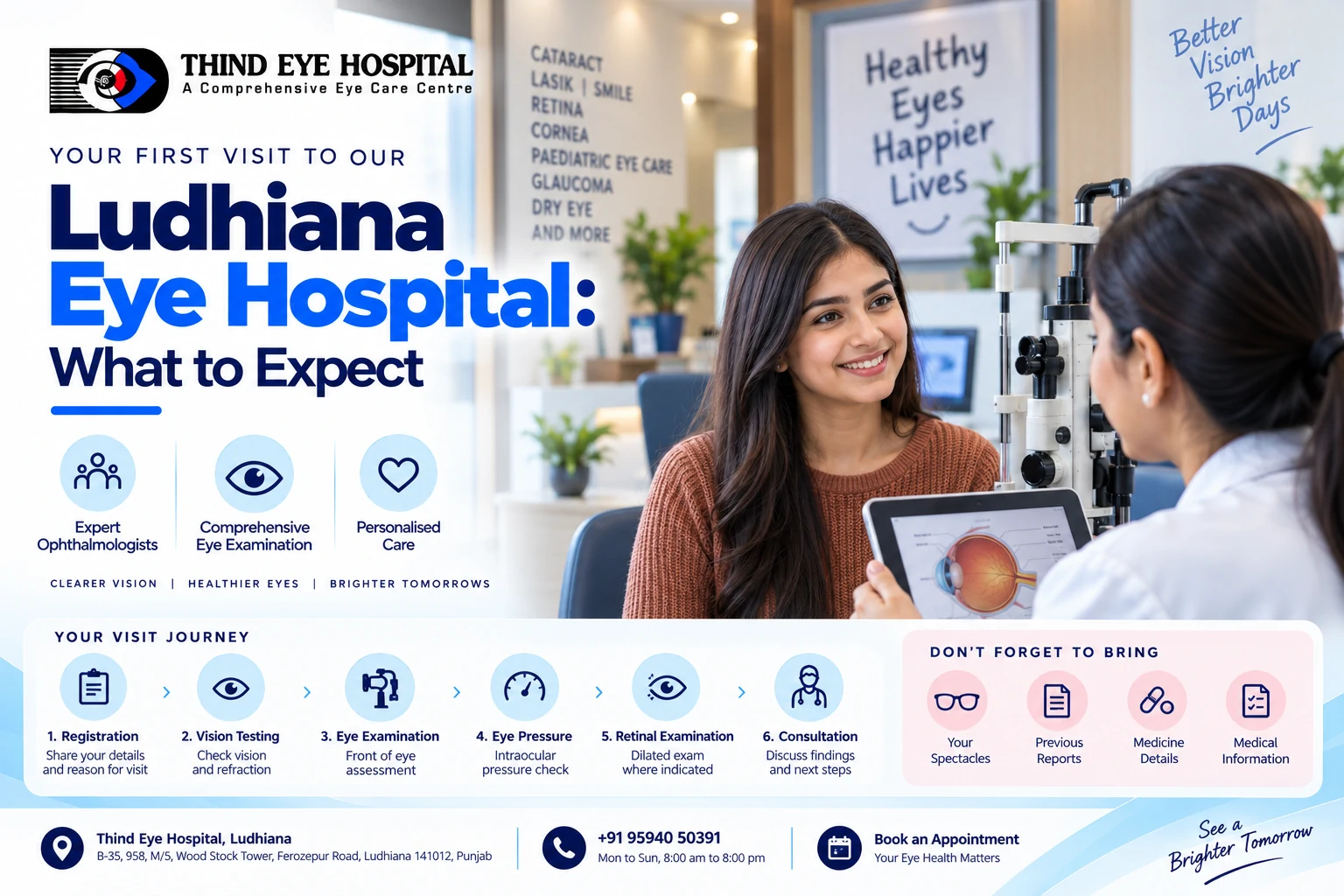
Your First Visit to Our Ludhiana Eye Hospital: What to Expect

Your first visit to an eye hospital in Ludhiana usually begins with registration, followed by a comprehensive eye examination. Your vision, spectacle power, front of the eye and eye pressure are assessed. A dilated retinal examination is also performed where indicated. Knowing what to bring and expect can make your visit easier.
Your First Visit to Our Ludhiana Eye Hospital What to Expect


What to Know Before Visiting an Eye Hospital in Ludhiana

If you are planning your first visit to an eye hospital in Ludhiana, start by checking the branch location and timings.

Thind Eye Hospital’s Ludhiana branch is at B-35, 958, M/5, Wood Stock Tower, Ferozepur Road, Ludhiana 141012, Punjab, opposite Wave Mall on Ferozepur Road.

The branch is open Monday to Sunday, 8:00 am to 8:00 pm. You can call +91 95940 50391 before your visit if you need help with appointment planning.

You can also view the eye hospital in Ludhiana branch information before travelling.

What should you bring?

For a smoother visit, bring:

  • Your current spectacles, if you wear them
  • Previous eye reports, if available
  • Details of any medicines you currently use
  • Information about any known eye conditions
  • Relevant medical information that your ophthalmologist may need

An ophthalmologist is a medical doctor specialising in eye care. An optometrist primarily examines vision and provides optical care.

What Happens When You Arrive?

Your first visit to an eye hospital in Ludhiana does not begin and end with checking spectacle power.

A comprehensive eye examination assesses more than refractive power. It includes visual acuity, refraction, examination of the front of the eye and intraocular pressure. Where indicated, a dilated retinal examination is also performed.

The sequence of your visit can therefore include:

  1. Registration and sharing your reason for visiting.
  2. Vision assessment and refraction.
  3. Examination of the front of the eye.
  4. Intraocular pressure assessment.
  5. A dilated retinal examination where indicated.
  6. Consultation with the ophthalmologist.

The exact assessment is guided by your symptoms, age and eye health needs.

If you are visiting because you have noticed changes in your vision, you can also review information about signs you need glasses before your appointment.

What Happens During a Dilated Eye Examination?

A dilated retinal examination allows the retina to be assessed when dilation is indicated.

Dilating drops blur near vision and increase light sensitivity for several hours. For this reason, it helps to arrange transport home after a dilated examination.

If you have diabetes, a dilated retinal examination is needed at least once a year, and sooner if advised, even when your vision appears normal.

People with a family history of glaucoma should also have regular examinations from an earlier age. Glaucoma is often symptomless until it becomes advanced.

Adults without symptoms or risk factors are generally advised to have a comprehensive eye examination every one to two years. More frequent examinations are advised from age 40, when the risk of glaucoma and other conditions rises.

Meet the Eye Specialists at Our Ludhiana Branch

An eye care hospital in Ludhiana should give you access to appropriate specialist care based on your eye concern.

At Thind Eye Hospital’s Ludhiana branch, Dr. Diksha, Consultant Ophthalmologist, Cornea and Refractive Surgery, consults daily. Her speciality includes cornea, cataract and refractive surgery, including LASIK, SMILE and PRK.

You can learn more about Dr. Diksha before your visit.

Dr. Dinesh Kumar, Consultant Ophthalmologist, Retina and Vitreoretinal Surgery, also consults daily at Ludhiana. His speciality includes retina, vitreoretinal surgery and cataract surgery.

Dr. Alia Yamin, Consultant Ophthalmologist, Cataract, Medical Retina and Dry Eye, also consults daily at the Ludhiana branch.

This specialist setup is useful when your examination identifies a need for further assessment within a particular area of eye care.

Eye Health Questions to Discuss During Your Visit

Your first visit is also a good time to discuss everyday factors that affect your eyes.

Screen use

Prolonged screen use is associated with dry eye and eye strain because blink rate falls. Regular breaks, suitable lighting and the correct working distance help reduce symptoms.

Age-related near vision

Presbyopia is the age-related loss of near focus. It typically begins in the forties and is a normal change rather than a disease.

Sun exposure

Ultraviolet exposure is linked to cataract and pterygium. Sunglasses with proper UV protection therefore matter in the Punjab climate.

The American Academy of Ophthalmology also provides patient information on eye health and eye conditions. For Indian public health information, you can refer to the National Programme for Control of Blindness and Visual Impairment.

What to Do After Your First Visit

Your next step will depend on what your examination shows and what your ophthalmologist recommends.

Keep your examination findings and follow any advised follow-up schedule. If you need another specialist assessment, the Ludhiana branch has consultants in cornea, refractive surgery, retina, vitreoretinal surgery, cataract and medical retina.

If you are looking for an eye hospital in Ludhiana, Thind Eye Hospital is located at Wood Stock Tower, Ferozepur Road, opposite Wave Mall. The branch is open Monday to Sunday, 8:00 am to 8:00 pm.

You can book an appointment or call +91 95940 50391 to plan your visit.

For anyone choosing an eye hospital in Ludhiana, knowing the location, timings, examination process and available specialists can help you prepare for your first consultation.

“This article provides general information about eye health and eye care services. It is not medical advice and does not replace a consultation with a qualified ophthalmologist. Symptoms vary between individuals. Please consult a licensed eye specialist before acting on any information here.”

FAQs

Paediatric Eye Testing in Jalandhar Schools: Finding a Child Eye Specialist in Jalandhar

A child eye specialist in Jalandhar can assess vision problems that children often do not report themselves. School screening helps adults spot signs such as squinting, headaches, close viewing and reduced school performance. Early assessment can identify conditions such as lazy eye, squint and childhood myopia when timely care matters.

Paediatric Eye Testing in Jalandhar Schools Finding a Child Eye Specialist in Jalandhar


Why School Eye Testing Matters for Children

Children rarely complain about poor vision because they assume everyone sees as they do. Detection often depends on parents, teachers and other adults noticing changes in behaviour.

A school eye checkup can help identify children who need a more detailed eye examination. This is especially useful when a child does not realise that their vision is different.

Watch for signs such as:

  • Holding books or screens very close
  • Sitting close to the television
  • Squinting or closing one eye
  • Tilting the head while looking
  • Frequent eye rubbing
  • Repeated headaches
  • Falling performance at school

If you notice these signs, a child eye specialist in Jalandhar can examine the child’s vision and eye health.

When Your Child Needs a Child Eye Specialist in Jalandhar

A school screening is useful, but it does not replace a complete examination when symptoms or concerns are present. A children eye doctor in Jalandhar can assess the child and determine whether further treatment or monitoring is needed.

Lazy eye

Amblyopia, commonly called lazy eye, is reduced vision in an eye that has not developed normally. Treatment is most effective when started early in childhood, which is why screening before school age matters.

Squint

Squint, or strabismus, means the eyes are misaligned. A child may appear to look in different directions or regularly close one eye.

A squint should not simply be watched at home. It does not get outgrown just by waiting. Treatment can include glasses, vision therapy, patching or surgery, depending on the type and cause.

Childhood myopia

Myopia, or short sightedness, is increasing among children. Recognised measures to slow its progression include increased outdoor time, low dose atropine therapy and myopia control spectacle or contact lenses.

A child eye specialist in Jalandhar can assess whether a child’s vision needs correction or whether myopia control should be considered.

What Happens During a Children’s Eye Examination?

A children’s eye examination is designed to assess how well the child sees and whether both eyes are developing normally.

The assessment may look for problems involving vision, eye alignment and conditions that require specialist attention. If a school screening identifies a concern, a fuller examination can provide a clearer clinical assessment.

Parents can also use the hospital’s guide to signs you need glasses to understand common signs that warrant an eye check.

A child eye specialist in Jalandhar can also assess a child when symptoms appear outside school. You should arrange prompt specialist assessment if there is sudden onset squint, a white reflex in the pupil or a rapid change in vision.

Paediatric Eye Care at Thind Eye Hospital in Jalandhar

Thind Eye Hospital runs school eye health checkup programmes for children as part of its community eye care work. The hospital is a multi superspeciality eye hospital with branches in Jalandhar, Ludhiana, Hoshiarpur and Pathankot.

At the Jalandhar branch, Dr. Saurabh Mittal, Cornea, Squint and Paediatric Ophthalmologist, consults daily. He is fellowship trained in cornea and paediatric ophthalmology from PGI Chandigarh.

If you are looking for a child eye specialist in Jalandhar, you can learn more about Dr. Saurabh Mittal and his area of practice.

Jalandhar branch details

The eye hospital in Jalandhar is located at:

701, Mall Road, Model Town, Jalandhar 144001, Punjab

  • Opening hours: Monday to Sunday, 8:00 am to 6:00 pm
  • Phone: +91 88720 70022
  • Location: Mall Road, Model Town

These details make the Jalandhar branch a practical option for families seeking a children eye doctor in Jalandhar after a school screening or because of concerns noticed at home.

What Parents Should Know About Early Eye Problems

Some childhood eye conditions need timely attention. Retinopathy of prematurity screening, for example, applies to babies born prematurely or with low birth weight and follows a time critical schedule.

Parents should also seek prompt specialist assessment for sudden onset squint, a white reflex in the pupil or a rapid change in a child’s vision.

You do not need to wait for a school screening if you notice these changes. A child eye specialist in Jalandhar can assess the child directly.

For broader information about children’s eye health, the American Academy of Ophthalmology provides patient education on eye conditions and care. The National Programme for Control of Blindness and Visual Impairment also provides information related to eye health in India.

What to Do After a School Eye Screening

If your child’s school screening suggests a possible vision problem, arrange an eye examination rather than assuming the issue will resolve on its own.

A child eye specialist in Jalandhar can assess concerns such as squint, lazy eye and childhood myopia. Parents should also act promptly if they notice sudden changes in vision or other unusual eye signs.

You can book an appointment with Thind Eye Hospital or contact the Jalandhar branch on +91 88720 70022.

For families specifically searching for a child eye specialist in Jalandhar, Thind Eye Hospital’s Jalandhar branch at Mall Road, Model Town provides access to Dr. Saurabh Mittal, Cornea, Squint and Paediatric Ophthalmologist, who consults daily.

“This article provides general information about eye health and eye care services. It is not medical advice and does not replace a consultation with a qualified ophthalmologist. Symptoms vary between individuals. Please consult a licensed eye specialist before acting on any information here.”

FAQs

Myopia in Children: How to Slow It Down

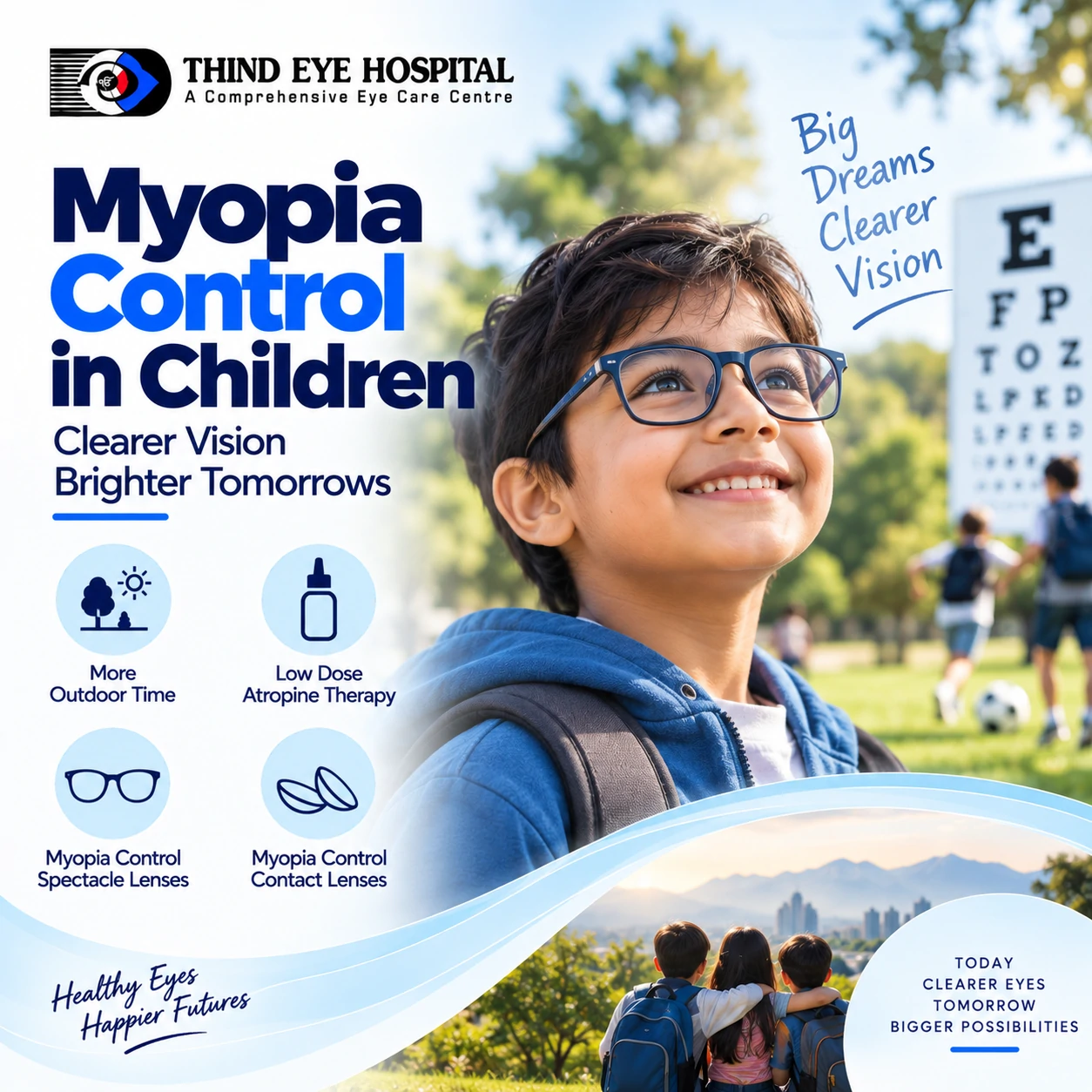
Myopia control in children focuses on slowing the progression of short-sightedness during childhood. Regular eye examinations help identify changes in vision early. Recognised measures include increased outdoor time, low dose atropine therapy, and myopia control spectacle or contact lenses. The right approach should follow a proper assessment of the child’s eyes.

Myopia in Children How to Slow It Down


What Is Childhood Myopia?

Childhood myopia means short-sightedness that develops during the growing years. A child with myopia may see nearby objects more clearly than distant ones.

Children rarely complain about poor vision because they assume everyone sees as they do. Parents and teachers often notice changes in behaviour first.

Signs that your child needs an eye examination include:

  • Holding books or screens very close
  • Sitting close to the television
  • Squinting or closing one eye
  • Tilting the head
  • Frequent eye rubbing
  • Complaining of headaches
  • Falling performance at school

These signs do not confirm myopia. They are reasons to arrange an eye examination.

You can also read about the signs you need glasses to understand common vision concerns.

Why Is Myopia Control in Children Important?

Childhood myopia is increasing. This makes myopia control in children an important part of managing a child’s developing vision.

The aim is to slow the progression of myopia rather than simply correcting blurred distance vision. Spectacles can correct vision, while myopia control measures are used to slow progression.

Recognised measures include:

  • Increased outdoor time
  • Low dose atropine therapy
  • Myopia control spectacle lenses
  • Myopia control contact lenses

A proper eye examination helps determine which approach is suitable for your child.

How Does Myopia Control in Children Work?

Different approaches to myopia control in children address progression in different ways.

Increased outdoor time

Spending more time outdoors is a recognised measure for slowing myopia progression. Encourage your child to include regular outdoor activity in their routine.

Low dose atropine therapy

Low dose atropine therapy is another recognised measure for myopia control. It should be used under appropriate specialist guidance.

Myopia control lenses

Myopia control spectacle or contact lenses are also recognised options. The choice should follow an eye assessment and discussion of your child’s needs.

These measures are different from ordinary glasses. Regular spectacles correct blurred vision, while myopia control approaches are intended to slow progression.

What Should Parents Watch For?

Children may not tell you that their distance vision has changed. They often assume their vision is normal because they have nothing to compare it with.

Watch for behaviour that suggests your child is struggling to see clearly.

For example, your child may sit unusually close to the television or bring books and screens close to the face. Squinting, closing one eye, head tilting and frequent eye rubbing are also reasons for an examination.

Headaches and falling school performance should also be discussed with an eye specialist.

A squint, or strabismus, means misalignment of the eyes. A squint in a child should not be left simply to see whether it disappears. It should be assessed rather than observed at home.

What Other Childhood Eye Conditions Need Attention?

Myopia control in children is only one part of children’s eye care. Some other conditions also need early assessment.

Lazy eye

Amblyopia, commonly called lazy eye, is reduced vision in an eye that has not developed normally. Treatment is most effective when started early in childhood, so screening before school age matters.

Retinopathy of prematurity

Retinopathy of prematurity screening applies to babies born prematurely or with low birth weight. It follows a time-critical schedule.

Parents of eligible babies should follow the required screening schedule rather than waiting for symptoms.

Sudden changes in vision

Sudden onset squint, a white reflex in the pupil, or a rapid change in a child’s vision needs prompt specialist assessment.

These signs should not be managed by simply waiting at home.

Myopia Control in Children at Thind Eye Hospital

Thind Eye Hospital is a multi superspeciality eye hospital with branches in Jalandhar, Ludhiana, Hoshiarpur and Pathankot.

Dr. Alia Yamin, Consultant Ophthalmologist, Cataract, Medical Retina and Dry Eye, has a speciality in cataract, refractive surgery, medical retina and dry eye management. She is experienced in myopia control with atropine therapy and myopia control lenses.

Dr. Alia Yamin consults at Ludhiana daily. You can read more on the Dr. Alia Yamin profile.

The hospital also conducts school eye health checkup programmes for children and community eye care camps for rural populations.

Thind Eye Hospital was founded in 1991 by Dr. Jaswant Singh Thind. The hospital brings more than 39 years of expertise in eye care.

When Should Your Child Have an Eye Examination?

Do not wait for your child to complain about poor vision. Children often do not recognise that their vision differs from others.

Arrange an eye examination if you notice:

  • Difficulty seeing distant objects
  • Sitting very close to the television
  • Holding screens close
  • Squinting or closing one eye
  • Head tilting
  • Frequent eye rubbing
  • Headaches
  • Falling school performance

Regular assessment is particularly useful when you are considering myopia control in children. It allows changes in vision to be identified and discussed with an eye specialist.

If you have concerns about your child’s vision, you can book an appointment for an assessment.

What Can Parents Do Next?

Myopia control in children starts with recognising changes in your child’s vision and arranging an eye examination.

Encourage regular outdoor time and discuss recognised myopia control options with an eye specialist. Low dose atropine therapy and myopia control spectacle or contact lenses are established measures used to slow progression.

Thind Eye Hospital provides children’s eye care through its specialist services. If you are concerned about myopia control in children, arrange a consultation to discuss your child’s vision and suitable options.


“This article provides general information about eye health and eye care services. It is not medical advice and does not replace a consultation with a qualified ophthalmologist. Symptoms vary between individuals. Please consult a licensed eye specialist before acting on any information here.”



For additional information, you can refer to the American Academy of Ophthalmology and the World Health Organization’s eye care information.

FAQs

Top 10 Things to Check Before Choosing an Eye Hospital in Ludhiana

Choosing among the top 10 eye hospital in Ludhiana searches should not be about rankings alone. Look for qualified ophthalmologists, comprehensive eye examinations, relevant specialities, clear treatment information, accessible follow-up care and a convenient location. A practical checklist helps you compare an eye hospital in Ludhiana based on factors that matter to your care.

Top 10 Things to Check Before Choosing an Eye Hospital in Ludhiana


10 Things to Check Before Choosing an Eye Hospital in Ludhiana

A search for the top 10 eye hospital in Ludhiana often produces many options. Instead of relying on a ranked list, use the following checklist to assess your choices.

1. Check the range of eye specialities

Eye care covers more than glasses and routine vision checks. Look for a hospital with relevant specialist services for your particular concern.

A multi superspeciality setup can provide access to different areas of eye care. Thind Eye Hospital has branches in Jalandhar, Ludhiana, Hoshiarpur and Pathankot.

2. Check whether comprehensive eye examinations are available

A proper eye examination should assess more than spectacle power.

A comprehensive examination includes:

  • Visual acuity
  • Refraction
  • Examination of the front of the eye
  • Intraocular pressure
  • Dilated retinal examination, where indicated

This is a useful criterion when comparing any eye hospital Ludhiana list.

Adults without symptoms or risk factors are generally advised to have a comprehensive examination every one to two years. More frequent examinations are advised from age 40.

People with diabetes need a dilated retinal examination at least once a year, even when their vision seems normal.

3. Look for the right ophthalmologist

An ophthalmologist is a medical eye doctor who examines and treats eye conditions. An optometrist primarily provides vision testing and optical care.

Check whether the hospital has specialists relevant to your needs. This matters more than simply choosing a hospital because it appears high on a top 10 eye hospital in Ludhiana search.

For example, Dr. Diksha, Consultant Ophthalmologist, Cornea and Refractive Surgery, consults at Ludhiana daily. Her speciality includes cornea, cataract and refractive surgery, including LASIK, SMILE and PRK.

You can learn more through the Dr. Diksha profile.

4. Check for retina care

Retinal conditions need specialist assessment. If you have diabetes or other concerns involving the retina, check whether appropriate retinal care is available.

Dr. Dinesh Kumar, Consultant Ophthalmologist, Retina and Vitreoretinal Surgery, consults at Ludhiana daily. His speciality includes retina, vitreoretinal surgery and cataract surgery.

This is another practical point to consider before choosing from a top 10 eye hospital in Ludhiana search.

5. Ask about screening for your risk factors

Your personal risk factors should influence how often you have your eyes examined.

Anyone with a family history of glaucoma should have regular examinations from an earlier age. Glaucoma is often symptomless until advanced.

Presbyopia, the age-related loss of near focus, typically begins in the forties. It is a normal change rather than a disease.

These are useful questions to discuss during your consultation rather than relying only on an online eye hospital Ludhiana list.

6. Consider children’s eye care

If you are choosing an eye hospital for your child, check whether children’s eye concerns are included in its services.

School eye health checkup programmes can also support early identification of vision problems. Thind Eye Hospital conducts school eye health checkup programmes for children and community eye care camps for rural populations.

7. Check how the hospital handles follow-up

Eye care does not always end with the first examination. Ask how follow-up consultations are arranged and whether the hospital is convenient for you to revisit.

Location matters, especially if your treatment requires repeated visits.

When comparing the top 10 eye hospital in Ludhiana, consider the practical journey from your home or workplace, not just the hospital’s online presence.

8. Consider the hospital’s accessibility

The Ludhiana branch of Thind Eye Hospital is located at B-35, 958, M/5, Wood Stock Tower, Ferozepur Road, Ludhiana 141012, Punjab, opposite Wave Mall.

The branch is open Monday to Sunday, 8:00 am to 8:00 pm.

The phone number is +91 95940 50391.

You can visit the eye hospital in Ludhiana to learn more about the branch.

9. Review the information provided before treatment

A good consultation should help you understand your eye condition, available treatment options and the next steps.

Do not select a hospital solely because it appears in a top 10 eye hospital in Ludhiana search. Look for clear information that helps you make an informed decision.

If you are concerned about changing vision, you can also review the signs you need glasses before arranging an examination.

10. Look at the hospital’s experience and history

Hospital history is another factor you can consider. Thind Eye Hospital was founded in 1991 by Dr. Jaswant Singh Thind, Chairman cum Managing Director.

The hospital brings more than 39 years of expertise in eye care. It has also performed more than 4,00,000 surgeries to date.

Its history includes being among the first in India to introduce 100% topical anaesthesia cataract surgery without injections in 1997. It introduced 100% blade-free cataract surgery with laser in 2013.

These are specific details you can consider when assessing an eye hospital in Ludhiana.

How to Compare the Top 10 Eye Hospital in Ludhiana

A useful comparison does not need to produce a ranking. Instead, score each hospital against the same questions.

What to checkWhy it matters
Relevant specialitiesHelps you access care suited to your concern
Comprehensive examinationGoes beyond checking spectacle power
Specialist doctorsProvides relevant clinical expertise
Retina servicesImportant for retinal concerns and diabetes
Children’s eye careUseful for families
Follow-up arrangementsMakes continuing care easier
Location and timingsHelps with practical access
Clear treatment informationSupports informed decisions
Hospital experienceProvides useful background
Risk-based screeningHelps address specific eye health risks


The best choice for you is not necessarily the hospital that appears first in a top 10 eye hospital in Ludhiana search. It is the hospital that matches your clinical and practical needs.

For further general information, the American Academy of Ophthalmology provides patient-focused eye health resources. The National Programme for Control of Blindness and Visual Impairment also provides information related to eye care in India.

Choosing an Eye Hospital in Ludhiana: What to Do Next

If you are comparing the top 10 eye hospital in Ludhiana, use the checklist above before making your decision.

Thind Eye Hospital Ludhiana is located at Wood Stock Tower on Ferozepur Road, opposite Wave Mall. The branch is open every day from 8:00 am to 8:00 pm.

You can call +91 95940 50391 or book an appointment for an eye examination.

A practical eye hospital Ludhiana list is only useful when you know what to look for. Compare specialities, examination services, doctors, accessibility and follow-up care rather than relying on rankings alone.

If you are searching for the top 10 eye hospital in Ludhiana, use these criteria to choose care that fits your needs and arrange a consultation when required.

“This article provides general information about eye health and eye care services. It is not medical advice and does not replace a consultation with a qualified ophthalmologist. Symptoms vary between individuals. Please consult a licensed eye specialist before acting on any information here.”

FAQs

Emergency Eye Care for Pathankot Residents

An eye emergency in Pathankot needs prompt assessment when vision changes suddenly, eye pain occurs with redness and reduced vision, or new floaters, flashes, double vision or a curtain-like shadow appears. Sudden painless loss of vision in one eye is also an emergency. Do not rely on home treatment for sudden vision changes.

Emergency Eye Care for Pathankot Residents


When Is an Eye Emergency in Pathankot?

Most sudden changes in vision need examination rather than home management. If you experience pain with redness and reduced vision, you need same-day assessment.

A sudden change does not always have the same cause. Blurred vision can occur with refractive error, dry eye, cataract, diabetic retinopathy, glaucoma or corneal disease. The pattern and speed of onset help guide the diagnosis.

Seek urgent eye care in Pathankot if you notice:

  • Sudden loss or major change in vision
  • Pain with redness and reduced vision
  • New flashes of light
  • A sudden increase in floaters
  • A curtain across your vision
  • Sudden double vision
  • Sudden painless loss of vision in one eye

These symptoms require an eye examination rather than waiting at home.

What Symptoms Need Urgent Eye Care in Pathankot?

Some eye symptoms are uncomfortable but are not necessarily emergencies. Others need prompt specialist assessment.

Sudden painless vision loss

Sudden painless loss of vision in one eye is an emergency. It can indicate retinal detachment, retinal vascular occlusion or optic nerve disease.

Flashes, floaters or a curtain

New floaters with flashes of light, a curtain across your vision, or sudden double vision all need urgent examination.

Do not wait for these symptoms to settle on their own.

Eye pain and redness

Pain combined with redness and reduced vision is always a reason for same-day assessment. This combination should not be managed with self-selected eye drops.

For general information about common vision symptoms, you can also read about the signs you need glasses.

What About Common Eye Problems?

Not every red, watery or irritated eye requires emergency care. However, knowing the difference helps you decide when to seek assessment.

Viral conjunctivitis

Viral conjunctivitis, commonly called eye flu, spreads through contact. Typical features include redness, watering, grittiness and discharge.

Hand hygiene and avoiding shared towels help limit its spread.

Antibiotic drops do not treat viral conjunctivitis. Steroid eye drops can be harmful when used without examination, so do not start them on your own.

Eyelid twitching

Eyelid twitching, known medically as myokymia, is usually benign. It is linked to fatigue, stress, caffeine and screen use.

Twitching that spreads to the face, causes the eye to close, or continues for weeks needs assessment.

Stye and chalazion

A stye is an infection of an eyelid gland that causes a painful lump. Warm compresses and lid hygiene are the usual first measures.

A painless, persistent lump is more likely to be a chalazion and should be assessed if it continues.

How Should You Respond to an Eye Emergency in Pathankot?

When an eye emergency in Pathankot occurs, avoid delaying assessment while trying multiple home remedies.

Do not start steroid eye drops without an examination. Also avoid assuming that sudden vision changes are caused by tiredness or screen use.

The safest next step is to arrange an examination, particularly when symptoms involve sudden vision loss, new flashes or floaters, a curtain across vision, double vision, or pain with redness and reduced vision.

The American Academy of Ophthalmology provides further information through its eye health resources. You can also refer to the National Programme for Control of Blindness and Visual Impairment for information on eye care in India.

Eye Emergency Care at Thind Eye Hospital Pathankot

Thind Eye Hospital is a multi superspeciality eye hospital with branches in Jalandhar, Ludhiana, Hoshiarpur and Pathankot.

The eye hospital in Pathankot is located at:

SCO-8, TMT Scheme, Near LIC Office, Pathankot 145001, Punjab

The branch is open Monday to Sunday, 8:00 am to 6:00 pm.

For Pathankot consultations, Dr. Jaswant Singh Thind, Chief Eye Surgeon and Chairman cum Managing Director, consults on Tuesday mornings. He completed his MS in Ophthalmology from King George’s Medical College, Lucknow, in 1986, and founded Thind Eye Hospital in 1991.

You can read more about Dr. Jaswant Singh Thind before your consultation.

The hospital has more than 39 years of expertise in eye care. It also operates community eye care camps for rural populations and school eye health checkup programmes for children.

What Should You Do Next?

If you are searching for an eye emergency in Pathankot, do not wait when vision changes suddenly or when serious symptoms appear.

For urgent eye care in Pathankot, visit the Thind Eye Hospital branch at TMT Scheme, near the LIC office. The branch is open every day from 8:00 am to 6:00 pm.

Call +91 88720 70055 to arrange a consultation. You can also book an appointment.

For an eye emergency in Pathankot, prompt examination is the right next step for sudden vision loss, new flashes or floaters, a curtain across vision, sudden double vision, or pain with redness and reduced vision.

“This article provides general information about eye health and eye care services. It is not medical advice and does not replace a consultation with a qualified ophthalmologist. Symptoms vary between individuals. Please consult a licensed eye specialist before acting on any information here.”

FAQs

Lazy Eye (Amblyopia): Why Early Treatment Changes Everything

Lazy eye treatment is most effective when started early in childhood. Amblyopia, commonly called lazy eye, is reduced vision in an eye that has not developed normally. Early screening helps identify vision problems before they affect a child’s visual development. Prompt assessment also helps guide the right treatment for the child.

Lazy Eye (Amblyopia) Why Early Treatment Changes Everything


What Is Lazy Eye and Why Does Early Treatment Matter?

Amblyopia is reduced vision in an eye that has not developed normally. It is often called a lazy eye.

Children rarely complain about poor vision because they assume everyone sees as they do. Detection often depends on parents, teachers or other adults noticing changes in behaviour.

This is why early eye examinations matter. Lazy eye treatment is most effective when started early in childhood, so screening before school age is important.

A child may need an eye examination if you notice:

  • Holding books or screens very close
  • Sitting close to the television
  • Squinting or closing one eye
  • Tilting the head
  • Frequent eye rubbing
  • Headaches
  • Falling performance at school

These signs do not confirm amblyopia. They are reasons to arrange an eye examination.

You can also read about the signs you need glasses to understand common childhood vision concerns.

Why Is Lazy Eye Treatment Started Early?

Visual development takes place during childhood. If one eye does not develop normal vision, the brain may rely more heavily on the other eye.

Early lazy eye treatment addresses reduced vision while the child’s visual system is still developing. Delaying assessment can mean missing an important period for treatment.

A squint, also called strabismus, is one condition that can be linked with amblyopia. Strabismus means the eyes are not properly aligned.

A squint in a child should not simply be watched at home. It should be assessed by an eye specialist.

Other childhood vision problems

Lazy eye is not the only reason a child may need an eye examination. Childhood myopia, or short-sightedness, is increasing.

Recognised measures to slow myopia progression include:

  • Increased outdoor time
  • Low dose atropine therapy
  • Myopia control spectacle or contact lenses

The right approach should be selected after a child’s eyes have been assessed.

What Does Lazy Eye Treatment Involve?

The treatment used for amblyopia depends on the cause and the child’s eye condition. Amblyopia treatment may involve correcting the underlying vision problem and encouraging the weaker eye to work more effectively.

For children with squint, treatment options include:

  • Glasses
  • Vision therapy
  • Patching
  • Surgery

The appropriate treatment depends on the type and cause of the squint.

A child with suspected amblyopia needs a proper eye examination rather than an assumption based on appearance. An ophthalmologist is a medical eye doctor who examines and treats eye conditions. An optometrist primarily provides vision testing and optical care.

How Do You Know If a Child Needs an Eye Examination?

Parents often notice behavioural clues before a child explains a vision problem.

A weak eye in a child may not be obvious during everyday activities. Watch for changes such as closing one eye, tilting the head or bringing books unusually close.

School performance can also provide a useful reason to arrange an eye examination. Headaches, frequent eye rubbing and sitting close to screens or television should also be taken seriously.

Sudden changes need particular attention. A sudden onset squint, white reflex in the pupil or rapid change in a child’s vision needs prompt specialist assessment.

Premature babies need timely screening

Retinopathy of prematurity screening applies to babies born prematurely or with low birth weight. It follows a time-critical schedule.

Parents should follow the recommended screening schedule for eligible babies rather than waiting for visible symptoms.

For additional information, the American Academy of Ophthalmology provides patient-focused eye health resources. You can also refer to the National Programme for Control of Blindness and Visual Impairment for information on eye care in India.

Lazy Eye Treatment at Thind Eye Hospital

Thind Eye Hospital is a multi superspeciality eye hospital with branches in Jalandhar, Ludhiana, Hoshiarpur and Pathankot.

For children requiring assessment for squint or amblyopia, Dr. Saurabh Mittal, Cornea, Squint and Paediatric Ophthalmologist, provides specialist consultations. He is fellowship trained in cornea and paediatric ophthalmology from PGI Chandigarh.

Dr. Saurabh Mittal consults in Jalandhar daily, at Hoshiarpur on Tuesday, and also at Pathankot. You can view the Dr. Saurabh Mittal profile for more information.

The hospital also conducts school eye health checkup programmes for children and community eye care camps for rural populations.

What Should You Do If You Suspect Lazy Eye?

Do not wait for a child to complain about poor vision. Children often do not recognise that their vision differs from others.

Arrange an eye examination if you notice signs such as squinting, closing one eye, head tilting, sitting very close to the television or falling school performance.

Early lazy eye treatment gives the child’s developing visual system the opportunity to receive appropriate care at the right stage.

If you are concerned about lazy eye treatment, arrange a consultation with the paediatric eye team at Thind Eye Hospital. You can book an appointment for assessment.

Lazy eye treatment should begin with a proper specialist examination, especially when a child has a squint, a white pupil reflex or a rapid change in vision.

“This article provides general information about eye health and eye care services. It is not medical advice and does not replace a consultation with a qualified ophthalmologist. Symptoms vary between individuals. Please consult a licensed eye specialist before acting on any information here.”

FAQs

What Affects the Cost of Cataract Surgery in Ludhiana

The cataract surgery cost in Ludhiana depends on several factors, including the surgical technique, lens type, tests required, and follow-up plan. The number of eyes being treated and applicable insurance or schemes can also affect the final cost. An accurate figure requires an eye examination and individual assessment.

What Affects the Cost of Cataract Surgery in Ludhiana


What Affects Cataract Surgery Cost in Ludhiana?

Cataract is a clouding of the eye’s natural lens. It develops gradually and is most commonly related to ageing. Common symptoms include cloudy or blurred vision, glare, haloes around lights, poor night vision, faded colours and frequent changes in spectacle power.

Cataract cannot be reversed with eye drops, exercises or diet. Surgery is the only definitive treatment.

For someone researching cataract surgery cost in Ludhiana, understanding what goes into the treatment plan is more useful than looking for one fixed figure.

1. Surgical technique

Modern cataract surgery removes the clouded natural lens and replaces it with an intraocular lens, or IOL.

The two common techniques are:

  • Phacoemulsification, which uses a small incision to remove the cataract.
  • Small incision cataract surgery (SICS), another established surgical approach.

The technique selected forms one part of the cataract operation cost in Ludhiana. Your eye examination helps the ophthalmologist decide which approach is suitable.

Thind Eye Hospital has also introduced 100% topical anaesthesia cataract surgery without injections since 1997. The hospital introduced 100% blade-free cataract surgery with laser in 2013.

How Does the Lens Affect Cataract Surgery Cost in Ludhiana?

The IOL selected after cataract removal is another important factor.

IOL options include:

  • Monofocal lenses, designed for a specific visual distance.
  • Toric lenses, used when astigmatism needs to be addressed.
  • Multifocal or extended depth of focus lenses, which provide different vision options.

The choice depends on your eye measurements and visual needs. This is why the cataract surgery cost in Ludhiana cannot be accurately determined without an examination.

Your ophthalmologist will review your measurements and discuss which lens options fit your visual requirements.

For more information about treatment and services, visit the eye hospital in Ludhiana.

What Tests and Assessments Are Included?

Before cataract surgery, your eyes need to be examined and measured. These assessments help the ophthalmologist plan the procedure and select the appropriate IOL.

The exact tests required form another factor in the cataract surgery cost in Ludhiana.

Your consultation also provides an opportunity to discuss:

  • Your current vision problems
  • Changes in spectacle power
  • Glare or difficulty seeing at night
  • Your preferred visual needs after surgery
  • The type of IOL being considered
  • Follow-up requirements

There is no upper age limit for cataract surgery. Fitness for surgery depends on the health of your eyes and your general medical condition, not age alone.

The American Academy of Ophthalmology provides additional information about cataracts and cataract surgery through its cataract information resources.

Does Treating One or Both Eyes Change the Cost?

Yes. Whether one eye or both eyes require cataract treatment is another factor in the overall treatment plan.

Your ophthalmologist will assess each eye separately. Surgery may be planned according to the condition of each eye and your clinical needs.

The follow-up schedule is also part of the overall care plan. Most patients notice improved vision within a few days, with vision continuing to settle over about four to six weeks.

You can read more about cataract surgery recovery time before your consultation.

Insurance or an applicable health scheme can also affect what you personally need to pay. Ask the hospital team about the documentation and coverage that apply to your situation.

Cataract Surgery at Thind Eye Hospital Ludhiana

Thind Eye Hospital is a multi superspeciality eye hospital with branches in Punjab, including Ludhiana. The hospital was founded in 1991 by Dr. Jaswant Singh Thind.

The Ludhiana branch is at B-35, 958, M/5, Wood Stock Tower, Ferozepur Road, Ludhiana 141012, Punjab, opposite Wave Mall.

The branch is open Monday to Sunday, 8:00 am to 8:00 pm. You can call +91 95940 50391 to discuss your consultation.

Meet the Ludhiana cataract specialist

Dr. Alia Yamin, Consultant Ophthalmologist, Cataract, Medical Retina and Dry Eye, consults at the Ludhiana branch daily. Her speciality includes cataract, refractive surgery, medical retina and dry eye management.

She is experienced in SICS and phacoemulsification cataract surgery. You can view the Dr. Alia Yamin profile.

The hospital’s history also includes being among the first in India to introduce 100% topical anaesthesia cataract surgery without injections in 1997.

What Is the Best Way to Find Your Cataract Surgery Cost in Ludhiana?

There is no single figure that applies to every cataract procedure. The cataract surgery cost in Ludhiana is based on the treatment plan prepared for your eyes.

The main factors include:

  1. Surgical technique selected
  2. IOL type
  3. Tests and measurements required
  4. Whether one or both eyes are treated
  5. Follow-up schedule
  6. Applicable insurance or health scheme

An accurate figure requires an examination. Avoid choosing treatment based only on a quoted figure before your eyes have been assessed.

For questions about the cataract surgery cost in Ludhiana, contact Thind Eye Hospital Ludhiana at +91 95940 50391. You can also book an appointment for an individual assessment.

For broader information on eye health and vision care, see the National Programme for Control of Blindness and Visual Impairment and the World Health Organization’s eye care information.

If you are looking for the cataract surgery cost in Ludhiana, the most useful next step is an eye examination at the Ludhiana branch. Call +91 95940 50391 to book a consultation and discuss the treatment options relevant to your eyes.

“This article provides general information about eye health and eye care services. It is not medical advice and does not replace a consultation with a qualified ophthalmologist. Symptoms vary between individuals. Please consult a licensed eye specialist before acting on any information here.”
FAQs

ICL Surgery in Punjab: An Alternative to Laser

ICL surgery in Punjab is an alternative to laser vision correction for people with high refractive errors or corneas that are too thin for laser treatment. An ICL, or implantable collamer lens, is placed inside the eye without removing corneal tissue. Proper assessment determines whether ICL or laser correction is suitable.

ICL Surgery in Punjab An Alternative to Laser


What Is ICL Surgery in Punjab?

ICL surgery uses an implantable collamer lens to correct existing refractive power. Unlike laser vision correction, the lens is placed inside the eye and does not remove corneal tissue.

Refractive surgery is designed to reduce dependence on glasses or contact lenses. The main laser options include LASIK, SMILE, PRK and TransPRK.

ICL surgery in Punjab is considered an alternative when a patient has a high refractive error or a cornea that is too thin for laser treatment.

People sometimes search for implantable contact lens Punjab when looking for information about this procedure. The clinical term is ICL, or implantable collamer lens.

ICL vs LASIK: How Are They Different?

When comparing ICL vs LASIK, the main difference is where the treatment takes place.

ICL places a lens inside the eye and does not remove corneal tissue. LASIK reshapes the cornea and creates a corneal flap.

Other laser options work differently:

  • SMILE uses a small incision and removes a lenticule of corneal tissue.
  • LASIK creates a corneal flap.
  • PRK and TransPRK work on the corneal surface and generally involve longer visual recovery.
  • ICL places a lens inside the eye without removing corneal tissue.

You can read more about SMILE Pro compared with LASIK before discussing your options with an eye specialist.

The right choice is based on your eye measurements, refractive power and overall eye health.

Who May Be Considered for ICL Surgery?

ICL surgery in Punjab requires a detailed pre-operative assessment. Candidates are usually assessed for several factors.

These include:

  • Age, generally 18 and above
  • Stable spectacle power for at least one year
  • Corneal thickness
  • Corneal topography
  • Pupil size
  • Dry eye status
  • General eye health

People with keratoconus, active eye infection, uncontrolled dry eye or certain retinal conditions may not be suitable for laser vision correction.

Contact lenses are usually stopped for a period before the pre-operative assessment. This is because contact lenses can alter corneal shape.

An assessment therefore matters before deciding between ICL vs LASIK or another refractive procedure.

What Is the Recovery After Refractive Surgery?

Laser vision correction is typically a day care procedure and takes a few minutes per eye. Most patients return to routine activities within one to two days.

Specific restrictions apply after treatment, including restrictions on swimming, dust exposure and eye rubbing.

The recovery pattern differs between procedures. SMILE uses a small incision, while LASIK creates a corneal flap. PRK and TransPRK treat the corneal surface and generally have a longer visual recovery.

ICL surgery in Punjab should also be discussed in the context of your individual examination rather than choosing a procedure based only on recovery time.

Does ICL prevent reading glasses later?

No. Refractive surgery corrects the existing spectacle power. It does not prevent age-related near vision change, known as presbyopia.

Presbyopia typically begins in the forties. Therefore, correcting distance power does not stop this natural age-related change in near vision.

ICL Surgery in Punjab at Thind Eye Hospital

Thind Eye Hospital is a multi superspeciality eye hospital with branches in Jalandhar, Ludhiana, Hoshiarpur and Pathankot.

The hospital was founded in 1991 by Dr. Jaswant Singh Thind, Chairman cum Managing Director. It was the first eye hospital in India to perform ICL surgery, in 2001.

It was also the first eye hospital in North India to introduce LASIK laser vision correction in 1998 and was among the earliest in India to introduce Blade-Free LASIK technology in 2007.

These milestones provide specific context for patients considering ICL surgery in Punjab alongside laser vision correction options.

Jalandhar

The Jalandhar branch is at 701, Mall Road, Model Town, Jalandhar 144001, Punjab.

Opening hours: Monday to Sunday, 8:00 am to 6:00 pm
Landmark: Mall Road, Model Town

Dr. Jaswant Singh Thind is Chief Eye Surgeon and Chairman cum Managing Director. He completed his MS in Ophthalmology from King George’s Medical College, Lucknow, in 1986, and founded Thind Eye Hospital in 1991. He consults in Jalandhar daily.

You can read more about Dr. Jaswant Singh Thind.

Other Punjab locations

Thind Eye Hospital also has branches in Ludhiana, Hoshiarpur and Pathankot, allowing patients across Punjab to access the hospital’s eye care services.

The hospital brings more than 39 years of expertise in eye care and has performed more than 4,00,000 surgeries to date.

For additional patient education, the American Academy of Ophthalmology provides information about refractive surgery and eye care. The World Health Organization’s eye care information provides broader information about vision and eye health.

What Should You Do Before Choosing ICL?

If you are considering ICL surgery in Punjab, start with a complete eye assessment rather than selecting a procedure based only on your spectacle number.

Your assessment should include corneal thickness, corneal topography, pupil size, dry eye status and general eye health. Your spectacle power should also be stable for at least a year.

A proper assessment helps determine whether ICL surgery in Punjab, LASIK, SMILE, PRK or TransPRK is appropriate for your eyes.

If you want to discuss your options, book an appointment with the eye specialist.

For patients comparing ICL vs LASIK, the decision should follow a clinical assessment of your eyes and visual needs. ICL surgery in Punjab is an option for selected patients, particularly those with high refractive errors or corneas too thin for laser treatment.

This article provides general information about eye health and eye care services. It is not medical advice and does not replace a consultation with a qualified ophthalmologist. Symptoms vary between individuals. Please consult a licensed eye specialist before acting on any information here.

FAQs

Children’s Eye Checkups in Hoshiarpur

A child eye specialist in Hoshiarpur can assess vision, eye alignment and common childhood eye problems. Children often do not complain about poor vision because they assume everyone sees the same way. Early eye checks help identify concerns such as amblyopia, squint and myopia before they affect daily learning and development.

Children Eye Checkups in Hoshiarpur


Why Does Your Child Need an Eye Checkup?

Children rarely complain about poor vision. They often assume their way of seeing is normal. Parents and teachers therefore play an important role in noticing changes in visual behaviour.

Signs that your child needs an eye examination include:

  • Holding books or screens very close
  • Sitting close to the television
  • Squinting or closing one eye
  • Tilting the head
  • Frequent eye rubbing
  • Headaches
  • Falling performance at school

These signs do not confirm an eye condition on their own. They are reasons to arrange an examination with a child eye specialist in Hoshiarpur.

You can also review the signs you need glasses if you notice changes in how your child reads, watches screens or views objects.

Child Eye Specialist in Hoshiarpur: What Does a Checkup Cover?

A children’s eye checkup looks at how your child’s vision and eyes are developing. The assessment helps identify concerns that children might not recognise themselves.

An ophthalmologist is a medical eye specialist who examines and treats eye conditions. An optometrist primarily checks vision and prescribes spectacles or contact lenses.

For parents searching for a children eye doctor Hoshiarpur, the key reason to arrange an examination is simple: children may not know that their vision is different from normal.

Amblyopia and lazy eye

Amblyopia, commonly called lazy eye, is reduced vision in an eye that has not developed normally.

Treatment is most effective when started early in childhood. This is why screening before school age matters.

A child does not need to complain about poor vision for amblyopia to affect them. Regular assessment can help identify reduced vision during the years when visual development is taking place.

Child Eye Specialist in Hoshiarpur for Squint and Myopia

Squint, also called strabismus, is a misalignment of the eyes. One eye may not point in the same direction as the other.

A squint in a child should not simply be watched at home. It is not something you should assume the child will outgrow.

Squint treatment may include:

  • Glasses
  • Vision therapy
  • Patching
  • Surgery

The treatment approach depends on the type and cause identified during assessment.

Childhood myopia

Childhood myopia is increasing. Recognised measures to slow its progression include increased outdoor time, low dose atropine therapy and myopia control spectacle or contact lenses.

If your child sits very close to screens or the television, holds books close, or frequently squints, arrange an eye examination rather than assuming the behaviour is simply a habit.

When Does a Child Need Prompt Eye Assessment?

Most childhood eye concerns can be assessed through a planned examination. Some signs, however, require prompt specialist assessment.

A child eye specialist in Hoshiarpur should assess your child promptly if there is:

  • Sudden onset squint
  • A white reflex in the pupil
  • A rapid change in the child’s vision

These signs should not be observed at home for several days before seeking advice.

Retinopathy of prematurity screening is also important for babies born prematurely or with low birth weight. It follows a time critical schedule, so parents should follow the recommended screening schedule.

Children’s Eye Care at Thind Eye Hospital Hoshiarpur

Thind Eye Hospital is a multi superspeciality eye hospital with branches in Jalandhar, Ludhiana, Hoshiarpur and Pathankot.

For families looking for a child eye specialist in Hoshiarpur, the Hoshiarpur branch is located at:

584, Model Town, Near Hotel Presidency, Hoshiarpur 146001, Punjab

Landmark: Model Town, near Hotel Presidency
Opening hours: Monday to Sunday, 8:00 am to 6:00 pm
Phone: +91 87410 87510

Dr. Saurabh Mittal is a Cornea, Squint and Paediatric Ophthalmologist. He is fellowship trained in cornea and paediatric ophthalmology at PGI Chandigarh. He consults in Hoshiarpur on Tuesday and also consults at Pathankot and Jalandhar.

You can learn more about Dr. Saurabh Mittal before arranging your child’s consultation.

Thind Eye Hospital was founded in 1991 by Dr. Jaswant Singh Thind, Chairman cum Managing Director. The hospital conducts school eye health checkup programmes for children and community eye care camps for rural populations.

Parents can also refer to the American Academy of Ophthalmology for educational information about children’s eye health. The National Programme for Control of Blindness and Visual Impairment provides information about eye health services in India.

What Should Parents Do Next?

Do not wait for your child to complain about poor vision. Children often assume that everyone sees the way they do.

Arrange an examination if you notice close viewing, frequent squinting, head tilting, eye rubbing, headaches or changes in school performance.

For a child eye specialist in Hoshiarpur, visit Thind Eye Hospital at Model Town, near Hotel Presidency.

Call +91 87410 87510, Monday to Sunday, 8:00 am to 6:00 pm, or book an appointment.

If you are looking for a child eye specialist in Hoshiarpur, early assessment is especially relevant for concerns such as amblyopia, squint and childhood myopia.

This article provides general information about eye health and eye care services. It is not medical advice and does not replace a consultation with a qualified ophthalmologist. Symptoms vary between individuals. Please consult a licensed eye specialist before acting on any information here.

FAQs

Cataract Surgery in Ludhiana: Techniques and Recovery

Cataract surgery in Ludhiana removes the clouded natural lens of the eye and replaces it with an intraocular lens (IOL). Surgery is the only definitive treatment for cataract. Common techniques include phacoemulsification and small incision cataract surgery (SICS), followed by recovery over the next few weeks.

Cataract Surgery in Ludhiana Techniques and Recovery


What Is a Cataract?

A cataract is a clouding of the eye’s natural lens. It develops gradually and is most commonly related to ageing.

Common symptoms include:

  • Cloudy or blurred vision
  • Glare and haloes around lights
  • Poor night vision
  • Faded colours
  • Frequent changes in spectacle power

If these symptoms are affecting your daily activities, an eye examination can determine whether cataract is present and whether surgery should be considered.

Cataract cannot be reversed with drops, exercises or diet. Cataract surgery in Ludhiana is the definitive treatment when a cataract requires surgery.

If you are unsure whether your symptoms relate to spectacle power, you can also review the signs you need glasses.

Cataract Surgery in Ludhiana: Which Technique Is Used?

Modern cataract surgery in Ludhiana removes the clouded lens and replaces it with an intraocular lens, commonly called an IOL.

Two common surgical techniques are:

Phacoemulsification

Phacoemulsification removes the clouded lens through a cataract surgery technique designed for lens removal. An IOL is then placed inside the eye.

Small Incision Cataract Surgery

Small incision cataract surgery, or SICS, is another established technique for removing the cloudy natural lens and replacing it with an IOL.

The appropriate technique is selected after assessing the eye and the patient’s surgical requirements.

Thind Eye Hospital introduced 100% topical anaesthesia cataract surgery without injections in 1997. It also introduced 100% blade-free cataract surgery with laser in 2013.

What IOL Options Are Available?

An intraocular lens replaces the natural lens removed during cataract surgery. Different IOL options are available for different visual needs.

These include:

  • Monofocal lenses, designed for a single main focus
  • Toric lenses, used for eyes with astigmatism
  • Multifocal lenses
  • Extended depth of focus lenses

The choice depends on your eye measurements and visual needs. A proper assessment is therefore needed before selecting an IOL.

For more detail about what happens after the procedure, you can read about cataract surgery recovery time.

Cataract Operation Ludhiana: What Is Recovery Like?

Most cataract operation Ludhiana patients notice improved vision within a few days. Vision continues to settle over about four to six weeks.

Cataract surgery is usually performed under topical or local anaesthesia as a day care procedure. General anaesthesia is rarely needed in adults.

Your recovery instructions are based on your individual examination and surgery. Follow the instructions given by your eye specialist during the recovery period.

There is no upper age limit for cataract surgery. Fitness for surgery depends on the health of the eye and your general medical condition, rather than age alone.

What should you expect after surgery?

Vision can improve within the first few days, but it continues to settle over the following weeks. The final recovery period is not the same as the first few days of visual improvement.

This distinction is useful when planning work, travel and other activities after cataract surgery in Ludhiana.

Motiyabind Ludhiana: When Should You Consider Surgery?

People searching for motiyabind Ludhiana are often looking for information about cataract symptoms and treatment.

Cataract develops gradually. Cloudy vision, glare, haloes, poor night vision, faded colours and frequent spectacle power changes are common symptoms.

Cataract does not improve through eye exercises, diet or eye drops. Surgery is the definitive treatment for cataract.

An examination is needed to assess the cataract and the overall health of the eye. This is also when your specialist can discuss the surgical technique and IOL options.

Cataract Surgery in Ludhiana at Thind Eye Hospital

Thind Eye Hospital is a multi superspeciality eye hospital with branches in Jalandhar, Ludhiana, Hoshiarpur and Pathankot.

The Ludhiana branch is located at:

B-35, 958, M/5, Wood Stock Tower, Ferozepur Road, Ludhiana 141012, Punjab

Landmark: Wood Stock Tower, Ferozepur Road, opposite Wave Mall
Opening hours: Monday to Sunday, 8:00 am to 8:00 pm
Phone: +91 95940 50391

Dr. Alia Yamin is a Consultant Ophthalmologist specialising in cataract, medical retina and dry eye. She has an MBBS and MS Ophthalmology qualification and consults in Ludhiana daily. She is experienced in SICS and phacoemulsification cataract surgery.

You can learn more about Dr. Alia Yamin before your consultation.

Dr. Dinesh Kumar is a Consultant Ophthalmologist specialising in retina, vitreoretinal surgery and cataract surgery. He also consults in Ludhiana daily.

Thind Eye Hospital was founded in 1991 by Dr. Jaswant Singh Thind, Chairman cum Managing Director. The hospital brings more than 39 years of expertise in eye care and has performed more than 4,00,000 surgeries to date.

For additional patient information, the American Academy of Ophthalmology provides educational resources on cataract and eye care. The World Health Organization’s eye care information also provides information about vision and eye health.

What Should You Do Next?

If cloudy vision, glare, poor night vision or frequent changes in spectacle power are affecting you, arrange an eye examination.

For cataract surgery in Ludhiana, you can visit Thind Eye Hospital at Wood Stock Tower, Ferozepur Road, opposite Wave Mall.

Call +91 95940 50391, Monday to Sunday, 8:00 am to 8:00 pm, or book an appointment.

Choosing cataract surgery in Ludhiana starts with a proper examination, followed by discussion of the suitable surgical technique, IOL option and expected recovery.

This article provides general information about eye health and eye care services. It is not medical advice and does not replace a consultation with a qualified ophthalmologist. Symptoms vary between individuals. Please consult a licensed eye specialist before acting on any information here.

FAQs

Emergency Eye Care in Jalandhar: When to Come Immediately

Eye emergency Jalandhar care is needed for sudden vision loss, new floaters with flashes, a curtain across vision, sudden double vision, or pain with redness and reduced vision. Most sudden vision changes need examination rather than home treatment. Prompt assessment helps identify problems that need urgent eye care in Jalandhar.

Emergency Eye Care in Jalandhar When to Come Immediately


When Is an Eye Emergency in Jalandhar?

Not every eye symptom requires emergency care, but sudden changes should not be managed at home without examination.

Eye emergency Jalandhar care is particularly important when your vision changes suddenly or you develop significant eye symptoms.

Seek same-day assessment for:

  • Pain with redness and reduced vision
  • Sudden painless loss of vision in one eye
  • New floaters with flashes of light
  • A curtain or shadow across your vision
  • Sudden-onset double vision

Sudden painless loss of vision in one eye is an emergency. It can indicate retinal detachment, retinal vascular occlusion or optic nerve disease.

If you are searching for urgent eye care Jalandhar, these symptoms should not be delayed until a routine appointment.

Eye Emergency Jalandhar: Symptoms You Should Not Ignore

Some symptoms can look minor but still need proper assessment.

Sudden vision loss

Sudden painless loss of vision in one eye requires emergency assessment. Do not wait to see whether your vision returns on its own.

Flashes, floaters or a curtain

New floaters with flashes of light, or a curtain across your vision, need urgent examination. These symptoms can occur with retinal problems.

Pain, redness and reduced vision

Pain with redness and reduced vision is always a reason for same-day assessment. This combination should not be treated through self-medication.

Sudden double vision

Double vision that starts suddenly needs urgent examination. Do not assume that it is simply tiredness or screen strain.

If your symptoms are less urgent but you have concerns about your vision, these signs you need glasses can help you recognise when a routine eye examination is worth arranging.

Common Eye Problems and What You Should Do

Eye emergency Jalandhar visits can involve different types of eye problems. The symptoms and speed of onset help the ophthalmologist assess what is happening.

Blurred vision has many causes, including refractive error, dry eye, cataract, diabetic retinopathy, glaucoma and corneal disease.

Viral conjunctivitis

Viral conjunctivitis, commonly called eye flu, spreads through contact. Typical features include redness, watering, grittiness and discharge.

Hand hygiene and avoiding shared towels help limit its spread. Antibiotic drops do not treat viral conjunctivitis.

Do not start steroid eye drops without an examination. Self-medication with steroid drops can be harmful.

Stye and chalazion

A stye is an infection of an eyelid gland that causes a painful lump. Warm compresses and lid hygiene are the usual first measures.

A painless, persistent lump is more likely to be a chalazion. Persistent eyelid lumps should be assessed rather than repeatedly treated at home.

Eyelid twitching

Eyelid twitching, known as myokymia, is usually benign. It is linked to fatigue, stress, caffeine and screen use.

Twitching that spreads to the face, causes the eye to close, or lasts for weeks needs assessment.

What Happens During Urgent Eye Care Jalandhar?

When you seek urgent eye care Jalandhar, the ophthalmologist first needs to understand what changed and how quickly it happened.

The examination focuses on your vision and eye health. The pattern and speed of symptoms help guide the diagnosis.

Most sudden changes in vision need examination rather than home management. This is especially relevant when symptoms involve loss of vision, flashes, floaters, a curtain across vision, sudden double vision, or pain with redness and reduced vision.

An ophthalmologist is a medical eye specialist who examines and treats eye conditions. An optometrist primarily assesses vision and prescribes spectacles or contact lenses.

For reliable background information on urgent vision problems, you can also refer to the American Academy of Ophthalmology and the World Health Organization’s eye care information.

Eye Hospital Open Now Jalandhar: Where to Go

If you are searching for an eye hospital open now Jalandhar, Thind Eye Hospital’s Jalandhar branch is located at:

701, Mall Road, Model Town, Jalandhar 144001, Punjab

Opening hours: Monday to Sunday, 8:00 am to 6:00 pm
Phone: +91 88720 70022

The branch is on Mall Road in Model Town, making the location specific to Jalandhar patients seeking eye emergency Jalandhar care.

Dr. Jaswant Singh Thind is Chief Eye Surgeon and Chairman cum Managing Director of Thind Eye Hospital. He completed his MS in Ophthalmology from King George’s Medical College, Lucknow, in 1986, and founded the hospital in 1991. He consults in Jalandhar daily.

You can read more about Dr. Jaswant Singh Thind before your consultation.

Thind Eye Hospital was founded in 1991 and has more than 39 years of expertise in eye care. It is a multi superspeciality eye hospital with branches in Jalandhar, Ludhiana, Hoshiarpur and Pathankot.

The hospital also launched its fully equipped Vitreo-Retinal department in 1999. This is particularly relevant for patients whose urgent symptoms involve flashes, floaters, sudden vision loss or other retinal concerns.

What Should You Do If You Have an Eye Emergency?

Do not wait for a routine appointment if you have sudden painless loss of vision, new floaters with flashes, a curtain across your vision, sudden double vision, or pain with redness and reduced vision.

If you are looking for eye emergency Jalandhar care, contact Thind Eye Hospital’s Jalandhar branch at +91 88720 70022.

You can also book an appointment when your symptoms are suitable for a planned consultation.

For eye emergency Jalandhar concerns, prompt examination is the safer next step than relying on home treatment or self-medication.

This article provides general information about eye health and eye care services. It is not medical advice and does not replace a consultation with a qualified ophthalmologist. Symptoms vary between individuals. Please consult a licensed eye specialist before acting on any information here.

FAQs

Squint in Children and Adults: Treatment Options

Squint eye treatment depends on why the eyes are misaligned and whether the problem affects vision. Squint, also called strabismus, may be treated with glasses, vision therapy, patching or surgery. Children should be assessed early because amblyopia, or lazy eye, develops when vision in one eye does not develop normally.


Squint in Children and Adults Treatment Options


What Is Squint and Why Does It Need Treatment?

Squint, or strabismus, is a misalignment of the eyes. The eyes do not point in the same direction at the same time. One eye may turn inward, outward, upward or downward.

Squint eye treatment is planned after an eye examination identifies the type and cause of the misalignment. Treatment is not the same for every child or adult.

Children rarely complain about poor vision because they assume everyone sees as they do. Detection often depends on adults noticing changes in behaviour or visual habits.

Signs that a child needs an eye examination include:

  • Holding books or screens very close
  • Sitting close to the television
  • Squinting or closing one eye
  • Tilting the head
  • Frequent eye rubbing
  • Headaches
  • Falling performance at school

You can also review these signs you need glasses when deciding whether your child needs an eye examination.

Squint Eye Treatment for Children

Early assessment is especially important in children. Amblyopia, commonly called lazy eye, is reduced vision in an eye that has not developed normally.

Treatment for amblyopia is most effective when started early in childhood. Screening before school age therefore matters.

Squint eye treatment for a child may include glasses, vision therapy, patching or surgery. The appropriate option is selected after assessing the child’s eyes and the reason for the misalignment.

A squint in a child should not simply be watched at home with the expectation that it will disappear. It should be assessed by an eye specialist.

Childhood myopia is also increasing. Recognised measures to slow its progression include increased outdoor time, low dose atropine therapy and myopia control spectacle or contact lenses.

Other childhood eye concerns

Retinopathy of prematurity screening applies to babies born prematurely or with low birth weight. It follows a time critical schedule, so parents should follow the screening plan advised for the baby.

Sudden onset squint, a white reflex in the pupil, or a rapid change in a child’s vision needs prompt specialist assessment.

Squint Eye Treatment for Adults

Adults can also develop or continue to have a squint. Squint eye treatment starts with an examination to understand the eye alignment and its effect on vision.

The treatment options include glasses, vision therapy, patching or surgery. The choice depends on the type and cause of the squint.

If you notice a new change in eye alignment, do not assume it is simply a long-standing squint. Sudden onset squint needs prompt specialist assessment.

Adults should also seek an eye examination if they experience changes in vision alongside an eye alignment problem. An ophthalmologist is a medical eye specialist who can assess eye health and provide or coordinate treatment. An optometrist primarily examines vision and prescribes spectacles or contact lenses.

What Does Strabismus Treatment Involve?

Strabismus treatment begins with an eye assessment. The specialist looks at how the eyes align and how vision is developing or functioning.

For children, this assessment is particularly important because reduced vision in one eye can lead to amblyopia. Starting treatment early gives the developing visual system the best opportunity to respond.

Depending on the clinical findings, squint eye treatment may involve:

Glasses

Glasses are one of the treatment options for squint. They can also address refractive errors that affect how clearly the child or adult sees.

Vision therapy

Vision therapy is another treatment option for selected cases. It is used to work on visual function and coordination.

Patching

Patching may be used where reduced vision in one eye needs treatment. The purpose is to encourage use of the affected eye.

Surgery

Some forms of squint require surgery. Surgery is considered after assessing the type and cause of the eye misalignment.

The goal of squint eye treatment is to address the underlying visual and alignment problem identified during examination.

Choosing a Squint Specialist in Punjab

For families in Punjab, access to a specialist is an important part of arranging squint eye treatment.

Thind Eye Hospital is a multi superspeciality eye hospital with branches in Jalandhar, Ludhiana, Hoshiarpur and Pathankot. The hospital was founded in 1991 by Dr. Jaswant Singh Thind, Chairman cum Managing Director.

The hospital also conducts school eye health checkup programmes for children and community eye care camps for rural populations.

For children and adults seeking squint eye treatment, Dr. Saurabh Mittal is a Cornea, Squint and Paediatric Ophthalmologist. He is fellowship trained in cornea and paediatric ophthalmology at PGI Chandigarh. He consults in Jalandhar daily, Hoshiarpur on Tuesday and also at Pathankot.

You can learn more about Dr. Saurabh Mittal and his speciality before arranging your visit.

For additional information about children’s eye health, the American Academy of Ophthalmology provides patient-focused eye care resources. The National Programme for Control of Blindness and Visual Impairment also provides information on eye health services in India.

When Should You Book an Eye Examination?

Do not wait for a child to complain about poor vision. Children may not realise that their vision differs from other people’s vision.

Arrange an examination if you notice frequent head tilting, closing one eye, sitting very close to screens, holding books close, headaches or a decline in school performance.

A sudden squint, white pupil reflex or rapid change in vision requires prompt specialist assessment.

For squint eye treatment, you can book an appointment with the appropriate eye specialist. Early assessment is particularly relevant for children because amblyopia treatment is most effective when started early.

If you are also concerned about your child’s spectacle power, review the signs you need glasses before your consultation.

What to do next

If you or your child has an eye alignment problem, arrange an examination rather than relying on observation at home. For squint eye treatment in Punjab, Thind Eye Hospital provides access to Dr. Saurabh Mittal at its Jalandhar, Hoshiarpur and Pathankot locations.

Jalandhar branch: 701, Mall Road, Model Town, Jalandhar 144001, Punjab
Phone: +91 88720 70022

Book an appointment to discuss your symptoms and treatment options.

This article provides general information about eye health and eye care services. It is not medical advice and does not replace a consultation with a qualified ophthalmologist. Symptoms vary between individuals. Please consult a licensed eye specialist before acting on any information here.

FAQs

What Affects the Cost of Laser Eye Surgery in Ludhiana

The laser eye surgery cost in Ludhiana depends on the procedure selected, required tests, laser platform or lens, and whether one or both eyes are treated. Follow-up needs and applicable insurance or schemes also affect the overall cost. An accurate figure requires an eye examination and assessment of your refractive surgery options.

What Affects the Cost of Laser Eye Surgery in Ludhiana

What Affects Laser Eye Surgery Cost in Ludhiana?

There is no single figure that applies to every patient. The laser eye surgery cost in Ludhiana changes according to the treatment selected and the assessment required.

The main factors include:

  • The refractive surgery technique chosen
  • The type of lens or laser platform used
  • Tests required before treatment
  • Whether one or both eyes are treated
  • The follow-up schedule
  • Whether any insurance or scheme applies

Your eye assessment determines which options are suitable for your eyes. This is why an accurate figure cannot be given without an examination.

If you are researching lasik cost Ludhiana, remember that LASIK is only one of the available refractive surgery options.

Which Procedures Affect Laser Eye Surgery Cost in Ludhiana?

Refractive surgery reshapes the cornea to reduce dependence on glasses or contact lenses. The main options are LASIK, SMILE, PRK and TransPRK.

Each procedure works differently.

LASIK

LASIK creates a corneal flap and reshapes the cornea. Thind Eye Hospital was the first eye hospital in North India to introduce LASIK laser vision correction in 1998.

SMILE

SMILE uses a small incision and removes a lenticule of corneal tissue. The technique differs from LASIK because it does not create a corneal flap.

PRK and TransPRK

PRK and TransPRK work on the corneal surface. They generally involve a longer visual recovery than LASIK and SMILE.

You can read more about SMILE Pro compared with LASIK before discussing your options with an eye specialist.

What Tests Are Included Before Laser Eye Surgery?

The pre-operative assessment is an important part of planning laser vision correction. Candidates are usually assessed for several factors.

These include:

  • Age, generally 18 years and above
  • Stable spectacle power for at least one year
  • Corneal thickness
  • Corneal topography, which maps corneal shape
  • Pupil size
  • Dry eye status
  • General eye health

Contact lenses are usually stopped for a period before the pre-operative assessment because they alter corneal shape.

These tests help establish whether laser vision correction is suitable and which procedure should be considered. They also contribute to the laser eye surgery cost in Ludhiana, because the tests required can differ between patients.

Does ICL Change the Cost of Laser Eye Surgery in Ludhiana?

ICL, or implantable collamer lens, is an alternative to laser treatment for patients with high refractive errors or corneas that are too thin for laser treatment.

The lens is placed inside the eye and does not remove corneal tissue.

ICL is therefore different from LASIK, SMILE, PRK and TransPRK. If your assessment indicates that laser treatment is not suitable, your eye specialist can discuss whether ICL is an appropriate alternative.

This is another reason that the laser eye surgery cost in Ludhiana cannot be determined from spectacle power alone.

What Else Should You Consider Besides Cost?

Cost is only one part of planning refractive surgery. Your suitability and the procedure recommended for your eyes should come first.

Patients with keratoconus, active eye infection, uncontrolled dry eye or certain retinal conditions may not be suitable for laser vision correction.

Recovery also differs between procedures. Laser vision correction is typically a day care procedure taking a few minutes per eye. Most patients return to routine activities within one to two days, with specific restrictions on swimming, dust exposure and eye rubbing.

Refractive surgery corrects your existing power. It does not prevent presbyopia, the age-related change in near focus that typically begins in the forties.

Laser Eye Surgery in Ludhiana at Thind Eye Hospital

Thind Eye Hospital is a multi superspeciality eye hospital with branches in Jalandhar, Ludhiana, Hoshiarpur and Pathankot. The hospital was founded in 1991 by Dr. Jaswant Singh Thind.

For refractive surgery in Ludhiana, you can consult Dr. Diksha, Consultant Ophthalmologist, Cornea and Refractive Surgery. She specialises in cornea, cataract and refractive surgery, including LASIK, SMILE and PRK, and consults at Ludhiana daily.

Dr. Diksha’s listed experience includes SMILE, LASIK and PRK, along with collagen crosslinking and CAIRS for keratoconus, corneal transplants, management of corneal ulcers and dry eye, amniotic membrane transplant and pterygium surgery.

Thind Eye Hospital was among the earliest in India to introduce Blade-Free LASIK technology in 2007. It was also the first hospital in North India to install the Schwind Amaris 750S laser system in 2011.

For general information about refractive and eye care, you can refer to the American Academy of Ophthalmology and the World Health Organization eye care information.

Ludhiana branch details

Address: B-35, 958, M/5, Wood Stock Tower, Ferozepur Road, Ludhiana 141012, Punjab

Landmark: Wood Stock Tower, Ferozepur Road, opposite Wave Mall

Opening hours: Monday to Sunday, 8:00 am to 8:00 pm

Phone: +91 95940 50391

You can visit the eye hospital in Ludhiana page for branch information or book an appointment for an assessment.

How to Get an Accurate Laser Eye Surgery Cost in Ludhiana

The laser eye surgery cost in Ludhiana depends on your procedure, assessment requirements and treatment plan. An accurate figure requires an examination.

If you are comparing lasik eye surgery cost near me, do not compare figures without checking what is included. The technique, tests, treatment of one or both eyes, follow-up schedule and applicable insurance or scheme can all affect the final cost.

For a personalised assessment, contact Thind Eye Hospital’s Ludhiana branch at +91 95940 50391. You can also book an appointment to discuss your refractive surgery options.

If you are researching laser eye surgery cost in Ludhiana, call the Ludhiana branch directly for an assessment and an accurate quote.

This article provides general information about eye health and eye care services. It is not medical advice and does not replace a consultation with a qualified ophthalmologist. Symptoms vary between individuals. Please consult a licensed eye specialist before acting on any information here.

FAQs

Diabetic Eye Screening in Pathankot

A diabetic eye check in Pathankot includes a dilated retinal examination to look for diabetic retinopathy, a complication of diabetes affecting retinal blood vessels. It is needed even when your vision seems normal because diabetic retinopathy can have no symptoms in its early stages.

Diabetic Eye Screening in Pathankot


Why Is a Diabetic Eye Check in Pathankot Important?

The retina is the light-sensitive layer at the back of your eye. Retinal disease is a leading cause of vision loss and often develops without pain.

Diabetic retinopathy affects the blood vessels of the retina. In its early stages, it can be present without noticeable symptoms. This makes regular screening an important part of eye care if you have diabetes.

A diabetic eye check in Pathankot helps your eye specialist examine the retina rather than relying only on how clearly you see.

You should not wait for blurred vision or other symptoms before arranging your retinal examination. Diabetes-related changes can occur while your vision still appears normal.

For more information about diabetic retinopathy, you can explore the condition and its eye-care considerations in more detail.

What Happens During a Diabetic Eye Check in Pathankot?

A diabetic eye check focuses on examining the retina. This usually involves a dilated retinal examination.

Dilating drops enlarge the pupil and allow the back of the eye to be examined more closely. Because the drops can cause blurred near vision and increased light sensitivity for several hours, arranging transport home is helpful after the examination.

The examination is important because retinal disease often develops without pain. A normal-looking day-to-day vision does not remove the need for regular diabetic retinal screening.

What your examination may assess

Your eye specialist may assess:

  • The retina at the back of the eye
  • Retinal blood vessels affected by diabetes
  • Changes associated with diabetic retinopathy
  • Other retinal conditions affecting vision

The exact assessment is determined during your eye consultation.

How Often Should You Have Diabetic Eye Screening?

People with diabetes need a dilated retinal examination at least once a year. A sooner examination is needed if your eye specialist advises it.

Regular screening matters because diabetic retinopathy can have no symptoms in the early stages.

A diabetic eye check in Pathankot should therefore be part of your ongoing eye care, rather than something you arrange only after noticing a vision problem.

Early detection matters in retinal disease. Vision already lost to advanced retinal disease often cannot be restored. Treatment is usually aimed at preserving the vision that remains.

What Treatments Are Available for Diabetic Retinopathy?

Screening and treatment are different steps. Screening looks for retinal changes. If retinal disease is identified, treatment options depend on the condition found.

Treatment options for retinal disease include:

  • Retinal laser, including pan retinal photocoagulation and barrage laser
  • Intravitreal injections, such as anti-VEGF and Ozurdex
  • Pars plana vitrectomy, a retinal surgery
  • Scleral buckling, a surgical treatment used for certain retinal problems

A diabetic eye check in Pathankot helps establish whether retinal assessment is needed and whether further retinal care should be considered.

Other retinal conditions can also affect central vision. Macular hole and epiretinal membrane can cause distortion of straight lines. Both are assessed with optical coherence tomography and may be treated surgically.

When Is a Retina Examination Urgent?

Some symptoms require same-day assessment rather than a routine appointment.

Warning signs of retinal detachment include:

  • A sudden increase in floaters
  • Flashes of light
  • A shadow or curtain moving across your field of vision

A sudden shower of new floaters, especially when accompanied by flashes, also needs urgent examination.

Retinal detachment is an emergency. If these symptoms occur, seek same-day eye assessment.

Retinopathy of prematurity is another retinal condition that requires time-critical screening. It affects the developing retina of premature babies, and screening follows the paediatrician’s referral schedule.

Retina Care at Thind Eye Hospital Pathankot

Thind Eye Hospital is a multi superspeciality eye hospital with branches in Jalandhar, Ludhiana, Hoshiarpur and Pathankot. Its Vitreo-Retinal department was launched in 1999.

At Pathankot, you can consult Dr. Kanwaljeet H. Madan, Senior Vitreo-Retinal Surgeon. He consults at the Pathankot branch on Mondays.

Dr. Kanwaljeet H. Madan is associated with retinal care, including conditions requiring retinal laser, injections and surgery. His listed credentials include PGIMER Chandigarh training, a FAICO Fellowship in Vitreo-Retina and more than 50 published papers. He has also received the Retina Rocks 2024 and ACOIN 2024 awards.

Pathankot branch details

Address: SCO-8, TMT Scheme, Near LIC Office, Pathankot 145001, Punjab
Landmark: TMT Scheme, near the LIC office
Opening hours: Monday to Sunday, 8:00 am to 6:00 pm
Phone: +91 88720 70055

You can visit the eye hospital in Pathankot page for branch information or book an appointment for a consultation.

For general information about diabetes-related eye care, you can also refer to the American Academy of Ophthalmology and the National Programme for Control of Blindness and Visual Impairment.

What Should You Do Next?

If you have diabetes, arrange a dilated retinal examination at least once a year, even if your vision seems normal. Do not wait for symptoms before arranging screening.

If you notice sudden new floaters, flashes or a curtain-like shadow across your vision, seek same-day assessment.

For a diabetic eye check in Pathankot, contact Thind Eye Hospital at the TMT Scheme branch, near the LIC office. Call +91 88720 70055 to book your consultation.

A regular diabetic eye check in Pathankot is an important part of monitoring your retinal health when you have diabetes.

This article provides general information about eye health and eye care services. It is not medical advice and does not replace a consultation with a qualified ophthalmologist. Symptoms vary between individuals. Please consult a licensed eye specialist before acting on any information here.

FAQs


Swollen Eyes and Eyelids: Common Causes Explained

Eye swelling treatment depends on what is causing the swelling. A swollen eyelid can result from an eyelid gland blockage, tear drainage problems or conditions affecting the tissues around the eye. Some changes need prompt assessment, especially a growing eyelid lump, lash loss, trauma or sudden changes in vision.

Swollen Eyes and Eyelids Common Causes Explained


What Are the Common Causes of Swollen Eyelids?

A swollen eyelid does not always have the same cause. The location, duration and other symptoms help an ophthalmologist assess what is happening.

One common cause is a chalazion. A chalazion is a blocked, usually painless eyelid gland swelling. Warm compresses are the first measure, while a persistent lump may need a minor procedure.

Watering can also occur alongside eye swelling. In adults, watering eyes can result from blocked tear drainage or dry eye. An examination is needed rather than assuming the cause.

This is why eye swelling treatment should begin with an appropriate assessment instead of treating every swollen eyelid in the same way.

Eye Swelling Treatment for Different Eyelid Problems

The approach to eye swelling treatment depends on the problem found during examination.

Chalazion

A chalazion is a blocked eyelid gland that usually causes a painless swelling. Warm compresses are the first measure.

If the lump persists, a minor procedure may be needed. Persistent eyelid swelling should therefore be assessed rather than ignored.

Ptosis

Ptosis means a drooping upper eyelid. In children, it can obstruct visual development and needs early assessment.

In adults, ptosis is more often age related. An ophthalmologist can assess the eyelid and determine whether further management is required.

Watering eyes

Excessive watering does not always mean that the eyes are producing too many tears. Blocked tear drainage and dry eye can both cause watering in adults.

This is another reason why eye swelling treatment should follow an examination when swelling and watering occur together.

When Does Eye Swelling Treatment Need Prompt Assessment?

Some eyelid changes should not simply be observed at home.

A rapidly growing eyelid lump needs assessment. The same applies to a lump associated with lash loss or an ulcerating lesion.

Trauma around the eyelid or orbit also needs prompt assessment. The orbit is the bony socket around the eye. Damage to the tear drainage system is easier to repair when assessed early.

These signs do not establish a diagnosis by themselves. They are reasons to seek an eye examination.

If you are also experiencing other changes in your vision, information about vision changes after 60 may be useful, particularly for older adults.

Eye Swelling Treatment and Thyroid Eye Disease

Thyroid eye disease is another condition that can affect the tissues around the eyes. It can cause prominence of the eyes, lid retraction and double vision.

In severe cases, thyroid eye disease can put pressure on the optic nerve. The optic nerve carries visual information from the eye towards the brain.

These symptoms need an eye assessment. Eye swelling treatment is not based on swelling alone because conditions affecting the orbit can have different clinical features.

An ophthalmologist can examine the eyes and surrounding structures when these changes occur.

What Does an Oculoplastic Specialist Treat?

Oculoplastic surgery deals with the eyelids, tear drainage system and orbit. It combines eye care with assessment of structures surrounding the eye.

At Thind Eye Hospital, Dr. Apoorva Mittal is an Oculoplastics, Orbit and Neuro-Ophthalmologist. Dr. Apoorva Mittal consults at the Jalandhar branch.

Neuro-ophthalmology deals with the connection between the eye and brain. This includes optic nerve disease, sudden double vision and unexplained visual field loss.

This area of care is relevant when swelling or eyelid changes occur alongside symptoms involving vision, eye movement or the visual field.

For reliable general information about eye conditions, you can also refer to the American Academy of Ophthalmology and the World Health Organization’s eye care information.

What Should You Do About Eye Swelling?

If you have a swollen eyelid, avoid assuming the cause from appearance alone. A persistent lump, rapidly growing swelling, lash loss or an ulcerating lesion needs assessment.

Eyelid or orbital trauma also needs prompt assessment. Watering with swelling should be examined because both blocked tear drainage and dry eye can cause watering.

For eye swelling treatment, you can book a consultation with the appropriate eye specialist. You can book an appointment at Thind Eye Hospital.

If your symptoms include eyelid swelling, watering or other changes around the eye, seek an examination rather than relying on self-treatment. The right eye swelling treatment starts with identifying the clinical problem.

This article provides general information about eye health and eye care services. It is not medical advice and does not replace a consultation with a qualified ophthalmologist. Symptoms vary between individuals. Please consult a licensed eye specialist before acting on any information here.

FAQs

SMILE Surgery in Ludhiana: A Small Incision Alternative to LASIK

SMILE surgery in Ludhiana is a laser vision correction procedure that uses a small incision to remove a lenticule of corneal tissue. It is an alternative to LASIK, PRK and TransPRK for suitable patients. Your suitability is assessed using factors such as spectacle power, corneal thickness, corneal shape, dry eye status and overall eye health.

SMILE Surgery in Ludhiana A Small Incision Alternative to LASIK


What Is SMILE Surgery in Ludhiana?

SMILE stands for small incision lenticule extraction. It is a form of refractive surgery that reshapes the cornea to reduce dependence on glasses or contact lenses.

Unlike LASIK, which creates a corneal flap, SMILE uses a small incision. A lenticule, which is a small piece of corneal tissue, is removed through this incision.

SMILE surgery in Ludhiana is therefore different from other laser vision correction procedures in how the cornea is accessed.

The main refractive surgery options include:

  • LASIK
  • SMILE
  • PRK
  • TransPRK

The right procedure is selected after a detailed eye assessment rather than by procedure name alone.


Who Can Consider SMILE Surgery in Ludhiana?

A detailed assessment is required before SMILE surgery in Ludhiana. Candidates are usually assessed for several factors that affect suitability.

These include:

  • Age, generally 18 years and above
  • Stable spectacle power for at least one year
  • Adequate corneal thickness
  • Corneal topography, which maps the shape of the cornea
  • Pupil size
  • Dry eye status
  • General eye health

People with keratoconus, active eye infection, uncontrolled dry eye or certain retinal conditions may not be suitable for laser vision correction.

Your assessment therefore matters as much as the choice of procedure. It helps the ophthalmologist determine which refractive surgery option is appropriate for your eyes.

SMILE Pro Ludhiana: How Does the Procedure Differ From LASIK?

If you are researching SMILE Pro Ludhiana, it is useful to first understand the basic difference between SMILE and LASIK.

SMILE uses a small incision and removes a lenticule from the cornea. LASIK creates a corneal flap before reshaping the cornea.

PRK and TransPRK work on the surface of the cornea. They generally involve a longer visual recovery than SMILE or LASIK.

Laser vision correction is typically a day care procedure and takes a few minutes per eye. Most patients return to routine activities within one to two days, with specific restrictions on swimming, dust exposure and eye rubbing.

For a more detailed comparison, read SMILE Pro compared with LASIK.

What Happens Before SMILE Surgery?

Preparation starts with the pre-operative assessment. Your eye doctor checks whether your eyes meet the requirements for laser vision correction.

Contact lenses are usually stopped for a period before this assessment because they alter the shape of the cornea.

The assessment looks at your spectacle power, corneal thickness and topography. It also considers pupil size, dry eye status and general eye health.

This is especially relevant if you have an existing eye condition. Keratoconus, active eye infection, uncontrolled dry eye and certain retinal conditions can affect suitability for laser vision correction.

A consultation gives you the opportunity to discuss the available options and understand which procedure fits your eye assessment.

SMILE Surgery in Ludhiana and Recovery

SMILE surgery in Ludhiana is typically performed as a day care procedure. The procedure itself takes a few minutes per eye.

Most patients return to routine activities within one to two days. However, you need to follow the specific restrictions given after surgery.

These include avoiding swimming, limiting dust exposure and avoiding eye rubbing during the advised period.

Visual recovery differs between procedures. SMILE and LASIK generally have a shorter visual recovery than PRK and TransPRK, which work on the corneal surface.

Laser vision correction corrects your existing spectacle power. It does not prevent presbyopia, the age-related loss of near focus that typically begins in the forties.

Meet the Refractive Surgery Specialist in Ludhiana

At Thind Eye Hospital’s Ludhiana branch, you can consult Dr. Diksha, Consultant Ophthalmologist, Cornea and Refractive Surgery.

Dr. Diksha specialises in cornea, cataract and refractive surgery, including LASIK, SMILE and PRK. She consults at the Ludhiana branch daily.

Her listed clinical experience includes SMILE, LASIK, PRK, collagen crosslinking and CAIRS for keratoconus, along with corneal transplant procedures, management of corneal ulcers and dry eye, amniotic membrane transplant and pterygium surgery.

Thind Eye Hospital was founded in 1991 by Dr. Jaswant Singh Thind. The hospital is a multi superspeciality eye hospital with branches in Jalandhar, Ludhiana, Hoshiarpur and Pathankot.

The hospital was among the earliest in India to introduce Blade-Free LASIK technology in 2007. It was also the first eye hospital in North India to introduce LASIK laser vision correction in 1998.

For additional patient information, you can refer to the American Academy of Ophthalmology and the World Health Organization eye care information.

Where to Get SMILE Surgery in Ludhiana

Thind Eye Hospital’s Ludhiana branch is located at:

Address: B-35, 958, M/5, Wood Stock Tower, Ferozepur Road, Ludhiana 141012, Punjab
Landmark: Wood Stock Tower, Ferozepur Road, opposite Wave Mall
Opening hours: Monday to Sunday, 8:00 am to 8:00 pm
Phone: +91 95940 50391

You can visit the eye hospital in Ludhiana for branch information or book an appointment for a consultation.

If you are considering SMILE surgery in Ludhiana, start with a detailed refractive assessment. Call the Ludhiana branch on +91 95940 50391 to book your consultation and discuss your available vision correction options.

This article provides general information about eye health and eye care services. It is not medical advice and does not replace a consultation with a qualified ophthalmologist. Symptoms vary between individuals. Please consult a licensed eye specialist before acting on any information here.

FAQs

Eye Test in Hoshiarpur: What to Expect

An eye test in hoshiarpur checks more than your spectacle power. A comprehensive eye examination includes visual acuity, refraction, examination of the front of the eye and eye pressure. A dilated retinal examination is also done where indicated. Regular testing helps identify changes that may not cause noticeable symptoms.

Eye Test in Hoshiarpur What to Expect


What Does an Eye Test in Hoshiarpur Include?

A full eye test in hoshiarpur is more than reading letters from a chart. An ophthalmologist, a medical doctor specialising in eye care, assesses different parts of your vision and eye health.

An optometrist is a trained eye-care professional who primarily assesses vision and refractive errors. An ophthalmologist can also examine and manage eye conditions.

A comprehensive examination includes:

  • Visual acuity: Checks how clearly you see at different distances.
  • Refraction: Measures whether you need spectacles and determines your spectacle power.
  • Front-of-eye examination: Checks the visible structures at the front of your eye.
  • Intraocular pressure: Measures pressure inside the eye.
  • Dilated retinal examination: Examines the retina after dilating the pupil, where indicated.

This makes an eye checkup hoshiarpur useful even when your vision appears normal.

When Should You Have an Eye Test in Hoshiarpur?

The right timing depends on your age, symptoms and risk factors. Adults without symptoms or known risk factors are generally advised to have a comprehensive eye examination every one to two years.

From around age 40, examinations are generally advised more often because the risk of glaucoma and other conditions rises.

Some people need more regular checks.

If you have diabetes

People with diabetes need a dilated retinal examination at least once a year. You may need one sooner if advised, even when your vision seems normal.

If glaucoma runs in your family

A family history of glaucoma is a reason to have regular examinations from an earlier age. Glaucoma is often symptomless until it becomes advanced.

If you are searching for an eye test near me hoshiarpur, regular screening can be especially relevant if you have these risk factors.

What Can Affect Your Eye Health?

Your daily habits can also affect how your eyes feel. Prolonged screen use is associated with dry eye and eye strain because your blink rate falls during screen work.

Regular breaks, suitable lighting and a correct working distance can reduce symptoms.

Ultraviolet exposure is also linked to cataract and pterygium, a growth on the surface of the eye. Sunglasses with proper UV protection matter in Punjab’s climate.

Age also brings normal changes in near vision. Presbyopia is the age-related loss of near focus and typically begins in the forties. It is a normal change rather than a disease.

If you are noticing changes in your vision, the signs you need glasses can help you understand when an examination is worth considering.

What Happens During a Dilated Eye Examination?

Your doctor may recommend pupil dilation when the retina needs a closer examination. Dilating drops enlarge the pupil so the back of the eye can be assessed.

The drops cause near vision to become blurred and increase light sensitivity for several hours. It is therefore helpful to arrange transport home after a dilated examination.

For people with diabetes, this examination is particularly relevant. A dilated retinal examination is recommended at least once a year, even when your vision appears normal.

A comprehensive eye test in hoshiarpur therefore looks beyond spectacle power. It provides an opportunity to assess several aspects of your eye health during one examination.

Eye Test in Hoshiarpur at Thind Eye Hospital

Thind Eye Hospital is a multi superspeciality eye hospital with branches in Jalandhar, Ludhiana, Hoshiarpur and Pathankot. The hospital was founded in 1991 by Dr. Jaswant Singh Thind, Chairman cum Managing Director.

At the Hoshiarpur branch, you can consult Dr. Jaswant Singh Thind, Chief Eye Surgeon and Chairman cum Managing Director. He completed his MS in Ophthalmology from King George’s Medical College, Lucknow, in 1986. He consults at Hoshiarpur on Thursday mornings.

Hoshiarpur branch details

Address: 584, Model Town, Near Hotel Presidency, Hoshiarpur 146001, Punjab
Landmark: Model Town, near Hotel Presidency
Opening hours: Monday to Sunday, 8:00 am to 6:00 pm
Phone: +91 87410 87510

You can also visit the eye hospital in Hoshiarpur page for branch information and use the book an appointment option before your visit.

Thind Eye Hospital brings more than 39 years of expertise in eye care. The hospital also conducts community eye care camps for rural populations and school eye health checkup programmes for children.

For broader eye-care information, you can refer to the American Academy of Ophthalmology

What to Do Before Your Eye Test in Hoshiarpur

Bring your current spectacles or contact lens details if available. Tell the doctor about any existing eye concerns and relevant health conditions.

If your examination includes dilation, plan for temporary blurred near vision and increased light sensitivity. Arranging transport home is helpful.

If you have diabetes, do not wait for vision changes before arranging your regular retinal examination. If glaucoma runs in your family, regular examinations from an earlier age are advised.

For a local eye test in hoshiarpur, visit Thind Eye Hospital at 584, Model Town, near Hotel Presidency. You can call +91 87410 87510 to book a consultation.

This article provides general information about eye health and eye care services. It is not medical advice and does not replace a consultation with a qualified ophthalmologist. Symptoms vary between individuals. Please consult a licensed eye specialist before acting on any information here.

FAQs

Glaucoma Care in Punjab: Detection and Long Term Management

Glaucoma treatment in Punjab focuses on protecting the vision you still have through early detection, regular monitoring and appropriate treatment. Glaucoma is often painless and may cause no early symptoms. Thind Eye Hospital provides glaucoma care through its branches in Jalandhar, Ludhiana, Hoshiarpur and Pathankot.

Glaucoma Care in Punjab Detection and Long Term Management


What is glaucoma and why is early detection important?

Glaucoma is a group of conditions in which the optic nerve, which carries visual information to the brain, is damaged. It is often, but not always, associated with raised intraocular pressure.

In Punjabi and Hindi, glaucoma is commonly called kala motia.

The commonest form, primary open angle glaucoma, usually causes no pain or early symptoms. Peripheral vision is lost first, and you may not notice the change until the disease is advanced.

Vision already lost to glaucoma cannot be recovered. Glaucoma treatment in Punjab therefore focuses on protecting the vision that remains.

Routine testing matters because a person can have glaucoma without noticing a change in everyday vision.

Who needs glaucoma treatment in Punjab?

Some people have a higher risk of developing glaucoma. Risk factors include:

  • Increasing age
  • Family history of glaucoma
  • High refractive error
  • Previous eye injury
  • Long term steroid use
  • Diabetes

A family history is especially relevant. Anyone with a family history of glaucoma should have regular eye examinations from an earlier age because glaucoma is often symptomless until advanced.

If you are unsure whether your current glasses or vision changes need assessment, you can read about the signs you need glasses.

Regular eye checks are also useful even when your vision appears normal.

Glaucoma treatment in Punjab: How is glaucoma detected?

Glaucoma diagnosis involves more than checking eye pressure. A comprehensive assessment typically includes several tests.

Tests used for glaucoma assessment

Intraocular pressure: Measures the pressure inside the eye.

Optic nerve examination: Checks the optic nerve for signs of damage.

Gonioscopy: Examines the drainage angle of the eye.

Visual field testing: Checks how well you see across your field of vision.

Optical coherence tomography: Examines the nerve fibre layer using detailed imaging.

A single normal pressure reading does not rule out glaucoma. Similarly, a raised pressure reading does not confirm glaucoma. The diagnosis is based on the complete examination.

This is why glaucoma treatment in Punjab should begin with appropriate assessment rather than relying on an eye pressure reading alone.

What does glaucoma treatment in Punjab involve?

Treatment aims to protect the vision that remains. The appropriate approach follows the findings of the eye examination.

Treatment options include:

  • Pressure-lowering eye drops
  • Laser procedures
  • Surgery

Laser procedures include trabeculoplasty and iridotomy. Surgery is considered when eye drops and laser treatment are not sufficient.

Regular follow-up is also part of long term glaucoma care. The purpose is to monitor the condition and assess whether the treatment continues to control the disease.

A glaucoma specialist Punjab patients consult can explain the findings and treatment plan after examination.

Meet glaucoma specialists at Thind Eye Hospital

Thind Eye Hospital has glaucoma specialists consulting across its Punjab branches.

Dr. Tejinder Nirmal Singh

Dr. Tejinder Nirmal Singh is an Associate Ophthalmologist and Glaucoma Specialist. He holds an MBBS and DOMS and is registered with the Punjab Medical Council.

His consulting schedule includes:

  • Jalandhar: Tuesday, Wednesday and Friday
  • Hoshiarpur: Monday, Thursday and Saturday

You can view the Dr. Tejinder Nirmal Singh profile for more information.

Dr. Neetu Negi

Dr. Neetu Negi is a Consultant Ophthalmologist and Glaucoma Specialist. She holds an MBBS from Government Medical College, Jamnagar, DNB from Sir Ganga Ram Hospital and a Fellowship in Glaucoma from Suraj Eye Institute.

Her consulting schedule includes:

  • Jalandhar: Monday to Thursday
  • Hoshiarpur: Friday

These fixed consulting days are useful when planning a glaucoma consultation. Call the relevant branch before travelling to confirm the current schedule.

Glaucoma care across Punjab

Thind Eye Hospital is a multi superspeciality eye hospital with branches in Jalandhar, Ludhiana, Hoshiarpur and Pathankot.

The hospital was founded in 1991 by Dr. Jaswant Singh Thind, Chairman cum Managing Director, who completed his MS from King George’s Medical College, Lucknow, in 1986.


It brings more than 39 years of expertise in eye care. More than 4,00,000 surgeries have been performed by Thind Eye Hospital to date.

The hospital also conducts community eye care camps for rural populations and school eye health checkup programmes for children.

Branch information

Jalandhar
701, Mall Road, Model Town, Jalandhar 144001, Punjab
Landmark: Mall Road, Model Town
Opening hours: Monday to Sunday, 8:00 am to 6:00 pm

Ludhiana
B-35, 958, M/5, Wood Stock Tower, Ferozepur Road, Ludhiana 141012, Punjab
Landmark: Wood Stock Tower, opposite Wave Mall
Opening hours: Monday to Sunday, 8:00 am to 8:00 pm

Hoshiarpur
584, Model Town, Near Hotel Presidency, Hoshiarpur 146001, Punjab
Opening hours: Monday to Sunday, 8:00 am to 6:00 pm

Pathankot
SCO-8, TMT Scheme, Near LIC Office, Pathankot 145001, Punjab
Opening hours: Monday to Sunday, 8:00 am to 6:00 pm

For general eye health information, you can also refer to the American Academy of Ophthalmology

When is glaucoma an emergency?

Most glaucoma develops without pain, but angle closure glaucoma can present suddenly.

Severe eye pain, redness, headache, nausea and haloes around lights can occur with acute angle closure glaucoma. This is an emergency and requires immediate medical assessment.

Do not wait for routine testing if these symptoms appear suddenly.

A glaucoma specialist Punjab patients consult can assess your symptoms and perform the appropriate examination. Early detection is particularly important because vision already lost to glaucoma cannot be recovered.

Book glaucoma treatment in Punjab

If you are searching for glaucoma treatment in Punjab, Thind Eye Hospital provides glaucoma care through its Jalandhar, Ludhiana, Hoshiarpur and Pathankot branches.

Regular testing is especially important if you have diabetes, a family history of glaucoma or another recognised risk factor.

You can book an appointment for an eye examination and glaucoma assessment.

Choosing glaucoma treatment in Punjab starts with the right examination. Contact your nearest Thind Eye Hospital branch to arrange a consultation.

“This article provides general information about eye health and eye care services. It is not medical advice and does not replace a consultation with a qualified ophthalmologist. Symptoms vary between individuals. Please consult a licensed eye specialist before acting on any information here.”

FAQs

LASIK Surgery in Ludhiana: Procedure, Recovery and Suitability

LASIK surgery in Ludhiana is a form of refractive surgery that reshapes the cornea to reduce dependence on glasses or contact lenses. Thind Eye Hospital offers refractive surgery assessment at its Ludhiana branch. The assessment checks your spectacle power, corneal health and other factors before deciding whether laser vision correction is suitable.

LASIK Surgery in Ludhiana Procedure, Recovery and Suitability


What is LASIK surgery in Ludhiana?

LASIK is a type of refractive surgery. It reshapes the cornea, the clear front surface of the eye, to correct existing spectacle power.

The main laser vision correction options include:

  • LASIK
  • SMILE
  • PRK
  • TransPRK

Each procedure works differently. LASIK creates a corneal flap. SMILE uses a small incision to remove a lenticule of corneal tissue. PRK and TransPRK work on the corneal surface and generally involve a longer visual recovery.

If you are considering lasik eye surgery in Ludhiana, a proper assessment should come before choosing a procedure.

Thind Eye Hospital was the first eye hospital in North India to introduce LASIK laser vision correction in 1998. It was also among the earliest in India to introduce Blade-Free LASIK technology in 2007.

Who is suitable for LASIK surgery in Ludhiana?

Not everyone with glasses or contact lenses is suitable for laser vision correction. The assessment looks at several factors before a procedure is considered.

These include:

  • Age, generally 18 years or above
  • Stable spectacle power for at least one year
  • Corneal thickness
  • Corneal topography
  • Pupil size
  • Dry eye status
  • General eye health

Contact lenses are usually stopped for a period before the pre-operative assessment. This is because contact lenses can alter the shape of the cornea.

People with keratoconus, active eye infection, uncontrolled dry eye or certain retinal conditions may not be suitable for laser vision correction.

This is why a consultation is essential before choosing LASIK surgery in Ludhiana.

LASIK surgery in Ludhiana: How does the procedure work?

LASIK reshapes the cornea using laser treatment. The procedure is typically performed as day care and takes a few minutes per eye.

LASIK creates a corneal flap before the cornea is reshaped. Other refractive procedures use different approaches.

LASIK vs SMILE vs PRK

LASIK: Creates a corneal flap and reshapes the cornea.

SMILE: Uses a small incision and removes a lenticule of corneal tissue.

PRK: Works on the corneal surface and generally has a longer visual recovery.

TransPRK: Also works on the corneal surface and generally has a longer visual recovery.

ICL: Implantable collamer lens is an alternative for patients with high refractive errors or corneas that are too thin for laser treatment. The lens is placed inside the eye and does not remove corneal tissue.

The right option should be selected after a detailed eye and corneal assessment.

You can also read about SMILE Pro compared with LASIK before discussing your options with an ophthalmologist.

What is LASIK recovery like?

Laser vision correction is typically a day care procedure. Most patients return to routine activities within one to two days.

Your doctor will provide specific restrictions after treatment. These include avoiding swimming, limiting dust exposure and avoiding eye rubbing during the relevant recovery period.

Recovery is different between procedures. LASIK, SMILE, PRK and TransPRK do not use the same surgical approach.

PRK and TransPRK generally involve a longer visual recovery because they work on the corneal surface.

Following the instructions given after laser eye surgery Ludhiana is an important part of the recovery process.

What LASIK does not correct

Refractive surgery corrects your existing spectacle power. It does not prevent presbyopia, which is the age-related loss of near focus.

Presbyopia typically begins in the forties. It is a normal age-related change rather than a disease.

This means that having LASIK surgery in Ludhiana does not prevent future age-related changes in near vision.

Your consultation should therefore cover your current vision needs as well as your expectations for the years ahead.

Meet the refractive surgery specialist in Ludhiana

Dr. Diksha is a Consultant Ophthalmologist specialising in Cornea and Refractive Surgery. She holds an MBBS and MS in Ophthalmology.

Her speciality includes cornea, cataract and refractive surgery, including LASIK, SMILE and PRK. She is experienced in SMILE, LASIK and PRK, along with collagen crosslinking and CAIRS for keratoconus.

Dr. Diksha also has experience in corneal transplants, management of corneal ulcers and dry eye, amniotic membrane transplant and pterygium surgery. She consults at the Ludhiana branch daily.

You can view the Dr. Diksha profile for more information.

Thind Eye Hospital was founded in 1991 by Dr. Jaswant Singh Thind, Chairman cum Managing Director. The hospital brings more than 39 years of expertise in eye care and has performed more than 4,00,000 surgeries to date.

For general information about vision and eye health, you can refer to the American Academy of Ophthalmology

Visit Thind Eye Hospital for LASIK surgery in Ludhiana

If you are considering LASIK surgery in Ludhiana, the first step is a detailed assessment of your eyes and cornea.

The Ludhiana branch is located at B-35, 958, M/5, Wood Stock Tower, Ferozepur Road, Ludhiana 141012, Punjab, opposite Wave Mall.

The branch is open Monday to Sunday, 8:00 am to 8:00 pm.

For appointments and information, call +91 95940 50391.

You can also visit the eye hospital in Ludhiana or book an appointment online.

If you are considering LASIK surgery in Ludhiana, speak with the eye specialist about your current power, corneal measurements, eye health and suitable refractive surgery options before making a decision.

“This article provides general information about eye health and eye care services. It is not medical advice and does not replace a consultation with a qualified ophthalmologist. Symptoms vary between individuals. Please consult a licensed eye specialist before acting on any information here.”

FAQs

Which Eye Doctor Is Available at Our Jalandhar Branch and When

If you are searching for an eye doctor in Jalandhar, Thind Eye Hospital’s Jalandhar branch has Dr. Jaswant Singh Thind available daily. He is the Chief Eye Surgeon and Chairman cum Managing Director. The branch is open Monday to Sunday, 8:00 am to 6:00 pm, at Mall Road, Model Town.

Which Eye Doctor Is Available at Our Jalandhar Branch and When


Eye doctor in Jalandhar: Who can you see?

The main doctor listed for the Jalandhar branch is Dr. Jaswant Singh Thind, Chief Eye Surgeon and Chairman cum Managing Director of Thind Eye Hospital.

Dr. Jaswant Singh Thind completed his MS in Ophthalmology from King George’s Medical College, Lucknow, in 1986. He founded Thind Eye Hospital in 1991.

Jalandhar doctor availability

DoctorSpecialityJalandhar availability
Dr. Jaswant Singh ThindChief Eye Surgeon and Chairman cum Managing DirectorDaily

If you are looking for an eye doctor in Jalandhar, the daily consulting schedule makes it easier to plan your visit. Call the branch before travelling, as consulting schedules can change.

Eye specialist Jalandhar timings and branch details

The Jalandhar branch is located at:

Thind Eye Hospital, Jalandhar
701, Mall Road, Model Town
Jalandhar 144001, Punjab

Opening hours: Monday to Sunday, 8:00 am to 6:00 pm
Phone: +91 88720 70022
Landmark: Mall Road, Model Town

For someone searching for an eye doctor in Jalandhar, these details help you plan your visit without having to search for the location separately.

You can also visit the eye hospital in Jalandhar page for branch information.

What does an eye doctor in Jalandhar check?


A comprehensive eye examination assesses more than your spectacle power. It includes visual acuity, refraction, examination of the front of the eye and intraocular pressure.

Where indicated, the examination also includes a dilated retinal examination. This allows the ophthalmologist, a medical eye doctor, to assess the retina when needed. An optometrist is a vision-care professional who assesses vision and certain eye problems.

How often should you have an eye examination?

Adults without symptoms or risk factors are generally advised to have a comprehensive eye examination every one to two years.

From around 40, examinations are generally advised more often because the risk of glaucoma and other conditions increases.

People with diabetes need a dilated retinal examination at least once a year, even when their vision seems normal.

Anyone with a family history of glaucoma should also have regular examinations from an earlier age. Glaucoma is often symptomless until it becomes advanced.

Eye doctor availability Jalandhar: What should you know before visiting?

Checking eye doctor availability Jalandhar patients need is useful before travelling to the branch. Dr. Jaswant Singh Thind consults in Jalandhar daily, while the branch remains open throughout the week.

Call +91 88720 70022 before your visit to confirm the current consulting schedule.

If your examination includes dilating drops, remember that they can blur near vision and increase light sensitivity for several hours. Arranging transport home can therefore be helpful after a dilated examination.

You can also book an appointment online.

When should you book an eye checkup?

You do not need to wait for major vision problems before arranging an examination. Regular checks are useful even when your vision appears normal.

You should pay particular attention to regular eye examinations if you:

  • Have diabetes
  • Have a family history of glaucoma
  • Are over 40
  • Notice changes in your vision
  • Need a comprehensive eye assessment

Presbyopia, the age-related loss of near focus, typically begins in the forties. It is a normal change rather than a disease.

Prolonged screen use is also associated with dry eye and eye strain because your blink rate falls. Regular breaks, adequate lighting and the correct working distance can reduce symptoms.

If you are unsure whether your symptoms relate to spectacle power, you can read about the signs you need glasses.

Why choose Thind Eye Hospital for eye care in Jalandhar?

Thind Eye Hospital was founded in 1991 by Dr. Jaswant Singh Thind. The hospital now operates as a multi superspeciality eye hospital with branches in Jalandhar, Ludhiana, Hoshiarpur and Pathankot.

The hospital brings more than 39 years of expertise in eye care. It has also performed more than 4,00,000 surgeries to date.

Its history includes the launch of a fully equipped Vitreo-Retinal department in 1999. The hospital was also among the first in India to introduce 100% topical anaesthesia cataract surgery without injections in 1997.

You can learn more about Dr. Jaswant Singh Thind and his role at the hospital.

For general eye health information, you can refer to the American Academy of Ophthalmology

Book an eye doctor in Jalandhar

If you are looking for an eye doctor in Jalandhar, Thind Eye Hospital’s branch at 701, Mall Road, Model Town, Jalandhar 144001, Punjab is open Monday to Sunday from 8:00 am to 6:00 pm.

Dr. Jaswant Singh Thind consults at the Jalandhar branch daily. Before travelling, call +91 88720 70022 to confirm the current schedule.

You can also book an appointment online. For anyone searching for an eye doctor in Jalandhar, contacting the branch first helps confirm availability and plan your visit.

“This article provides general information about eye health and eye care services. It is not medical advice and does not replace a consultation with a qualified ophthalmologist. Symptoms vary between individuals. Please consult a licensed eye specialist before acting on any information here.”

FAQs

Eye Infections: Types, Symptoms and Treatment

Eye infection treatment depends on the type and cause of the infection. Common problems include viral conjunctivitis, eyelid infections such as styes, and other causes of redness or discharge. If you have pain with redness and reduced vision, seek same-day eye assessment rather than relying on home treatment.

Eye Infections Types, Symptoms and Treatment


What are the common types of eye infections?

An eye infection happens when an infectious process affects the eye or surrounding tissues. The symptoms can differ based on the affected area and cause.

Common examples include:

Viral conjunctivitis

Viral conjunctivitis, often called eye flu, spreads through contact. Typical eye infection symptoms include:

  • Redness
  • Watering
  • Grittiness
  • Discharge

Good hand hygiene can help limit spread. You should also avoid sharing towels with someone who has an infected eye.

Antibiotic drops do not treat viral conjunctivitis. Steroid eye drops can be harmful if used without examination, so do not start them on your own.

Stye

A stye is an infection of an eyelid gland. It usually causes a painful lump on the eyelid.

Warm compresses and lid hygiene are the usual first measures. A painless lump that persists is more likely to be a chalazion, which is different from a stye.

Eye infection symptoms you should not ignore

Eye infection symptoms can overlap with other eye conditions. Redness, watering or discharge does not always mean you have an infection.

Most sudden changes in vision need examination rather than home management. Pain with redness and reduced vision is always a reason for same-day assessment.

An infected eye can also have symptoms that need urgent attention rather than routine monitoring.

Seek urgent examination if you develop:

  • Sudden painless loss of vision in one eye
  • New floaters with flashes of light
  • A curtain or shadow across your vision
  • Sudden double vision
  • Pain with redness and reduced vision
  • A sudden change in vision

Sudden painless loss of vision in one eye is an emergency. It can indicate retinal detachment, retinal vascular occlusion or optic nerve disease.

These symptoms are not something you should try to diagnose at home.

Eye infection treatment depends on the cause

The right eye infection treatment starts with an eye examination. Treatment should match the underlying cause rather than the appearance of redness alone.

For example, antibiotics do not treat viral conjunctivitis. Similarly, steroid drops should never be started without examination because self-medication can be harmful.

If you have redness, watering, grittiness or discharge, an ophthalmologist, a medical eye doctor, can assess the problem. An optometrist is a vision-care professional who can assess vision and certain eye problems, but an ophthalmologist is trained to diagnose and medically treat eye disease.

Your symptoms, their speed of onset and your examination findings guide the diagnosis.

What about blurred vision?

Blurred vision has many possible causes. These include:

  • Refractive error
  • Dry eye
  • Cataract
  • Diabetic retinopathy
  • Glaucoma
  • Corneal disease

Because several conditions can cause similar symptoms, blurred vision should not automatically be treated as an eye infection.

You can also read about the signs you need glasses if you are experiencing changes in vision.

How to manage a viral eye infection at home

Viral conjunctivitis commonly spreads through contact. If you have symptoms such as redness, watering, grittiness and discharge, good hygiene is important.

Steps that help reduce spread
  • Wash your hands regularly.
  • Avoid touching or rubbing your eyes.
  • Do not share towels.
  • Avoid close contact that could spread eye discharge.
  • Seek examination if vision changes or significant pain develops.

These measures help limit contact-based spread, but they do not replace an eye examination when symptoms are severe or changing.

Do not use antibiotic drops simply because the eye is red. Antibiotics do not treat viral conjunctivitis.

Also avoid self-medicating with steroid eye drops. Steroid drops can be harmful when started without an examination.

Other symptoms that can look like an eye infection

Not every red or uncomfortable eye has an infection. Some symptoms have other causes and need a different approach.

Eyelid twitching

Eyelid twitching, called myokymia, is usually benign. It is linked to fatigue, stress, caffeine and screen use.

Twitching that spreads to the face, causes the eye to close, or lasts for weeks needs assessment.

Floaters and flashes

Floaters are common and often harmless. However, a sudden shower of new floaters, particularly with flashes of light, needs urgent examination.

A curtain or shadow across your vision also needs urgent assessment because it is a warning sign of retinal detachment.

Sudden double vision

New double vision with sudden onset needs urgent examination. Do not assume it is caused by an infected eye.

The same applies to sudden painless loss of vision. This is an emergency and needs prompt assessment.

Eye infection treatment at Thind Eye Hospital

If you are looking for eye infection treatment, Thind Eye Hospital provides eye care through its multi superspeciality hospital network in Punjab.

The hospital was founded in 1991 by Dr. Jaswant Singh Thind, Chairman cum Managing Director. He completed his MS from King George’s Medical College, Lucknow, in 1986.

Thind Eye Hospital has branches in Jalandhar, Ludhiana, Hoshiarpur and Pathankot. The hospital also conducts community eye care camps for rural populations and school eye health checkup programmes for children.

For patients in Punjab, the right place to seek eye infection treatment depends on your symptoms and location. If your symptoms include sudden vision changes, pain with redness and reduced vision, or sudden floaters and flashes, arrange an eye examination promptly.

Dr. Saurabh Mittal

Dr. Saurabh Mittal is a Cornea, Squint and Paediatric Ophthalmologist. He is fellowship trained in cornea and paediatric ophthalmology at PGI Chandigarh.

He consults in Jalandhar daily, Hoshiarpur on Tuesday and also at Pathankot.

You can view the Dr. Saurabh Mittal profile for more information.

For additional reliable eye health information, refer to the American Academy of Ophthalmology

What should you do next?

If you have mild redness, watering or grittiness, avoid sharing towels and maintain good hand hygiene. Do not start antibiotic or steroid drops without appropriate examination.

If you have sudden vision changes, pain with redness and reduced vision, sudden new floaters with flashes, a curtain across your vision or sudden double vision, seek urgent eye assessment.

For eye infection treatment, you can book an appointment with an appropriate eye specialist.

If you are unsure whether your symptoms indicate an infected eye, an examination is the safest way to identify the cause and decide on treatment.

“This article provides general information about eye health and eye care services. It is not medical advice and does not replace a consultation with a qualified ophthalmologist. Symptoms vary between individuals. Please consult a licensed eye specialist before acting on any information here.”

FAQs