

Your first visit to an eye hospital in Ludhiana usually begins with registration, followed by a comprehensive eye examination. Your vision, spectacle power, front of the eye and eye pressure are assessed. A dilated retinal examination is also performed where indicated. Knowing what to bring and expect can make your visit easier.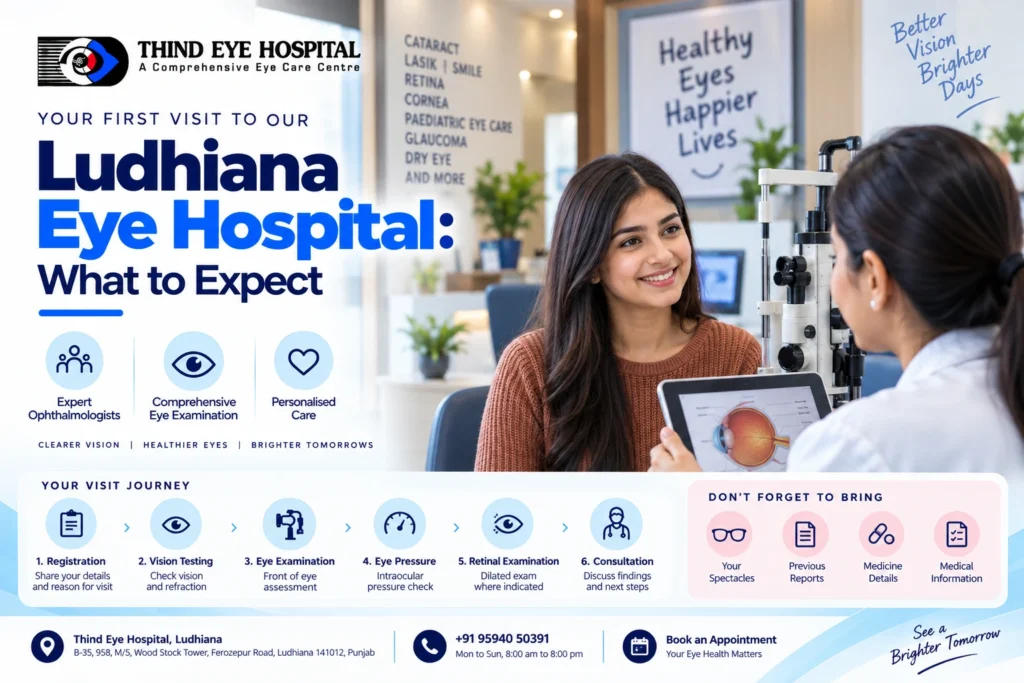
What to Know Before Visiting an Eye Hospital in Ludhiana
If you are planning your first visit to an eye hospital in Ludhiana, start by checking the branch location and timings.
Thind Eye Hospital’s Ludhiana branch is at B-35, 958, M/5, Wood Stock Tower, Ferozepur Road, Ludhiana 141012, Punjab, opposite Wave Mall on Ferozepur Road.
The branch is open Monday to Sunday, 8:00 am to 8:00 pm. You can call +91 95940 50391 before your visit if you need help with appointment planning.
You can also view the eye hospital in Ludhiana branch information before travelling.
What should you bring?
For a smoother visit, bring:
- Your current spectacles, if you wear them
- Previous eye reports, if available
- Details of any medicines you currently use
- Information about any known eye conditions
- Relevant medical information that your ophthalmologist may need
An ophthalmologist is a medical doctor specialising in eye care. An optometrist primarily examines vision and provides optical care.
What Happens When You Arrive?
Your first visit to an eye hospital in Ludhiana does not begin and end with checking spectacle power.
A comprehensive eye examination assesses more than refractive power. It includes visual acuity, refraction, examination of the front of the eye and intraocular pressure. Where indicated, a dilated retinal examination is also performed.
The sequence of your visit can therefore include:
- Registration and sharing your reason for visiting.
- Vision assessment and refraction.
- Examination of the front of the eye.
- Intraocular pressure assessment.
- A dilated retinal examination where indicated.
- Consultation with the ophthalmologist.
The exact assessment is guided by your symptoms, age and eye health needs.
If you are visiting because you have noticed changes in your vision, you can also review information about signs you need glasses before your appointment.
What Happens During a Dilated Eye Examination?
A dilated retinal examination allows the retina to be assessed when dilation is indicated.
Dilating drops blur near vision and increase light sensitivity for several hours. For this reason, it helps to arrange transport home after a dilated examination.
If you have diabetes, a dilated retinal examination is needed at least once a year, and sooner if advised, even when your vision appears normal.
People with a family history of glaucoma should also have regular examinations from an earlier age. Glaucoma is often symptomless until it becomes advanced.
Adults without symptoms or risk factors are generally advised to have a comprehensive eye examination every one to two years. More frequent examinations are advised from age 40, when the risk of glaucoma and other conditions rises.
Meet the Eye Specialists at Our Ludhiana Branch
An eye care hospital in Ludhiana should give you access to appropriate specialist care based on your eye concern.
At Thind Eye Hospital’s Ludhiana branch, Dr. Diksha, Consultant Ophthalmologist, Cornea and Refractive Surgery, consults daily. Her speciality includes cornea, cataract and refractive surgery, including LASIK, SMILE and PRK.
You can learn more about Dr. Diksha before your visit.
Dr. Dinesh Kumar, Consultant Ophthalmologist, Retina and Vitreoretinal Surgery, also consults daily at Ludhiana. His speciality includes retina, vitreoretinal surgery and cataract surgery.
Dr. Alia Yamin, Consultant Ophthalmologist, Cataract, Medical Retina and Dry Eye, also consults daily at the Ludhiana branch.
This specialist setup is useful when your examination identifies a need for further assessment within a particular area of eye care.
Eye Health Questions to Discuss During Your Visit
Your first visit is also a good time to discuss everyday factors that affect your eyes.
Screen use
Prolonged screen use is associated with dry eye and eye strain because blink rate falls. Regular breaks, suitable lighting and the correct working distance help reduce symptoms.
Age-related near vision
Presbyopia is the age-related loss of near focus. It typically begins in the forties and is a normal change rather than a disease.
Sun exposure
Ultraviolet exposure is linked to cataract and pterygium. Sunglasses with proper UV protection therefore matter in the Punjab climate.
The American Academy of Ophthalmology also provides patient information on eye health and eye conditions. For Indian public health information, you can refer to the National Programme for Control of Blindness and Visual Impairment.
What to Do After Your First Visit
Your next step will depend on what your examination shows and what your ophthalmologist recommends.
Keep your examination findings and follow any advised follow-up schedule. If you need another specialist assessment, the Ludhiana branch has consultants in cornea, refractive surgery, retina, vitreoretinal surgery, cataract and medical retina.
If you are looking for an eye hospital in Ludhiana, Thind Eye Hospital is located at Wood Stock Tower, Ferozepur Road, opposite Wave Mall. The branch is open Monday to Sunday, 8:00 am to 8:00 pm.
You can book an appointment or call +91 95940 50391 to plan your visit.
For anyone choosing an eye hospital in Ludhiana, knowing the location, timings, examination process and available specialists can help you prepare for your first consultation.
“This article provides general information about eye health and eye care services. It is not medical advice and does not replace a consultation with a qualified ophthalmologist. Symptoms vary between individuals. Please consult a licensed eye specialist before acting on any information here.”