


SMILE surgery in Ludhiana is a laser vision correction procedure that uses a small incision to remove a lenticule of corneal tissue. It is an alternative to LASIK, PRK and TransPRK for suitable patients. Your suitability is assessed using factors such as spectacle power, corneal thickness, corneal shape, dry eye status and overall eye health.
What Is SMILE Surgery in Ludhiana?
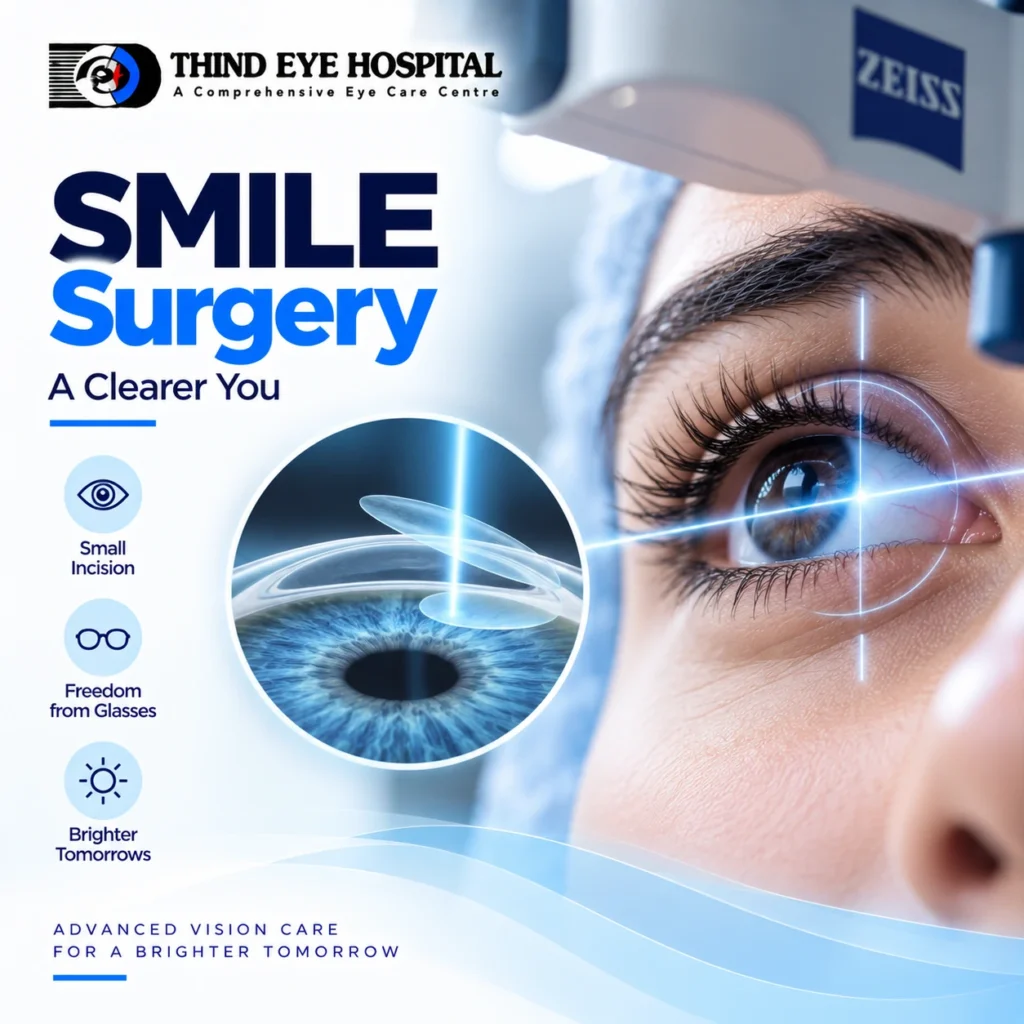
SMILE stands for small incision lenticule extraction. It is a form of refractive surgery that reshapes the cornea to reduce dependence on glasses or contact lenses.
Unlike LASIK, which creates a corneal flap, SMILE uses a small incision. A lenticule, which is a small piece of corneal tissue, is removed through this incision.
SMILE surgery in Ludhiana is therefore different from other laser vision correction procedures in how the cornea is accessed.
The main refractive surgery options include:
- LASIK
- SMILE
- PRK
- TransPRK
The right procedure is selected after a detailed eye assessment rather than by procedure name alone.
Who Can Consider SMILE Surgery in Ludhiana?
A detailed assessment is required before SMILE surgery in Ludhiana. Candidates are usually assessed for several factors that affect suitability.
These include:
- Age, generally 18 years and above
- Stable spectacle power for at least one year
- Adequate corneal thickness
- Corneal topography, which maps the shape of the cornea
- Pupil size
- Dry eye status
- General eye health
People with keratoconus, active eye infection, uncontrolled dry eye or certain retinal conditions may not be suitable for laser vision correction.
Your assessment therefore matters as much as the choice of procedure. It helps the ophthalmologist determine which refractive surgery option is appropriate for your eyes.
SMILE Pro Ludhiana: How Does the Procedure Differ From LASIK?
If you are researching SMILE Pro Ludhiana, it is useful to first understand the basic difference between SMILE and LASIK.
SMILE uses a small incision and removes a lenticule from the cornea. LASIK creates a corneal flap before reshaping the cornea.
PRK and TransPRK work on the surface of the cornea. They generally involve a longer visual recovery than SMILE or LASIK.
Laser vision correction is typically a day care procedure and takes a few minutes per eye. Most patients return to routine activities within one to two days, with specific restrictions on swimming, dust exposure and eye rubbing.
For a more detailed comparison, read SMILE Pro compared with LASIK.
What Happens Before SMILE Surgery?
Preparation starts with the pre-operative assessment. Your eye doctor checks whether your eyes meet the requirements for laser vision correction.
Contact lenses are usually stopped for a period before this assessment because they alter the shape of the cornea.
The assessment looks at your spectacle power, corneal thickness and topography. It also considers pupil size, dry eye status and general eye health.
This is especially relevant if you have an existing eye condition. Keratoconus, active eye infection, uncontrolled dry eye and certain retinal conditions can affect suitability for laser vision correction.
A consultation gives you the opportunity to discuss the available options and understand which procedure fits your eye assessment.
SMILE Surgery in Ludhiana and Recovery
SMILE surgery in Ludhiana is typically performed as a day care procedure. The procedure itself takes a few minutes per eye.
Most patients return to routine activities within one to two days. However, you need to follow the specific restrictions given after surgery.
These include avoiding swimming, limiting dust exposure and avoiding eye rubbing during the advised period.
Visual recovery differs between procedures. SMILE and LASIK generally have a shorter visual recovery than PRK and TransPRK, which work on the corneal surface.
Laser vision correction corrects your existing spectacle power. It does not prevent presbyopia, the age-related loss of near focus that typically begins in the forties.
Meet the Refractive Surgery Specialist in Ludhiana
At Thind Eye Hospital’s Ludhiana branch, you can consult Dr. Diksha, Consultant Ophthalmologist, Cornea and Refractive Surgery.
Dr. Diksha specialises in cornea, cataract and refractive surgery, including LASIK, SMILE and PRK. She consults at the Ludhiana branch daily.
Her listed clinical experience includes SMILE, LASIK, PRK, collagen crosslinking and CAIRS for keratoconus, along with corneal transplant procedures, management of corneal ulcers and dry eye, amniotic membrane transplant and pterygium surgery.
Thind Eye Hospital was founded in 1991 by Dr. Jaswant Singh Thind. The hospital is a multi superspeciality eye hospital with branches in Jalandhar, Ludhiana, Hoshiarpur and Pathankot.
The hospital was among the earliest in India to introduce Blade-Free LASIK technology in 2007. It was also the first eye hospital in North India to introduce LASIK laser vision correction in 1998.
For additional patient information, you can refer to the American Academy of Ophthalmology and the World Health Organization eye care information.
Where to Get SMILE Surgery in Ludhiana
Thind Eye Hospital’s Ludhiana branch is located at:
Address: B-35, 958, M/5, Wood Stock Tower, Ferozepur Road, Ludhiana 141012, Punjab
Landmark: Wood Stock Tower, Ferozepur Road, opposite Wave Mall
Opening hours: Monday to Sunday, 8:00 am to 8:00 pm
Phone: +91 95940 50391
You can visit the eye hospital in Ludhiana for branch information or book an appointment for a consultation.
If you are considering SMILE surgery in Ludhiana, start with a detailed refractive assessment. Call the Ludhiana branch on +91 95940 50391 to book your consultation and discuss your available vision correction options.
This article provides general information about eye health and eye care services. It is not medical advice and does not replace a consultation with a qualified ophthalmologist. Symptoms vary between individuals. Please consult a licensed eye specialist before acting on any information here.