

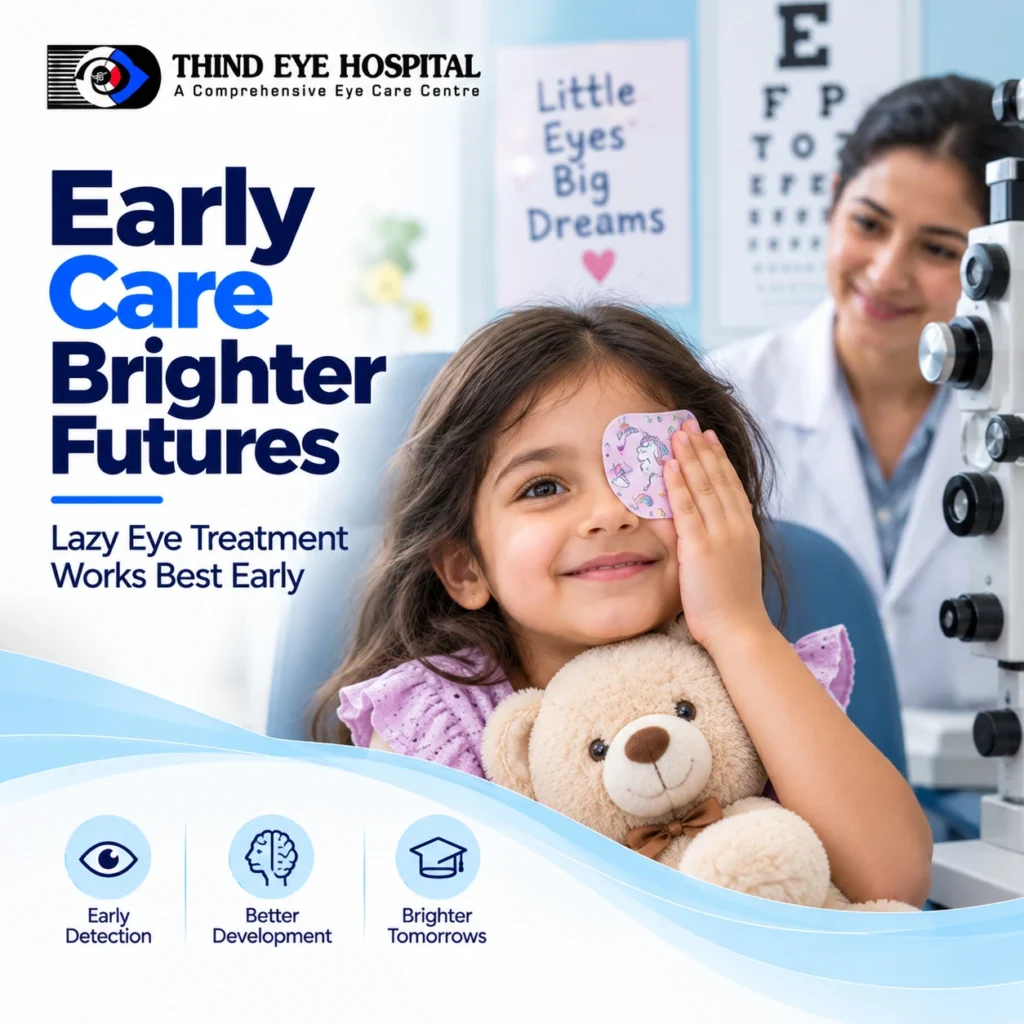
Lazy eye treatment is most effective when started early in childhood. Amblyopia, commonly called lazy eye, is reduced vision in an eye that has not developed normally. Early screening helps identify vision problems before they affect a child’s visual development. Prompt assessment also helps guide the right treatment for the child.
What Is Lazy Eye and Why Does Early Treatment Matter?
Amblyopia is reduced vision in an eye that has not developed normally. It is often called a lazy eye.
Children rarely complain about poor vision because they assume everyone sees as they do. Detection often depends on parents, teachers or other adults noticing changes in behaviour.
This is why early eye examinations matter. Lazy eye treatment is most effective when started early in childhood, so screening before school age is important.
A child may need an eye examination if you notice:
- Holding books or screens very close
- Sitting close to the television
- Squinting or closing one eye
- Tilting the head
- Frequent eye rubbing
- Headaches
- Falling performance at school
These signs do not confirm amblyopia. They are reasons to arrange an eye examination.
You can also read about the signs you need glasses to understand common childhood vision concerns.
Why Is Lazy Eye Treatment Started Early?
Visual development takes place during childhood. If one eye does not develop normal vision, the brain may rely more heavily on the other eye.
Early lazy eye treatment addresses reduced vision while the child’s visual system is still developing. Delaying assessment can mean missing an important period for treatment.
A squint, also called strabismus, is one condition that can be linked with amblyopia. Strabismus means the eyes are not properly aligned.
A squint in a child should not simply be watched at home. It should be assessed by an eye specialist.
Other childhood vision problems
Lazy eye is not the only reason a child may need an eye examination. Childhood myopia, or short-sightedness, is increasing.
Recognised measures to slow myopia progression include:
- Increased outdoor time
- Low dose atropine therapy
- Myopia control spectacle or contact lenses
The right approach should be selected after a child’s eyes have been assessed.
What Does Lazy Eye Treatment Involve?
The treatment used for amblyopia depends on the cause and the child’s eye condition. Amblyopia treatment may involve correcting the underlying vision problem and encouraging the weaker eye to work more effectively.
For children with squint, treatment options include:
- Glasses
- Vision therapy
- Patching
- Surgery
The appropriate treatment depends on the type and cause of the squint.
A child with suspected amblyopia needs a proper eye examination rather than an assumption based on appearance. An ophthalmologist is a medical eye doctor who examines and treats eye conditions. An optometrist primarily provides vision testing and optical care.
How Do You Know If a Child Needs an Eye Examination?
Parents often notice behavioural clues before a child explains a vision problem.
A weak eye in a child may not be obvious during everyday activities. Watch for changes such as closing one eye, tilting the head or bringing books unusually close.
School performance can also provide a useful reason to arrange an eye examination. Headaches, frequent eye rubbing and sitting close to screens or television should also be taken seriously.
Sudden changes need particular attention. A sudden onset squint, white reflex in the pupil or rapid change in a child’s vision needs prompt specialist assessment.
Premature babies need timely screening
Retinopathy of prematurity screening applies to babies born prematurely or with low birth weight. It follows a time-critical schedule.
Parents should follow the recommended screening schedule for eligible babies rather than waiting for visible symptoms.
For additional information, the American Academy of Ophthalmology provides patient-focused eye health resources. You can also refer to the National Programme for Control of Blindness and Visual Impairment for information on eye care in India.
Lazy Eye Treatment at Thind Eye Hospital
Thind Eye Hospital is a multi superspeciality eye hospital with branches in Jalandhar, Ludhiana, Hoshiarpur and Pathankot.
For children requiring assessment for squint or amblyopia, Dr. Saurabh Mittal, Cornea, Squint and Paediatric Ophthalmologist, provides specialist consultations. He is fellowship trained in cornea and paediatric ophthalmology from PGI Chandigarh.
Dr. Saurabh Mittal consults in Jalandhar daily, at Hoshiarpur on Tuesday, and also at Pathankot. You can view the Dr. Saurabh Mittal profile for more information.
The hospital also conducts school eye health checkup programmes for children and community eye care camps for rural populations.
What Should You Do If You Suspect Lazy Eye?
Do not wait for a child to complain about poor vision. Children often do not recognise that their vision differs from others.
Arrange an eye examination if you notice signs such as squinting, closing one eye, head tilting, sitting very close to the television or falling school performance.
Early lazy eye treatment gives the child’s developing visual system the opportunity to receive appropriate care at the right stage.
If you are concerned about lazy eye treatment, arrange a consultation with the paediatric eye team at Thind Eye Hospital. You can book an appointment for assessment.
Lazy eye treatment should begin with a proper specialist examination, especially when a child has a squint, a white pupil reflex or a rapid change in vision.
“This article provides general information about eye health and eye care services. It is not medical advice and does not replace a consultation with a qualified ophthalmologist. Symptoms vary between individuals. Please consult a licensed eye specialist before acting on any information here.”