


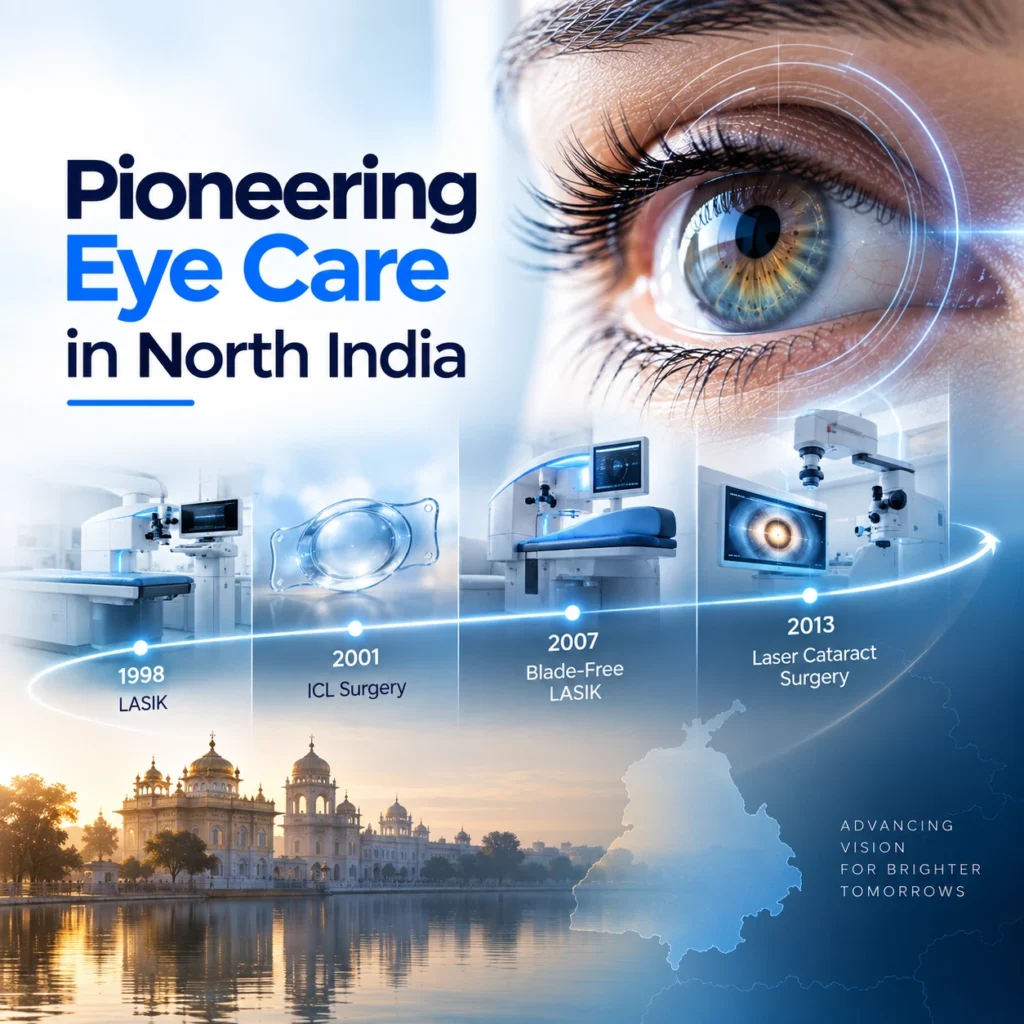
An advanced eye hospital in Punjab combines specialised eye care with a history of introducing new treatment approaches. Thind Eye Hospital has brought several eye care innovations to North India and India, including LASIK in 1998, ICL surgery in 2001, Blade-Free LASIK in 2007 and laser-assisted blade-free cataract surgery in 2013.
What Makes an Advanced Eye Hospital in Punjab?
An advanced eye hospital in Punjab should offer more than routine spectacle testing. A comprehensive eye examination assesses visual acuity, refraction, the front of the eye, intraocular pressure and, where indicated, the retina after dilation.
The need for these services changes with age and health.
Adults without symptoms or risk factors are generally advised to have a comprehensive eye examination every one to two years. From age 40, examinations are advised more often as the risk of glaucoma and other conditions increases.
People with diabetes need a dilated retinal examination at least once a year, even when their vision seems normal. Anyone with a family history of glaucoma should also be examined regularly from an earlier age.
Presbyopia, the age-related loss of near focus, typically begins in the forties. It is a normal change rather than a disease.
You can also read about common signs you need glasses and when an eye examination may be useful.
Advanced Eye Hospital in Punjab: A History of Eye Care Firsts
Thind Eye Hospital was founded in 1991 by Dr. Jaswant Singh Thind, Chairman cum Managing Director. He completed his MS from King George’s Medical College, Lucknow, in 1986.
The hospital’s history includes several notable milestones in eye care.
LASIK introduced in North India
In 1998, Thind Eye Hospital became the first eye hospital in North India to introduce LASIK laser vision correction.
This was followed by the launch of a fully equipped Vitreo-Retinal department in 1999.
ICL surgery introduced in India
In 2001, Thind Eye Hospital became the first eye hospital in India to perform ICL surgery.
ICL is an implantable lens procedure used in refractive eye care. Its introduction forms part of the hospital’s history of adopting specialised eye care approaches.
Blade-Free LASIK and laser cataract surgery
In 2007, the hospital was among the earliest in India to introduce Blade-Free LASIK technology.
In 2011, it became the first hospital in North India to install the Schwind Amaris 750S laser system.
In 2013, the hospital introduced 100% blade-free cataract surgery with laser.
These milestones help explain why patients researching an advanced eye hospital in Punjab may consider the hospital’s history alongside its current services.
Modern Eye Care Punjab Across Different Specialities
Modern eye care Punjab involves more than one area of ophthalmology. A multi superspeciality eye hospital brings different areas of eye care together under one organisation.
Thind Eye Hospital has branches in Jalandhar, Ludhiana, Hoshiarpur and Pathankot.
The hospital also launched its fully equipped Vitreo-Retinal department in 1999. Its broader eye care history includes refractive surgery, cataract care and retinal services.
An advanced eye hospital in Punjab also needs to recognise that routine examinations remain important alongside specialised procedures.
For example, prolonged screen use is associated with dry eye and eye strain because blink rate falls. Regular breaks, adequate lighting and the correct working distance help reduce symptoms.
Ultraviolet exposure is linked to cataract and pterygium. Sunglasses with proper UV protection therefore matter in the Punjab climate.
These simple aspects of eye care remain relevant even when you are considering specialised treatment.
Eye Technology Punjab: Why Assessment Still Matters
The phrase eye technology Punjab often brings attention to procedures and equipment. Technology is useful, but an appropriate eye examination remains the starting point for deciding what care you need.
A comprehensive examination checks visual acuity and refraction. It also includes examination of the front of the eye and intraocular pressure. A dilated retinal examination is included where indicated.
Dilation requires some planning. Dilating drops blur near vision and increase light sensitivity for several hours. It helps to arrange transport home after a dilated examination.
People with diabetes should have a dilated retinal examination at least once a year. Glaucoma can also remain symptomless until advanced, making regular examinations important for people with a family history.
This approach places eye technology Punjab within a wider system of examination, diagnosis and specialised eye care.
For additional information, the American Academy of Ophthalmology provides patient information on eye health.
Thind Eye Hospital’s Punjab Presence
Thind Eye Hospital is a multi superspeciality eye hospital serving Punjab through its branches in Jalandhar, Ludhiana, Hoshiarpur and Pathankot.
The hospital brings more than 39 years of expertise in eye care. More than 4,00,000 surgeries have been performed by the hospital to date.
Its history also includes the introduction of 100% topical anaesthesia cataract surgery without injections in 1997. This was followed by the LASIK milestone in 1998 and ICL surgery milestone in 2001.
For patients considering an advanced eye hospital in Punjab, these dates provide specific points in the hospital’s development rather than general claims about modern care.
Jalandhar
The Jalandhar branch is on Mall Road, Model Town.
Dr. Jaswant Singh Thind, Chief Eye Surgeon and Chairman cum Managing Director, consults in Jalandhar daily. His profile provides more information about his role and background: Dr. Jaswant Singh Thind.
Hoshiarpur
Dr. Jaswant Singh Thind consults in Hoshiarpur on Thursday mornings.
Pathankot
Dr. Jaswant Singh Thind consults in Pathankot on Tuesday mornings.
The supplied brief does not provide additional permitted doctor profiles for this article, so no other doctor names or credentials are added.
Choosing an Advanced Eye Hospital in Punjab
If you are comparing an advanced eye hospital in Punjab, look beyond a list of procedures. Consider the hospital’s history, range of eye care services and access to appropriate examinations.
Your needs may be different from another patient’s. A person with diabetes needs regular dilated retinal examinations. Someone with a family history of glaucoma needs regular assessment from an earlier age.
Screen-related eye strain also deserves attention. Regular breaks, adequate lighting and correct working distance can help reduce symptoms associated with prolonged screen use.
The hospital’s community work is another part of its wider role. Thind Eye Hospital conducts community eye care camps for rural populations and school eye health checkup programmes for children.
If you want to learn more about the hospital’s services or discuss your eye care needs, you can book an appointment.
What to Do Next
Choosing an advanced eye hospital in Punjab should begin with your specific eye care needs and an appropriate examination.
Thind Eye Hospital has branches across Jalandhar, Ludhiana, Hoshiarpur and Pathankot, with a history that includes LASIK in 1998, ICL surgery in 2001 and Blade-Free LASIK in 2007.
If you are considering an advanced eye hospital in Punjab, you can arrange a consultation and discuss which eye examination or specialist service is appropriate for you.
This article provides general information about eye health and eye care services. It is not medical advice and does not replace a consultation with a qualified ophthalmologist. Symptoms vary between individuals. Please consult a licensed eye specialist before acting on any information here.