


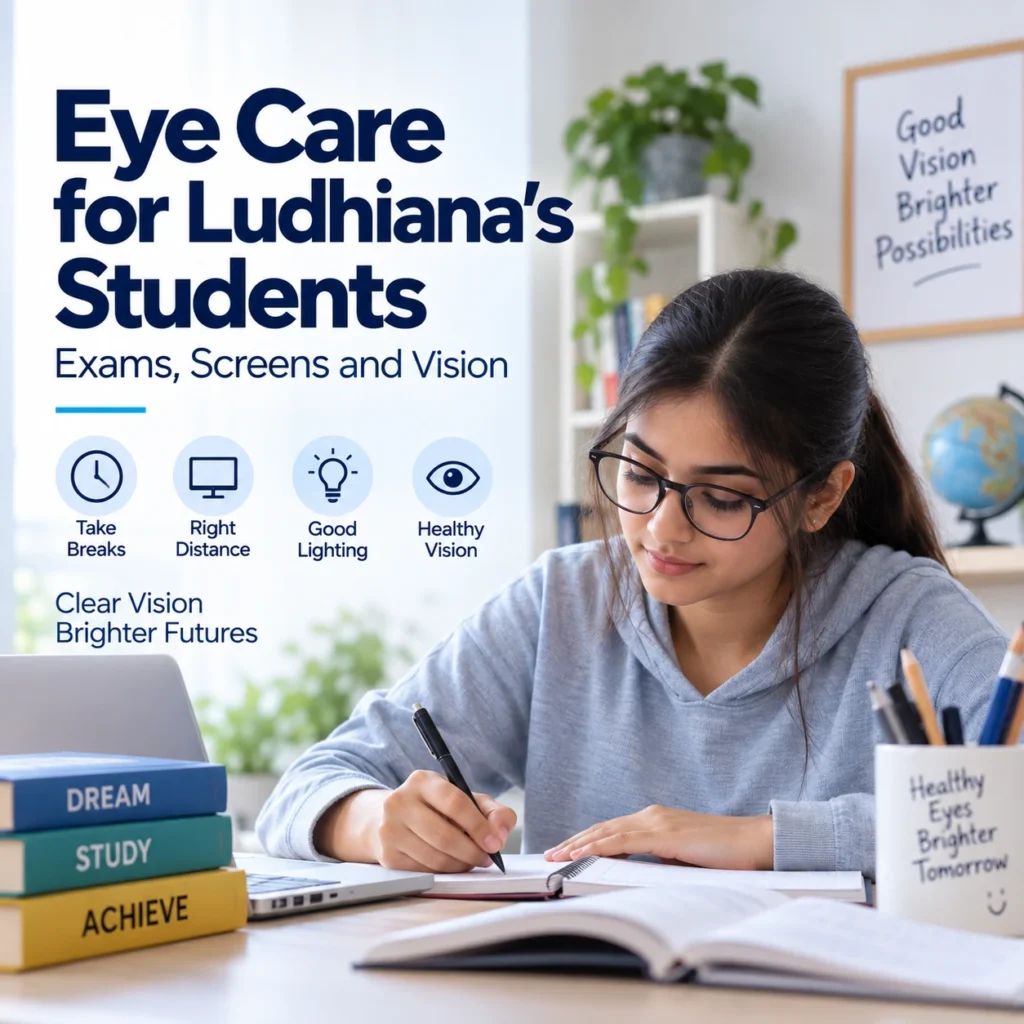
Eye care for students matters during long study hours, especially when books, laptops and phones are part of daily learning. Regular breaks, suitable lighting, correct working distance and proper eye examinations can help manage student eye strain. In Ludhiana, students can access comprehensive eye care at Thind Eye Hospital on Ferozepur Road.
Why is eye care for students important?
Students often spend long periods reading, studying or using digital screens. Prolonged screen use is associated with dry eye and eye strain because blink rate falls.
This makes exam eye care particularly relevant during long preparation periods. Regular breaks, adequate lighting and the correct working distance can reduce symptoms.
Student eye strain can include discomfort or tired eyes after prolonged near work. These symptoms should not automatically be treated as a diagnosis. If they continue or affect studying, an eye examination can help identify the cause.
WHO guidance for school-age children recommends regular breaks during near-vision activities, including reading and digital-device use, to help reduce eye strain and dry eyes.
For students, eye care for students is therefore not only about spectacle power. A comprehensive eye examination assesses several parts of eye health.
What does a student eye examination include?
A comprehensive eye examination assesses more than spectacle power. It includes:
- Visual acuity
- Refraction
- Examination of the front of the eye
- Intraocular pressure
- A dilated retinal examination where indicated
An ophthalmologist is a medical doctor who examines and treats eye conditions. An optometrist primarily assesses vision and provides vision correction services.
Students who are struggling to see the board, read comfortably or focus during prolonged study should have their symptoms assessed rather than assuming they simply need stronger glasses.
WHO notes that uncorrected refractive errors are a major cause of vision impairment and that regular eye checks help identify vision problems.
When should students have an eye examination?
The timing of an examination depends on the student’s age, symptoms and risk factors.
A family history of glaucoma is one reason for regular eye examinations from an earlier age because glaucoma is often symptomless until advanced.
Students with diabetes also need particular attention to eye health. People with diabetes need a dilated retinal examination at least once a year, and sooner if advised, even when vision seems normal.
How can students reduce student eye strain during exams?
Long study sessions can increase student eye strain, particularly when students spend hours looking at screens or books without breaks.
Good exam eye care habits include:
Take regular breaks
Look away from close work regularly. WHO guidance recommends the 20-20-20 approach for school-age children, looking at something around 20 feet away for at least 20 seconds after 20 minutes of screen or near work.
Use suitable lighting
Poor lighting can make studying uncomfortable. Use adequate lighting for reading and keep the screen at a suitable working distance.
Remember to blink
Blinking tends to fall during prolonged screen use. Reduced blinking is associated with dry eye and eye strain.
Spend time outdoors
Outdoor time is part of healthy eye habits for children and adolescents. WHO guidance notes that spending time outdoors can help delay the onset and slow the progression of myopia in children.
These simple habits are an important part of eye care for students, especially during examination periods.
What if a student has blurred vision?
Blurred vision can affect reading, classroom learning and screen use. It can also make a student move closer to a screen or book.
If a student regularly struggles to see clearly, arrange an eye examination. Do not assume that the problem is caused only by excessive screen use.
You can also read about the signs you need glasses to understand some common reasons to seek an eye examination.
A comprehensive examination assesses more than spectacle power. It checks visual acuity, refraction and the health of the eye, with additional examination where indicated.
WHO recommends regular eye checks for children and notes that children may not always recognise that their vision is blurred.
Eye care for students in Ludhiana
For students and families in Ludhiana, Thind Eye Hospital is located at B-35, 958, M/5, Wood Stock Tower, Ferozepur Road, Ludhiana 141012, Punjab.
The landmark is Wood Stock Tower, Ferozepur Road, opposite Wave Mall.
The Ludhiana branch is open Monday to Sunday, 8:00 am to 8:00 pm. You can call +91 95940 50391 to confirm services and consultation availability.
Thind Eye Hospital is a multi superspeciality eye hospital with branches in Jalandhar, Ludhiana, Hoshiarpur and Pathankot. The hospital also conducts community eye care camps and school eye health checkup programmes for children.
Meet the Ludhiana eye specialist
Dr. Alia Yamin, Consultant Ophthalmologist, Cataract, Medical Retina and Dry Eye, consults in Ludhiana daily.
Her speciality includes cataract, refractive surgery, medical retina and dry eye management. Her clinical experience also includes myopia control with atropine therapy and myopia control lenses, along with vision therapy for squint and amblyopia.
You can learn more about Dr. Alia Yamin.
What should students do before exams?
Students can make eye care part of their regular study routine rather than waiting for discomfort.
A simple checklist includes:
- Take regular breaks from close work.
- Maintain a suitable working distance.
- Use adequate lighting.
- Blink regularly during screen use.
- Spend time outdoors.
- Do not ignore persistent vision problems.
- Arrange an eye examination if symptoms continue.
These habits support exam eye care and can reduce the discomfort associated with prolonged near work.
Students should also use prescribed spectacles as advised. Spectacles should not be shared between students.
What to do next in Ludhiana
If you are looking for eye care for students in Ludhiana, Thind Eye Hospital provides comprehensive eye care at its Wood Stock Tower branch on Ferozepur Road.
Call +91 95940 50391 to confirm available services and consultation arrangements. The branch is open Monday to Sunday, 8:00 am to 8:00 pm.
You can also book an appointment before visiting.
For students experiencing persistent student eye strain, blurred vision or difficulty seeing clearly during study, arrange an eye examination rather than relying only on screen-use changes.
If you are looking for eye care for students in Ludhiana, contact the Thind Eye Hospital branch on Ferozepur Road to discuss the appropriate next step.
This article provides general information about eye health and eye care services. It is not medical advice and does not replace a consultation with a qualified ophthalmologist. Symptoms vary between individuals. Please consult a licensed eye specialist before acting on any information here. Please note that some services may not be available at every Thind Eye Hospital centre. Kindly call the relevant centre to confirm service availability before visiting.