

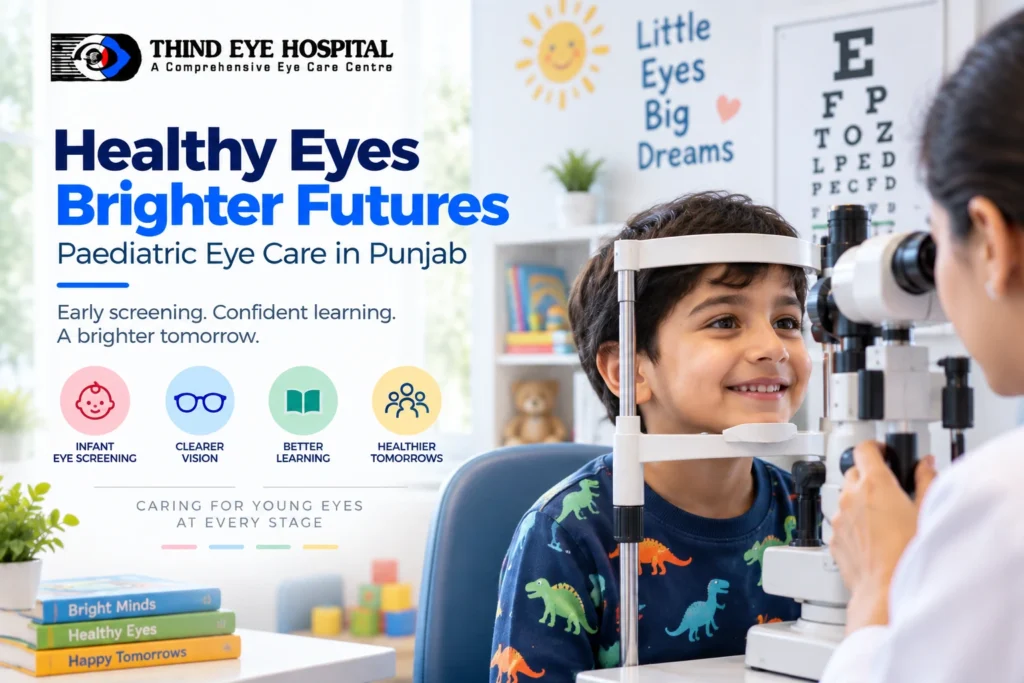
A child eye specialist in Punjab helps identify vision problems that children often cannot describe themselves. Screening can detect concerns such as amblyopia, squint and childhood myopia. Babies born prematurely or with low birth weight may also need retinopathy of prematurity screening. Early assessment supports timely care during important stages of visual development.
Why Children Need Eye Screening
Children rarely complain about poor vision because they assume everyone sees as they do. Parents, teachers and other adults often need to notice changes in behaviour or school performance.
Signs that your child needs an eye examination include:
- Holding books or screens very close
- Sitting close to the television
- Squinting or closing one eye
- Tilting the head
- Frequent eye rubbing
- Headaches
- Falling performance at school
These signs do not tell you the cause by themselves. They are reasons to arrange an eye examination with a child eye specialist in Punjab.
You can also read about the signs you need glasses to understand common vision-related behaviours.
When Should Your Child See a Child Eye Specialist in Punjab?
Eye screening should not begin only when a child starts complaining about poor vision. Some childhood eye conditions need assessment during early development.
Before school age
Amblyopia, commonly called lazy eye, is reduced vision in an eye that has not developed normally. Treatment is most effective when started early in childhood, so screening before school age matters.
Squint, also called strabismus, is a misalignment of the eyes. A squint in a child should be assessed rather than simply observed at home. It does not outgrow simply by waiting.
During school years
School-age children spend significant time reading, writing and using screens. Changes in classroom performance, frequent headaches or difficulty seeing the board are reasons for an eye examination.
A child eye specialist in Punjab can assess your child’s vision and identify whether further evaluation is needed.
Childhood Eye Conditions Parents Should Know
Knowing the common concerns can help you recognise when an examination is needed.
Amblyopia
Amblyopia occurs when vision in one eye has not developed normally. Early treatment is more effective, which makes screening before school age important.
Squint
Squint means the eyes are not properly aligned. Treatment can include glasses, vision therapy, patching or surgery, depending on the type and cause.
Childhood myopia
Myopia means short-sightedness, where distant objects appear less clear. Childhood myopia is increasing.
Recognised measures to slow progression include:
- Increased outdoor time
- Low dose atropine therapy
- Myopia control spectacle lenses
- Myopia control contact lenses
Your child eye specialist in Punjab can assess your child’s vision and discuss appropriate options.
Retinopathy of prematurity
Retinopathy of prematurity is an eye condition that requires screening in babies born prematurely or with low birth weight. Screening follows a time-critical schedule.
Parents should follow the recommended screening schedule rather than waiting for visible symptoms.
When Does Your Child Need Prompt Eye Assessment?
Some changes require prompt specialist assessment.
A sudden onset of squint, a white reflex in the pupil or a rapid change in your child’s vision needs prompt assessment by a specialist.
Do not rely on home observation if these changes appear. Arrange specialist assessment so the child’s eyes can be properly examined.
The American Academy of Ophthalmology provides information about children’s eye health and vision. The World Health Organization’s eye care resources also provide information about vision and eye care.
Finding a Child Eye Specialist in Punjab
Thind Eye Hospital is a multi superspeciality eye hospital with branches in Jalandhar, Ludhiana, Hoshiarpur and Pathankot.
For paediatric eye care, Dr. Saurabh Mittal, Cornea, Squint and Paediatric Ophthalmologist, consults at Jalandhar daily, Hoshiarpur on Tuesdays and also at Pathankot. He is fellowship trained in cornea and paediatric ophthalmology from PGI Chandigarh.
Dr. Alia Yamin is a Consultant Ophthalmologist specialising in cataract, medical retina and dry eye. She consults at the Ludhiana branch daily and also has experience with vision therapy for squint and amblyopia.
This gives families across Punjab access to paediatric and related eye-care services at different Thind Eye Hospital branches.
Thind Eye Hospital Locations Across Punjab
If you are searching for a children eye hospital Punjab, knowing the available locations can make planning easier.
Jalandhar
The Jalandhar branch is at 701, Mall Road, Model Town, Jalandhar 144001, Punjab. It is open Monday to Sunday, 8:00 am to 6:00 pm.
Ludhiana
The Ludhiana branch is at B-35, 958, M/5, Wood Stock Tower, Ferozepur Road, Ludhiana 141012, Punjab, opposite Wave Mall. It is open Monday to Sunday, 8:00 am to 8:00 pm.
Hoshiarpur
The Hoshiarpur branch is at 584, Model Town, Near Hotel Presidency, Hoshiarpur 146001, Punjab. It is open Monday to Sunday, 8:00 am to 6:00 pm.
Pathankot
The Pathankot branch is at SCO-8, TMT Scheme, Near LIC Office, Pathankot 145001, Punjab. It is open Monday to Sunday, 8:00 am to 6:00 pm.
Thind Eye Hospital also conducts school eye health checkup programmes for children and community eye care camps for rural populations.
What Parents Should Do Next
If you notice changes in your child’s vision, behaviour or school performance, arrange an eye examination rather than waiting for the problem to become more obvious.
A child eye specialist in Punjab can assess concerns such as amblyopia, squint and childhood myopia. Babies born prematurely or with low birth weight should also follow the appropriate retinopathy of prematurity screening schedule.
You can book an appointment with Thind Eye Hospital for your child’s eye assessment.
If you are looking for a child eye specialist in Punjab, early assessment is a practical step towards protecting your child’s developing vision.
“This article provides general information about eye health and eye care services. It is not medical advice and does not replace a consultation with a qualified ophthalmologist. Symptoms vary between individuals. Please consult a licensed eye specialist before acting on any information here.”