

Kala motia treatment focuses on protecting the vision you still have. Glaucoma damages the optic nerve and often causes no early symptoms. Because vision lost to glaucoma cannot be recovered, timely eye testing is essential. Treatment may include eye drops, laser procedures or surgery, based on the examination.
What Is Kala Motia?
Kala motia, commonly called glaucoma in Punjabi and Hindi, refers to a group of conditions that damage the optic nerve. The damage is often, but not always, linked with raised pressure inside the eye.
The most common form is primary open-angle glaucoma. It usually causes no pain or early warning signs. Peripheral vision is often affected first, and you may not notice the change until the disease has become advanced.
This is why kala motia treatment should not be based only on symptoms. Regular eye testing helps identify changes before noticeable vision loss occurs.
If you are concerned about changes in your eyesight, read about the signs you need glasses, but remember that glaucoma often has no early symptoms.
Why Early Kala Motia Treatment Matters
Vision lost because of glaucoma cannot be recovered. The aim of kala motia treatment is to protect the vision that remains and slow further damage.
You may have glaucoma without experiencing pain, blurred vision or another obvious symptom. A routine examination can detect findings that a person cannot identify at home.
Who has a higher risk?
Risk factors include:
- Increasing age
- A family history of glaucoma
- High refractive error
- Previous eye injury
- Long-term steroid use
- Diabetes
Having a risk factor does not mean you have glaucoma. It does mean that discussing appropriate eye testing with an ophthalmologist, a medical doctor specialising in eye care, is worthwhile.
What Does a Glaucoma Test Check?
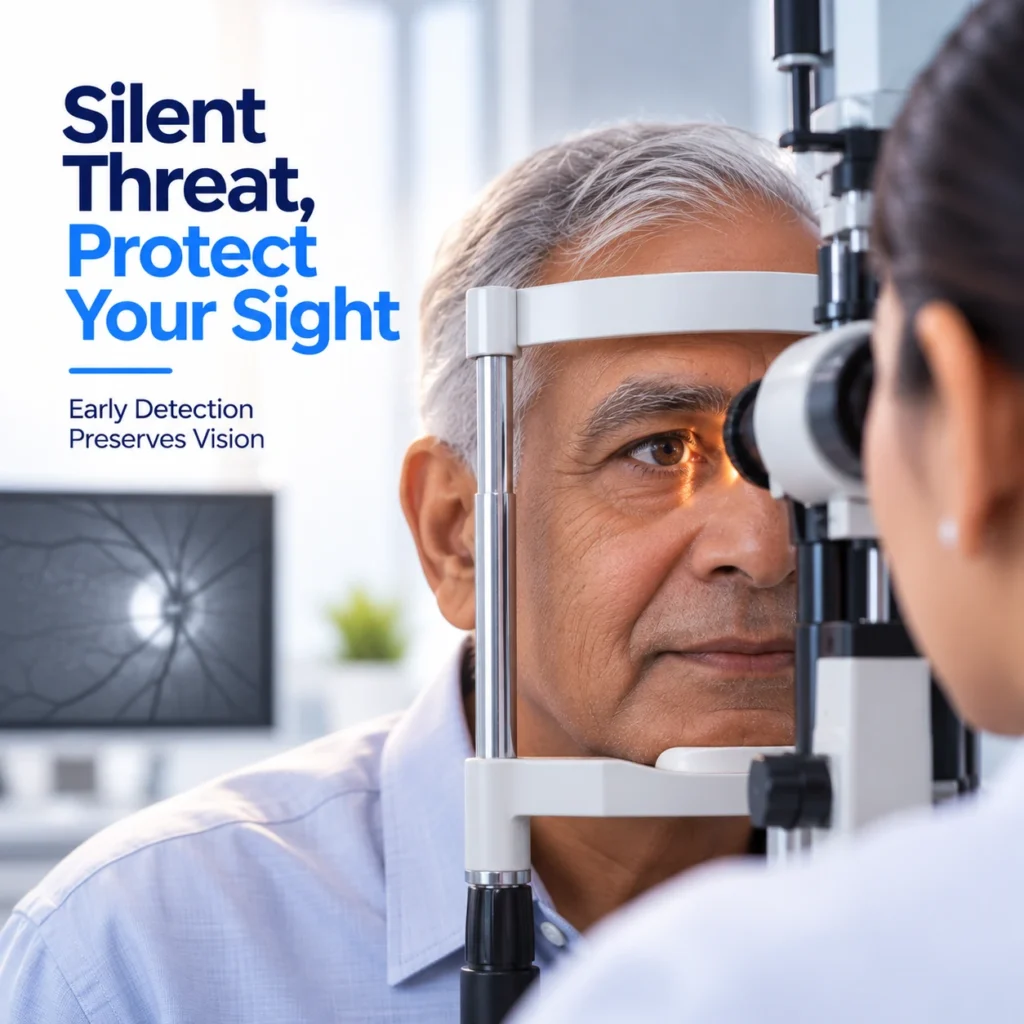
A proper assessment is more than a single eye pressure reading. Kala motia treatment decisions are based on the overall examination.
Testing typically includes:
- Intraocular pressure measurement, which checks pressure inside the eye.
- Optic nerve examination, which looks for changes linked with glaucoma.
- Gonioscopy, which examines the drainage angle of the eye.
- Visual field testing, which checks for areas of lost vision.
- Optical coherence tomography, or OCT, of the nerve fibre layer.
A single normal pressure reading does not rule out glaucoma. Similarly, a raised pressure reading does not confirm glaucoma. The diagnosis is based on the complete examination.
This is one reason a proper kala motia treatment assessment is more useful than relying on eye pressure alone.
Kala Motia Treatment Options
The right kala motia treatment depends on the type of glaucoma and the findings from your examination.
Eye drops
Pressure-lowering eye drops are commonly used to manage glaucoma. They work as part of an ongoing treatment plan designed to protect the remaining vision.
Your ophthalmologist will advise you on their use and follow-up based on your examination.
Laser treatment
Laser procedures are another kala motia treatment option. These include procedures such as:
- Trabeculoplasty
- Iridotomy
The procedure used depends on the type of glaucoma and the condition of the drainage angle.
Surgery
Surgery may be considered when eye drops and laser treatment are not sufficient. The purpose remains the same, to control the condition and protect the vision that remains.
Your examination helps the ophthalmologist decide which approach is appropriate.
When Kala Motia Needs Emergency Attention
Most primary open-angle glaucoma does not cause sudden pain. Angle-closure glaucoma is different and can present acutely.
Symptoms can include:
- Severe eye pain
- Redness
- Headache
- Nausea
- Halos around lights
This is an emergency. If these symptoms appear suddenly, seek urgent eye care rather than waiting for a routine appointment.
Prompt assessment also matters if you notice a significant change in your vision. A sudden change should be examined instead of being assumed to be glaucoma or another specific condition.
For general information about blindness and vision loss, you can also refer to the World Health Organization’s eye care information and the National Programme for Control of Blindness and Visual Impairment.
Kala Motia Treatment at Thind Eye Hospital
Thind Eye Hospital is a multi superspeciality eye hospital with branches in Jalandhar, Ludhiana, Hoshiarpur and Pathankot. The hospital was founded in 1991 by Dr. Jaswant Singh Thind.
The hospital also launched its fully equipped Vitreo-Retinal department in 1999. It has conducted community eye care camps for rural populations and school eye health checkup programmes for children.
For glaucoma care, Dr. Neetu Negi, Consultant Ophthalmologist and Glaucoma Specialist, consults at the Jalandhar branch from Monday to Thursday and at Hoshiarpur on Friday. You can learn more about Dr. Neetu Negi before booking a consultation.
What should you do next?
Do not wait for symptoms before considering glaucoma testing, especially if you have known risk factors. Kala motia treatment is focused on protecting the vision you have, because vision already lost to glaucoma cannot be recovered.
You can book an appointment for an eye examination and discuss your concerns with a qualified ophthalmologist.
Jalandhar: 701, Mall Road, Model Town, Jalandhar 144001, Punjab
Consulting: Dr. Neetu Negi, Monday to Thursday
Hoshiarpur: 584, Model Town, Near Hotel Presidency, Hoshiarpur 146001, Punjab
Consulting: Dr. Neetu Negi, Friday
This article provides general information about eye health and eye care services. It is not medical advice and does not replace a consultation with a qualified ophthalmologist. Symptoms vary between individuals. Please consult a licensed eye specialist before acting on any information here.