

Cataract surgery risks should be understood before you decide on treatment. Modern cataract surgery is a common procedure, but like any surgery, it has potential complications. Knowing the possible cataract surgery complications, the recovery process and the factors considered before surgery can help you make an informed decision with your ophthalmologist.
What are the main cataract surgery risks?
A cataract is a clouding of the eye’s natural lens. It usually develops gradually and is most commonly related to ageing.
Common symptoms include:
- Cloudy or blurred vision
- Glare and haloes around lights
- Poor night vision
- Faded colours
- Frequent changes in spectacle power
Cataract cannot be reversed with eye drops, exercises or diet. Surgery is the only definitive treatment.
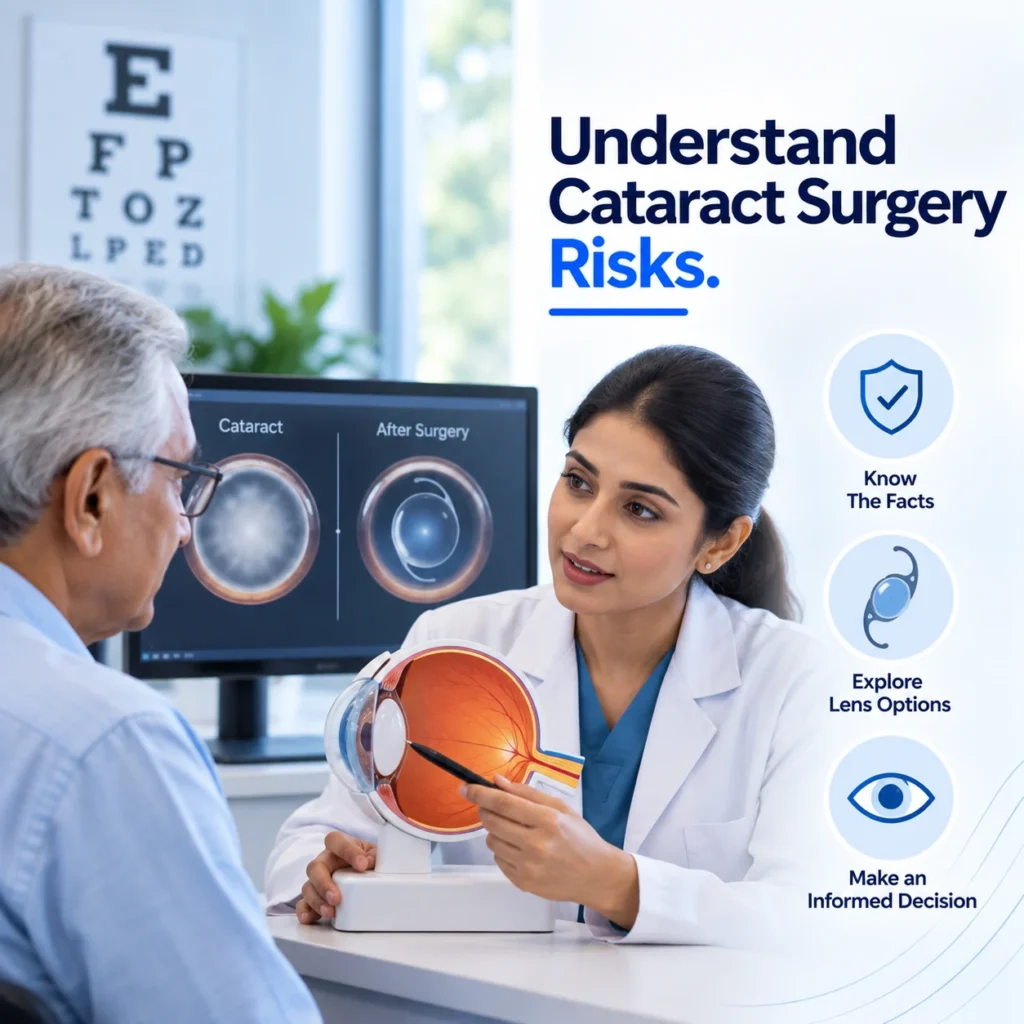
Understanding cataract surgery risks starts with understanding what the procedure involves. Modern cataract surgery removes the cloudy natural lens and replaces it with an intraocular lens, or IOL.
Is cataract surgery safe?
People often ask, is cataract surgery safe? The procedure has a well-established role in treating cataracts, but no surgery should be described as completely without risk.
The specific cataract surgery risks should be discussed during your consultation. Your ophthalmologist will assess your eye and general medical condition before recommending surgery.
Cataract surgery is usually performed under topical or local anaesthesia as a day care procedure. General anaesthesia is rarely needed in adults.
The two common surgical techniques are:
- Phacoemulsification
- Small incision cataract surgery, or SICS
Your ophthalmologist can explain which approach is suitable for your eye.
Cataract surgery complications you should know
Knowing the possible cataract surgery complications does not mean that you should expect them. It means you understand what your consultation and follow-up care are designed to address.
One recognised issue after cataract surgery is posterior capsule opacification. It can develop months or years after surgery and cause vision to become cloudy again.
It is treated with a short outpatient Nd:YAG laser capsulotomy. This does not require repeat cataract surgery.
Your ophthalmologist will also discuss your individual cataract surgery risks before treatment and explain the follow-up process.
How does age affect cataract surgery risks?
There is no upper age limit for cataract surgery. Fitness for surgery depends on the health of your eye and your general medical condition, not age alone.
This means that being older does not automatically rule out cataract surgery. Your medical history and eye examination remain important parts of the assessment.
After surgery, most patients notice improved vision within a few days. Vision continues to settle over about four to six weeks.
You can read more about cataract surgery recovery time to understand the expected recovery timeline.
Can the choice of lens affect your cataract surgery risks?
During cataract surgery, the cloudy natural lens is replaced with an IOL. Several IOL options are available.
These include:
- Monofocal lenses
- Toric lenses, used for astigmatism
- Multifocal lenses
- Extended depth of focus lenses
The choice depends on your eye measurements and visual needs.
A detailed discussion before surgery helps you understand the available IOL choices and how they relate to your vision requirements. It also gives you an opportunity to discuss your individual cataract surgery risks.
Cataract surgery at Thind Eye Hospital
Thind Eye Hospital is a multi superspeciality eye hospital with branches in Jalandhar, Ludhiana, Hoshiarpur and Pathankot.
The hospital was founded in 1991 by Dr. Jaswant Singh Thind, Chairman cum Managing Director. He completed his MS from King George’s Medical College, Lucknow, in 1986.
The hospital has more than 39 years of expertise in eye care and has performed more than 4,00,000 surgeries to date.
Thind Eye Hospital was among the first in India to introduce 100% topical anaesthesia cataract surgery without injections in 1997. It also introduced 100% blade-free cataract surgery with laser in 2013.
For more information, you can view the profile of Dr. Jaswant Singh Thind.
For general eye health information, you can also refer to the American Academy of Ophthalmology
What should you do before cataract surgery?
If cataract symptoms are affecting your daily activities, arrange an eye examination. Do not rely on symptoms alone to decide whether surgery is appropriate.
Your consultation is the right time to discuss:
- Your vision symptoms
- Your general medical condition
- The surgical technique
- IOL options
- Expected recovery
- Individual cataract surgery risks
Cataract surgery is a definitive treatment for cataract, but choosing the right time and approach requires an eye assessment.
Book a cataract consultation
If you are considering cataract surgery, speak with an ophthalmologist about your individual cataract surgery risks and treatment options.
You can book an appointment with Thind Eye Hospital to discuss your cataract and suitable treatment options.
Understanding cataract surgery risks before treatment helps you have a clearer discussion with your eye specialist and make a decision based on your eye health and visual needs.
“This article provides general information about eye health and eye care services. It is not medical advice and does not replace a consultation with a qualified ophthalmologist. Symptoms vary between individuals. Please consult a licensed eye specialist before acting on any information here.”