

Myopia control in children focuses on slowing the progression of short-sightedness during childhood. Regular eye examinations help identify changes in vision early. Recognised measures include increased outdoor time, low dose atropine therapy, and myopia control spectacle or contact lenses. The right approach should follow a proper assessment of the child’s eyes.
What Is Childhood Myopia?
Childhood myopia means short-sightedness that develops during the growing years. A child with myopia may see nearby objects more clearly than distant ones.
Children rarely complain about poor vision because they assume everyone sees as they do. Parents and teachers often notice changes in behaviour first.
Signs that your child needs an eye examination include:
- Holding books or screens very close
- Sitting close to the television
- Squinting or closing one eye
- Tilting the head
- Frequent eye rubbing
- Complaining of headaches
- Falling performance at school
These signs do not confirm myopia. They are reasons to arrange an eye examination.
You can also read about the signs you need glasses to understand common vision concerns.
Why Is Myopia Control in Children Important?
Childhood myopia is increasing. This makes myopia control in children an important part of managing a child’s developing vision.
The aim is to slow the progression of myopia rather than simply correcting blurred distance vision. Spectacles can correct vision, while myopia control measures are used to slow progression.
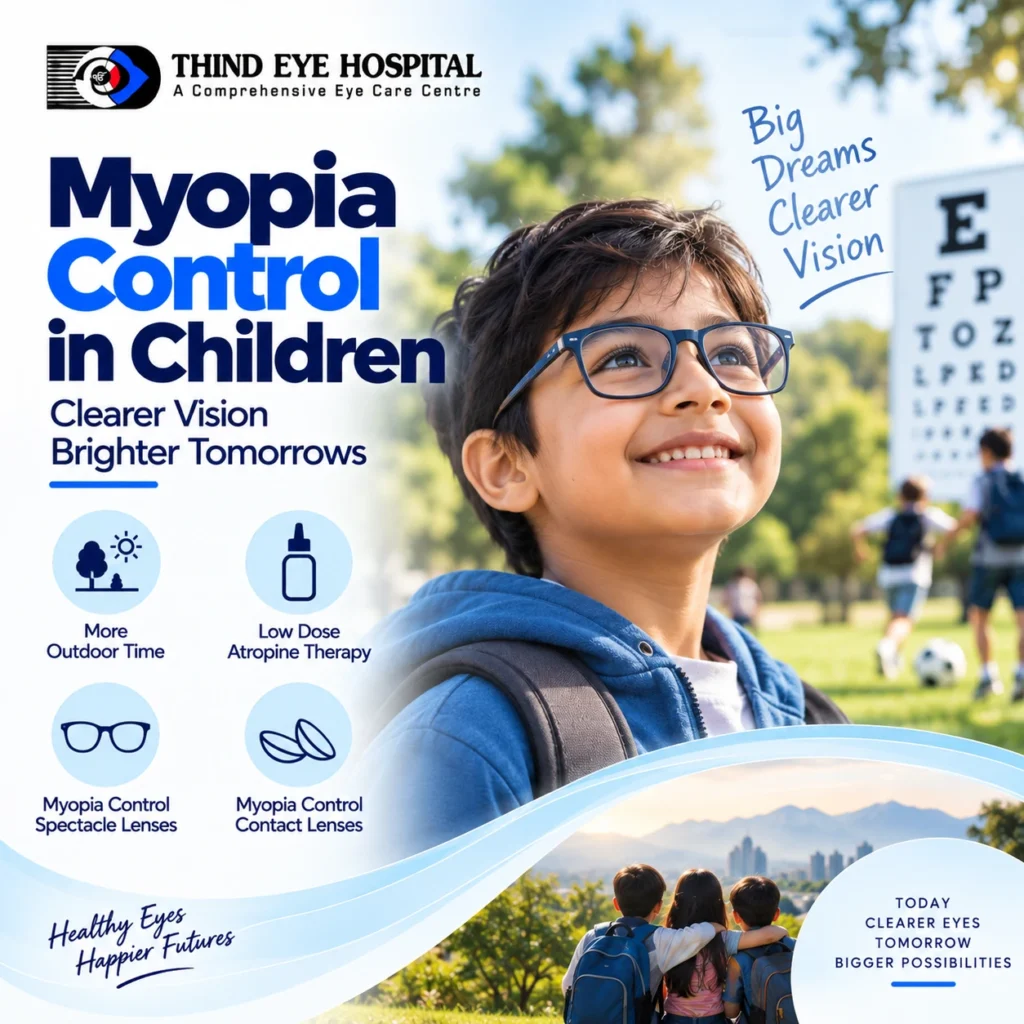
Recognised measures include:
- Increased outdoor time
- Low dose atropine therapy
- Myopia control spectacle lenses
- Myopia control contact lenses
A proper eye examination helps determine which approach is suitable for your child.
How Does Myopia Control in Children Work?
Different approaches to myopia control in children address progression in different ways.
Increased outdoor time
Spending more time outdoors is a recognised measure for slowing myopia progression. Encourage your child to include regular outdoor activity in their routine.
Low dose atropine therapy
Low dose atropine therapy is another recognised measure for myopia control. It should be used under appropriate specialist guidance.
Myopia control lenses
Myopia control spectacle or contact lenses are also recognised options. The choice should follow an eye assessment and discussion of your child’s needs.
These measures are different from ordinary glasses. Regular spectacles correct blurred vision, while myopia control approaches are intended to slow progression.
What Should Parents Watch For?
Children may not tell you that their distance vision has changed. They often assume their vision is normal because they have nothing to compare it with.
Watch for behaviour that suggests your child is struggling to see clearly.
For example, your child may sit unusually close to the television or bring books and screens close to the face. Squinting, closing one eye, head tilting and frequent eye rubbing are also reasons for an examination.
Headaches and falling school performance should also be discussed with an eye specialist.
A squint, or strabismus, means misalignment of the eyes. A squint in a child should not be left simply to see whether it disappears. It should be assessed rather than observed at home.
What Other Childhood Eye Conditions Need Attention?
Myopia control in children is only one part of children’s eye care. Some other conditions also need early assessment.
Lazy eye
Amblyopia, commonly called lazy eye, is reduced vision in an eye that has not developed normally. Treatment is most effective when started early in childhood, so screening before school age matters.
Retinopathy of prematurity
Retinopathy of prematurity screening applies to babies born prematurely or with low birth weight. It follows a time-critical schedule.
Parents of eligible babies should follow the required screening schedule rather than waiting for symptoms.
Sudden changes in vision
Sudden onset squint, a white reflex in the pupil, or a rapid change in a child’s vision needs prompt specialist assessment.
These signs should not be managed by simply waiting at home.
Myopia Control in Children at Thind Eye Hospital
Thind Eye Hospital is a multi superspeciality eye hospital with branches in Jalandhar, Ludhiana, Hoshiarpur and Pathankot.
Dr. Alia Yamin, Consultant Ophthalmologist, Cataract, Medical Retina and Dry Eye, has a speciality in cataract, refractive surgery, medical retina and dry eye management. She is experienced in myopia control with atropine therapy and myopia control lenses.
Dr. Alia Yamin consults at Ludhiana daily. You can read more on the Dr. Alia Yamin profile.
The hospital also conducts school eye health checkup programmes for children and community eye care camps for rural populations.
Thind Eye Hospital was founded in 1991 by Dr. Jaswant Singh Thind. The hospital brings more than 39 years of expertise in eye care.
When Should Your Child Have an Eye Examination?
Do not wait for your child to complain about poor vision. Children often do not recognise that their vision differs from others.
Arrange an eye examination if you notice:
- Difficulty seeing distant objects
- Sitting very close to the television
- Holding screens close
- Squinting or closing one eye
- Head tilting
- Frequent eye rubbing
- Headaches
- Falling school performance
Regular assessment is particularly useful when you are considering myopia control in children. It allows changes in vision to be identified and discussed with an eye specialist.
If you have concerns about your child’s vision, you can book an appointment for an assessment.
What Can Parents Do Next?
Myopia control in children starts with recognising changes in your child’s vision and arranging an eye examination.
Encourage regular outdoor time and discuss recognised myopia control options with an eye specialist. Low dose atropine therapy and myopia control spectacle or contact lenses are established measures used to slow progression.
Thind Eye Hospital provides children’s eye care through its specialist services. If you are concerned about myopia control in children, arrange a consultation to discuss your child’s vision and suitable options.
“This article provides general information about eye health and eye care services. It is not medical advice and does not replace a consultation with a qualified ophthalmologist. Symptoms vary between individuals. Please consult a licensed eye specialist before acting on any information here.”
For additional information, you can refer to the American Academy of Ophthalmology and the World Health Organization’s eye care information.