

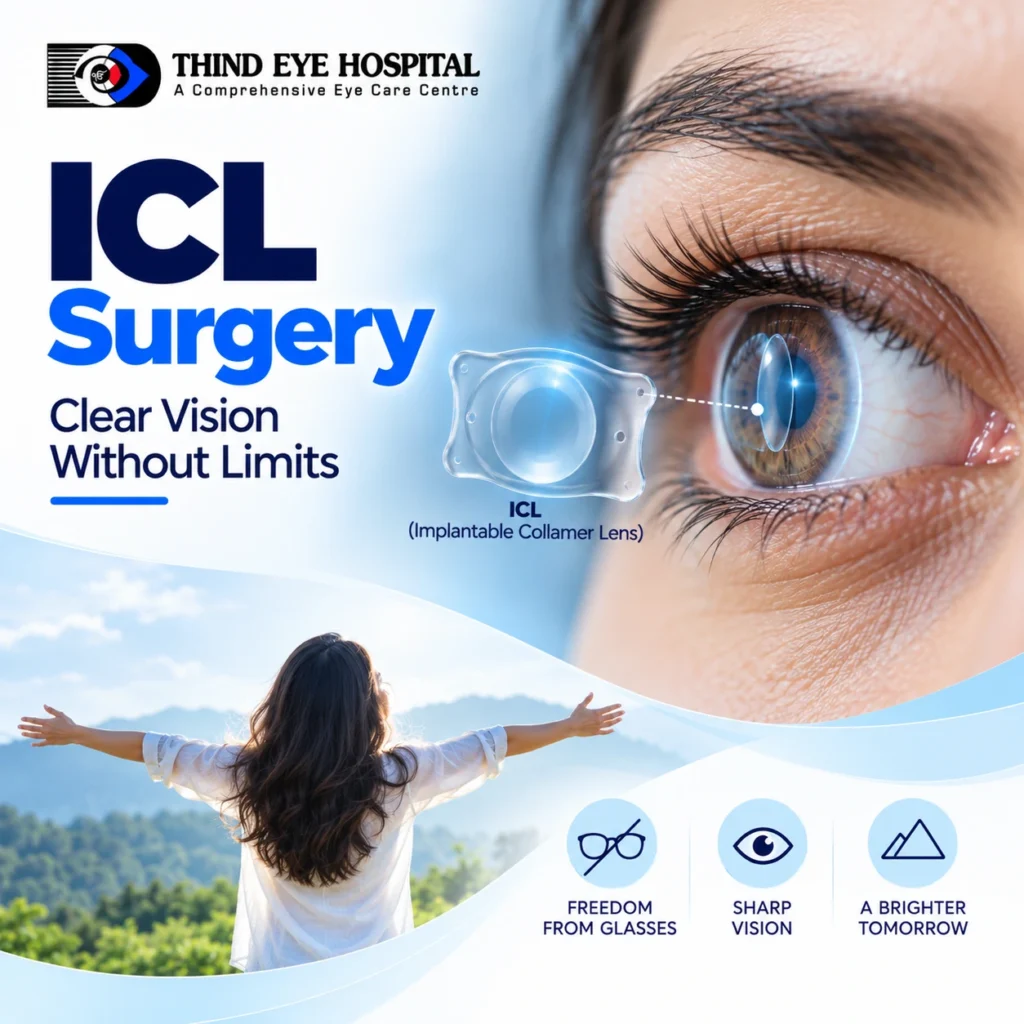
ICL surgery in Punjab is an alternative to laser vision correction for people with high refractive errors or corneas that are too thin for laser treatment. An ICL, or implantable collamer lens, is placed inside the eye without removing corneal tissue. Proper assessment determines whether ICL or laser correction is suitable.
What Is ICL Surgery in Punjab?
ICL surgery uses an implantable collamer lens to correct existing refractive power. Unlike laser vision correction, the lens is placed inside the eye and does not remove corneal tissue.
Refractive surgery is designed to reduce dependence on glasses or contact lenses. The main laser options include LASIK, SMILE, PRK and TransPRK.
ICL surgery in Punjab is considered an alternative when a patient has a high refractive error or a cornea that is too thin for laser treatment.
People sometimes search for implantable contact lens Punjab when looking for information about this procedure. The clinical term is ICL, or implantable collamer lens.
ICL vs LASIK: How Are They Different?
When comparing ICL vs LASIK, the main difference is where the treatment takes place.
ICL places a lens inside the eye and does not remove corneal tissue. LASIK reshapes the cornea and creates a corneal flap.
Other laser options work differently:
- SMILE uses a small incision and removes a lenticule of corneal tissue.
- LASIK creates a corneal flap.
- PRK and TransPRK work on the corneal surface and generally involve longer visual recovery.
- ICL places a lens inside the eye without removing corneal tissue.
You can read more about SMILE Pro compared with LASIK before discussing your options with an eye specialist.
The right choice is based on your eye measurements, refractive power and overall eye health.
Who May Be Considered for ICL Surgery?
ICL surgery in Punjab requires a detailed pre-operative assessment. Candidates are usually assessed for several factors.
These include:
- Age, generally 18 and above
- Stable spectacle power for at least one year
- Corneal thickness
- Corneal topography
- Pupil size
- Dry eye status
- General eye health
People with keratoconus, active eye infection, uncontrolled dry eye or certain retinal conditions may not be suitable for laser vision correction.
Contact lenses are usually stopped for a period before the pre-operative assessment. This is because contact lenses can alter corneal shape.
An assessment therefore matters before deciding between ICL vs LASIK or another refractive procedure.
What Is the Recovery After Refractive Surgery?
Laser vision correction is typically a day care procedure and takes a few minutes per eye. Most patients return to routine activities within one to two days.
Specific restrictions apply after treatment, including restrictions on swimming, dust exposure and eye rubbing.
The recovery pattern differs between procedures. SMILE uses a small incision, while LASIK creates a corneal flap. PRK and TransPRK treat the corneal surface and generally have a longer visual recovery.
ICL surgery in Punjab should also be discussed in the context of your individual examination rather than choosing a procedure based only on recovery time.
Does ICL prevent reading glasses later?
No. Refractive surgery corrects the existing spectacle power. It does not prevent age-related near vision change, known as presbyopia.
Presbyopia typically begins in the forties. Therefore, correcting distance power does not stop this natural age-related change in near vision.
ICL Surgery in Punjab at Thind Eye Hospital
Thind Eye Hospital is a multi superspeciality eye hospital with branches in Jalandhar, Ludhiana, Hoshiarpur and Pathankot.
The hospital was founded in 1991 by Dr. Jaswant Singh Thind, Chairman cum Managing Director. It was the first eye hospital in India to perform ICL surgery, in 2001.
It was also the first eye hospital in North India to introduce LASIK laser vision correction in 1998 and was among the earliest in India to introduce Blade-Free LASIK technology in 2007.
These milestones provide specific context for patients considering ICL surgery in Punjab alongside laser vision correction options.
Jalandhar
The Jalandhar branch is at 701, Mall Road, Model Town, Jalandhar 144001, Punjab.
Opening hours: Monday to Sunday, 8:00 am to 6:00 pm
Landmark: Mall Road, Model Town
Dr. Jaswant Singh Thind is Chief Eye Surgeon and Chairman cum Managing Director. He completed his MS in Ophthalmology from King George’s Medical College, Lucknow, in 1986, and founded Thind Eye Hospital in 1991. He consults in Jalandhar daily.
You can read more about Dr. Jaswant Singh Thind.
Other Punjab locations
Thind Eye Hospital also has branches in Ludhiana, Hoshiarpur and Pathankot, allowing patients across Punjab to access the hospital’s eye care services.
The hospital brings more than 39 years of expertise in eye care and has performed more than 4,00,000 surgeries to date.
For additional patient education, the American Academy of Ophthalmology provides information about refractive surgery and eye care. The World Health Organization’s eye care information provides broader information about vision and eye health.
What Should You Do Before Choosing ICL?
If you are considering ICL surgery in Punjab, start with a complete eye assessment rather than selecting a procedure based only on your spectacle number.
Your assessment should include corneal thickness, corneal topography, pupil size, dry eye status and general eye health. Your spectacle power should also be stable for at least a year.
A proper assessment helps determine whether ICL surgery in Punjab, LASIK, SMILE, PRK or TransPRK is appropriate for your eyes.
If you want to discuss your options, book an appointment with the eye specialist.
For patients comparing ICL vs LASIK, the decision should follow a clinical assessment of your eyes and visual needs. ICL surgery in Punjab is an option for selected patients, particularly those with high refractive errors or corneas too thin for laser treatment.
This article provides general information about eye health and eye care services. It is not medical advice and does not replace a consultation with a qualified ophthalmologist. Symptoms vary between individuals. Please consult a licensed eye specialist before acting on any information here.