

An eye number test measures your spectacle power by checking how clearly you see and how your eyes focus. It includes visual acuity and refraction, but a comprehensive eye examination also checks the front of the eye, eye pressure and, where indicated, the retina.
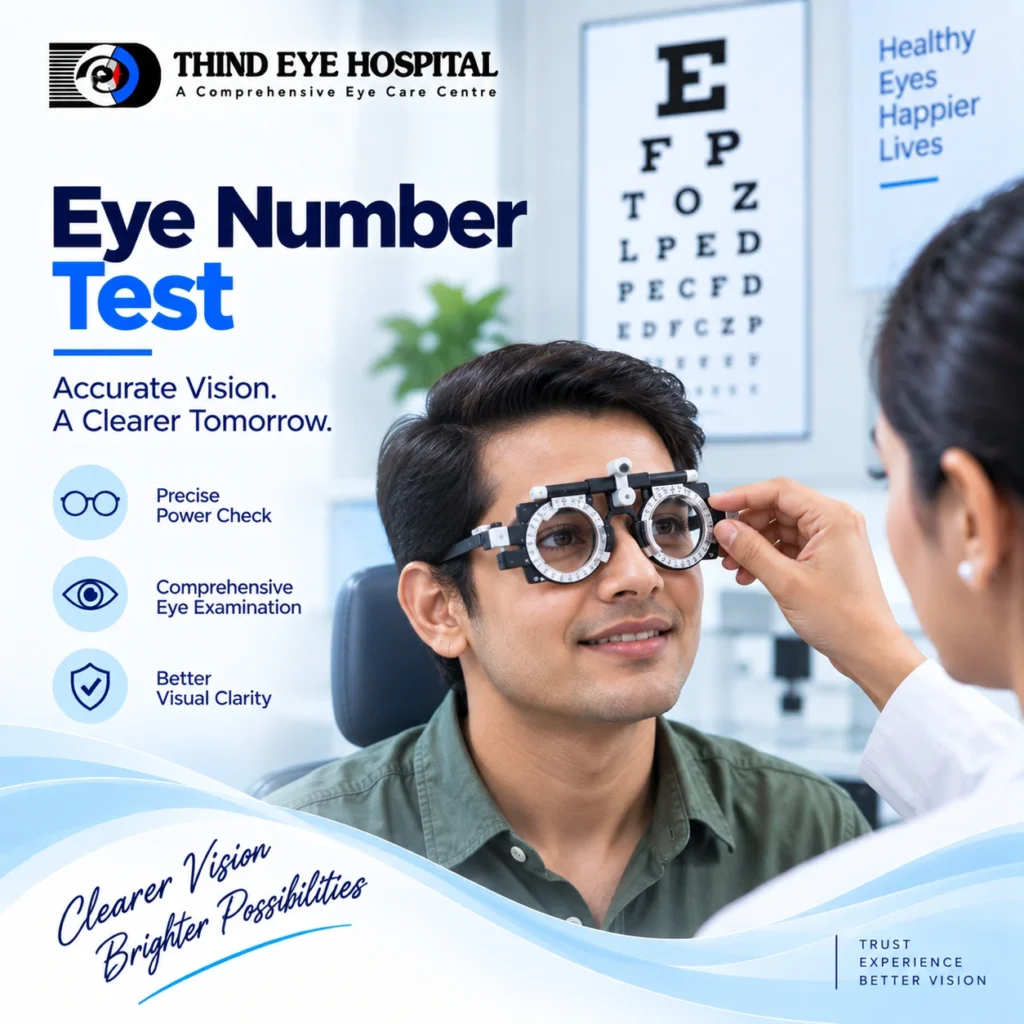
What Is an Eye Number Test?
An eye number test is commonly used to check whether you need spectacles and to measure your refractive power. The process includes visual acuity testing and refraction.
Visual acuity checks how clearly you can see. Refraction identifies the lens power needed to correct your vision.
However, an eye power test is only one part of a complete eye examination. A comprehensive examination assesses more than spectacle power.
It includes:
- Visual acuity
- Refraction
- Examination of the front of the eye
- Intraocular pressure
- Dilated retinal examination, where indicated
This broader assessment is useful because a change in vision is not always explained by spectacle power alone.
Eye Number Test: How Is Spectacle Power Measured?
During an eye number test, refraction is used to determine your spectacle power. The test checks how your eyes focus and helps establish the appropriate vision correction.
A refraction test is therefore an important part of measuring spectacle power.
You may be asked to read letters or symbols during visual acuity testing. Different lens powers are then assessed during refraction.
The final spectacle prescription is based on the examination findings rather than simply choosing a stronger or weaker lens.
Why should you not rely only on your old prescription?
Your spectacle power can change over time. If your vision has become blurred, you are having difficulty reading or your existing spectacles no longer feel adequate, a fresh eye number test is useful.
You can also read about the signs you need glasses before arranging an examination.
What Does a Full Eye Examination Check?
A complete eye number test appointment can involve more than refraction.
A comprehensive eye examination checks visual acuity, refraction, the front of the eye and intraocular pressure. A dilated retinal examination is performed where indicated.
Eye pressure
Intraocular pressure measures pressure inside the eye. It forms part of a comprehensive eye examination.
This is especially relevant because glaucoma is often symptomless until advanced. Anyone with a family history of glaucoma should therefore have regular examinations from an earlier age.
Retinal examination
The retina can be examined after dilation when indicated. This is particularly important for people with diabetes.
People with diabetes need a dilated retinal examination at least once a year, even when their vision seems normal.
The American Academy of Ophthalmology provides further information about eye examinations and eye health.
When Should You Have an Eye Number Test?
Adults without symptoms and without risk factors are generally advised to have a comprehensive eye examination every one to two years.
From age 40, examinations are advised more often because the risk of glaucoma and other conditions rises.
Presbyopia, the age-related loss of near focus, typically begins in the forties. It is a normal change rather than a disease.
If your near vision has changed, do not assume that you simply need a stronger spectacle number. A comprehensive examination provides a broader assessment.
What if you have diabetes?
People with diabetes need a dilated retinal examination at least once a year. This applies even when your vision appears normal.
Your regular eye number test should therefore not be treated as a substitute for a complete retinal assessment when one is indicated.
For information about eye care in India, you can also refer to the National Programme for Control of Blindness and Visual Impairment.
Can Screens Affect Your Eyesight?
Prolonged screen use is associated with dry eye and eye strain because blink rate falls.
If you spend long periods looking at a screen, regular breaks, adequate lighting and the correct working distance can reduce symptoms.
These measures support comfortable screen use, but they do not replace an eye number test when you are experiencing ongoing changes in vision.
Ultraviolet exposure is also linked to cataract and pterygium. Sunglasses with proper UV protection therefore matter in the Punjab climate.
The World Health Organization’s eye care information is another useful source for general vision information.
Eye Number Test at Thind Eye Hospital
Thind Eye Hospital is a multi superspeciality eye hospital with branches in Jalandhar, Ludhiana, Hoshiarpur and Pathankot.
The hospital was founded in 1991 by Dr. Jaswant Singh Thind, Chairman cum Managing Director. He completed his MS from King George’s Medical College, Lucknow, in 1986.
The hospital brings more than 39 years of expertise in eye care. More than 4,00,000 surgeries have been performed by Thind Eye Hospital to date.
Thind Eye Hospital introduced LASIK laser vision correction in North India in 1998. It launched a fully equipped Vitreo-Retinal department in 1999 and was the first eye hospital in India to perform ICL surgery in 2001.
For patients seeking an eye number test, Dr. Monisha Malhotra is a Consultant Ophthalmologist who consults at Jalandhar.
You can learn more about Dr. Monisha Malhotra before booking your consultation.
What Should You Do Next?
If you are noticing blurred vision or difficulty seeing clearly, an eye number test is a sensible starting point. A comprehensive eye examination goes further by checking your eyes beyond spectacle power.
Do not rely only on an old prescription if your vision has changed. Arrange an examination and discuss your concerns with a qualified ophthalmologist.
You can book an appointment for an eye examination. If you are looking for an eye number test, the assessment can help establish your spectacle power while also checking other important aspects of eye health.
This article provides general information about eye health and eye care services. It is not medical advice and does not replace a consultation with a qualified ophthalmologist. Symptoms vary between individuals. Please consult a licensed eye specialist before acting on any information here.
FAQs