

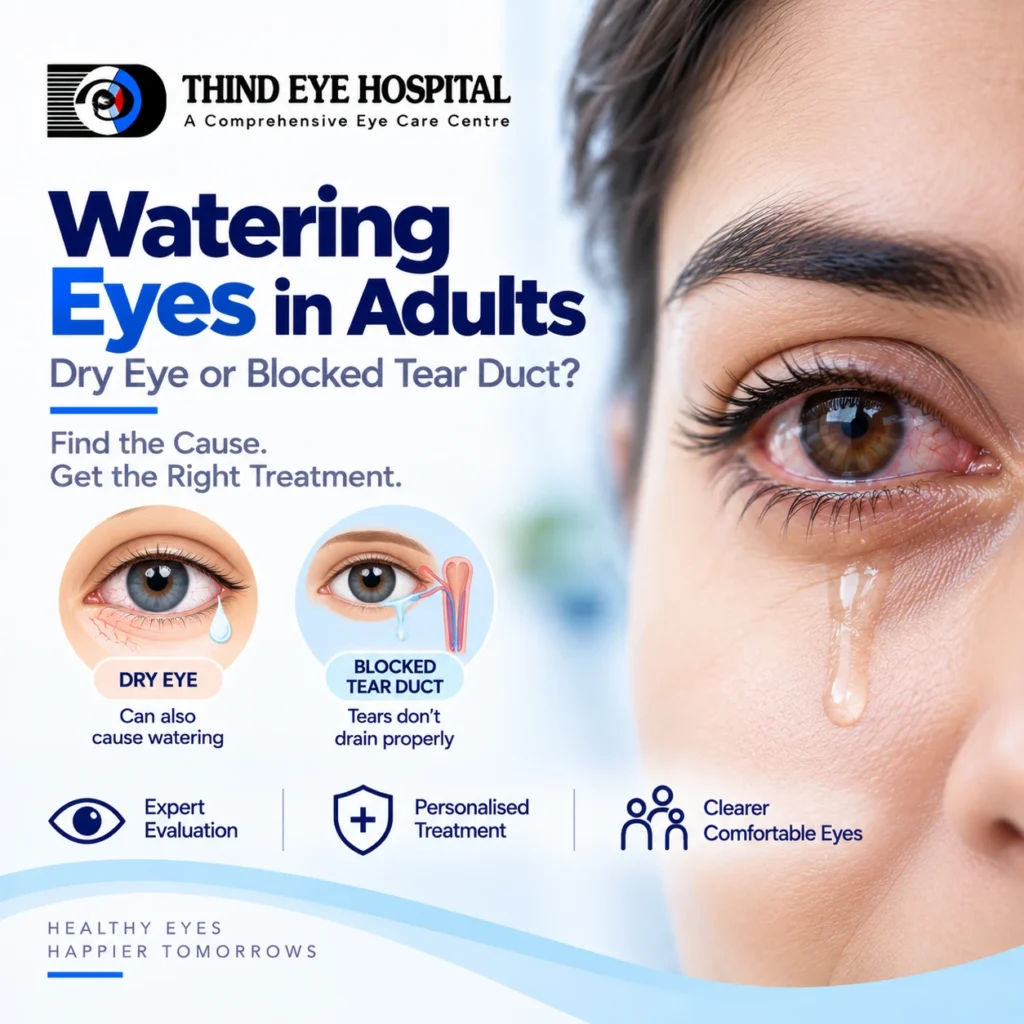
Watering eyes causes in adults include both blocked tear drainage and dry eye. Excessive tearing does not always mean you are producing too many tears. Dryness can trigger watering, while a blocked tear drainage system can stop tears from leaving the eye normally. An eye examination helps identify the underlying cause.
Common Watering Eyes Causes in Adults
There are several watering eyes causes, but two important ones are dry eye and blocked tear drainage.
It may seem strange that dry eye causes watering. However, dry eye affects the tear film, the thin layer covering the eye surface. When this layer becomes unstable, the eye can respond with excess tearing.
A blocked tear drainage system works differently. Tears are produced normally but cannot drain properly through the usual pathway. This can result in persistent watering.
This is why excessive tearing should not automatically be assumed to mean an overproduction of tears.
Dry Eye and Watering
Dry eye is a common condition of the tear film. It can cause:
- Burning
- Grittiness
- Watering
- Fluctuating vision
If your eyes water frequently, especially alongside burning or grittiness, an examination can help establish whether dry eye is contributing to the problem.
Watering Eyes Causes: Dry Eye or Blocked Tear Drainage?
The symptoms of these conditions can overlap, making examination important.
With dry eye, watering can occur because the tear film is not functioning normally. The eye surface responds by producing additional tears.
With blocked tear drainage, the issue is different. Tears do not drain away properly, so they collect and spill over the eyelids.
Both conditions can therefore cause similar complaints. The correct eye watering treatment starts with finding the reason for the watering rather than treating the symptom alone.
If watering continues or interferes with your daily activities, arrange an eye examination.
How a Tear and Eye Examination Helps
Oculoplastic surgery deals with the eyelids, tear drainage system and the orbit, which is the bony socket around the eye.
A specialist examination is particularly relevant when watering is persistent or follows an injury around the eye.
Orbital and eyelid trauma needs prompt assessment because damage to the tear drainage system is easier to repair early.
Your doctor will assess the eye and surrounding structures to understand what is contributing to the watering. This is especially useful when the cause is not obvious from the symptoms alone.
For broader information about vision and eye care, you can refer to the American Academy of Ophthalmology and the World Health Organization eye care information.
Other Conditions That Need Eye Assessment
Watering is not always caused by dry eye or tear drainage problems. Other eyelid and eye conditions can also require specialist assessment.
Chalazion
A chalazion is a blocked, usually painless eyelid gland swelling. Warm compresses are the first measure. A persistent lump may need a minor procedure.
Eyelid Lumps
Any rapidly growing eyelid lump, a lump with lash loss, or an ulcerating lesion needs assessment rather than simple observation.
Thyroid Eye Disease
Thyroid eye disease can cause prominence of the eyes, lid retraction and double vision. In severe cases, it can put pressure on the optic nerve.
These conditions show why persistent eye symptoms should be examined instead of assuming that one cause explains every case.
Watering Eyes and Specialist Care in Jalandhar
If you are looking for specialist care for watering eyes causes, Thind Eye Hospital has an oculoplastics, orbit and neuro-ophthalmology specialist in Jalandhar.
Dr. Apoorva Mittal is an Oculoplastics, Orbit and Neuro-Ophthalmologist. Oculoplastics, orbit and neuro-ophthalmology focus on conditions involving the eyelids, tear drainage system, eye socket and the connection between the eye and brain.
You can read more about Dr. Apoorva Mittal.
Neuro-ophthalmology includes optic nerve disease, sudden double vision and unexplained visual field loss. These problems require proper assessment because the eye and brain work closely together.
You can also read about vision changes after 60 for information about other changes that can affect vision with age.
Thind Eye Hospital is a multi superspeciality eye hospital with branches in Jalandhar, Ludhiana, Hoshiarpur and Pathankot.
What Should You Do About Persistent Eye Watering?
If you are experiencing persistent watering, do not assume that dry eye is the cause. Watering eyes causes include both dry eye and blocked tear drainage, and an examination is needed to distinguish between them.
The appropriate eye watering treatment depends on what the examination finds. A specialist can assess the tear drainage system, eyelids and surrounding structures where required.
If you are concerned about persistent excessive tearing, you can book an appointment with Thind Eye Hospital.
You can also explore vision changes after 60 if you are noticing other changes in your vision.
Understanding the watering eyes causes is the first step towards getting the right eye assessment and appropriate care.
This article provides general information about eye health and eye care services. It is not medical advice and does not replace a consultation with a qualified ophthalmologist. Symptoms vary between individuals. Please consult a licensed eye specialist before acting on any information here.