

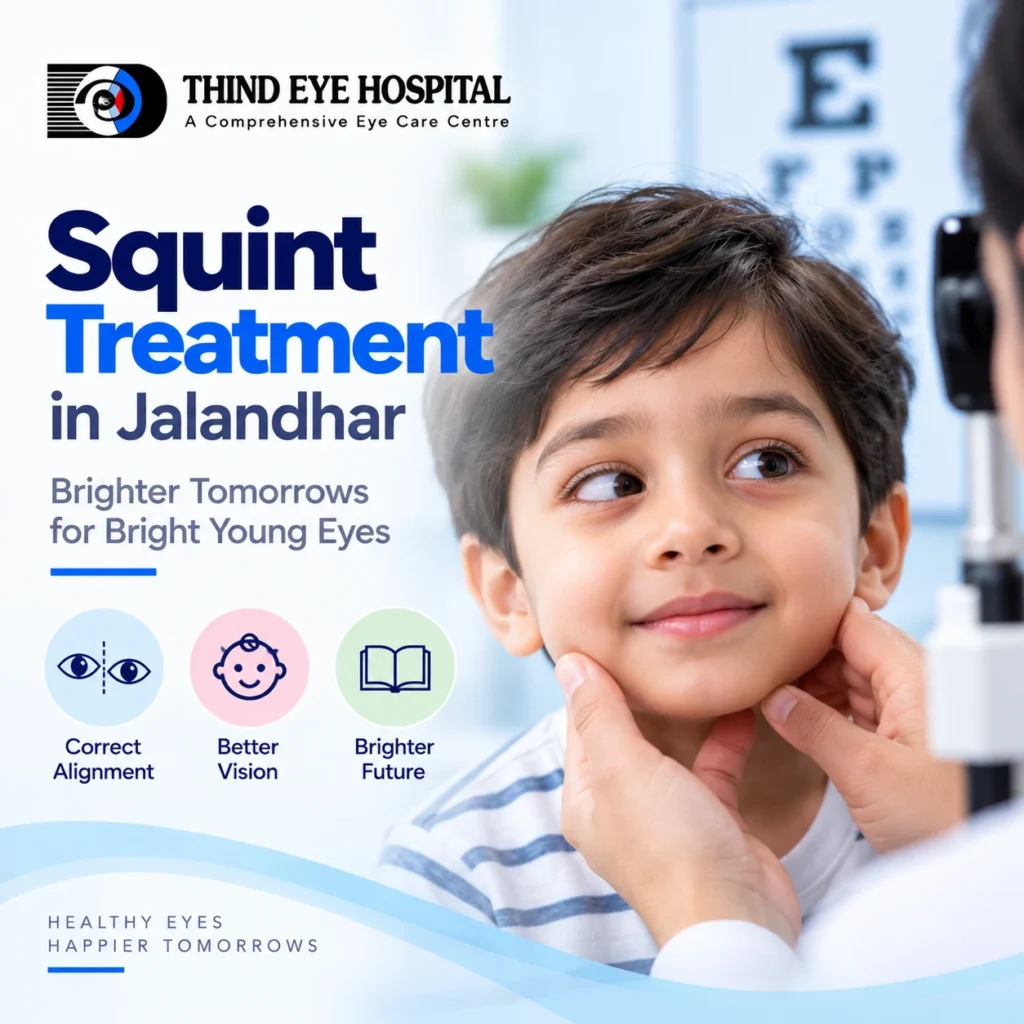
Squint treatment in Jalandhar starts with a proper assessment of the child’s eyes. Squint, also called strabismus, is a misalignment of the eyes. Depending on its type and cause, treatment may include glasses, vision therapy, patching or surgery. Early assessment also helps identify related problems such as amblyopia, commonly called lazy eye.
What Is a Squint in Children?
A squint means the eyes are not properly aligned. One eye may appear to look in a different direction from the other.
Parents may notice the problem clearly, but some children do not complain about poor vision. Children often assume everyone sees the way they do. Detection therefore depends on adults noticing changes in behaviour.
A child who has a squint should be assessed rather than simply observed at home. A squint is not something that should be left alone with the expectation that it will simply disappear.
For families looking for squint treatment in Jalandhar, an early eye examination is a useful first step.
Signs parents should watch for
Your child may need an eye examination if they:
- Hold books or screens very close
- Sit close to the television
- Squint or close one eye
- Tilt their head while looking
- Rub their eyes frequently
- Complain of headaches
- Show a change in school performance
These signs do not confirm a particular eye condition. They are reasons to arrange an examination.
Squint Treatment in Jalandhar: When Is Surgery Needed?
Squint treatment in Jalandhar is not limited to surgery. Squint may be treated with glasses, vision therapy, patching or surgery, depending on the type and cause.
An ophthalmologist is a medical eye specialist who examines and treats eye conditions. An optometrist primarily provides vision and eye-care services such as vision assessment and correction. For a child’s squint, specialist ophthalmic assessment is important.
The purpose of the assessment is to understand how the eyes are aligned and how the child’s vision has developed.
What about lazy eye?
Amblyopia, commonly called lazy eye, is reduced vision in an eye that has not developed normally. Treatment is most effective when started early in childhood, so screening before school age matters.
A child can have both a squint and amblyopia. This is one reason parents should not wait for the child to report a vision problem.
What Does Squint Surgery in Jalandhar Involve?
Squint surgery in Jalandhar is one possible treatment for selected cases of strabismus. However, surgery is not automatically required for every child with a squint.
The treatment plan follows the assessment of the type and cause of the misalignment. Glasses, vision therapy, patching or surgery may be used.
Parents should therefore focus first on getting the child’s eyes examined. This allows the specialist to determine which treatment approach is appropriate.
A sudden-onset squint needs prompt specialist assessment. A white reflex in the pupil or a rapid change in a child’s vision also needs prompt assessment.
Other Vision Problems Parents Should Know
Squint is not the only childhood eye concern. Childhood myopia is increasing, and recognising vision problems early is important.
Childhood myopia
Myopia means short-sightedness, where distant objects appear less clear. Recognised measures to slow myopia progression include increased outdoor time, low-dose atropine therapy and myopia control spectacle or contact lenses.
Parents should arrange an eye examination if their child sits unusually close to screens or television, or regularly squints while looking at distant objects.
You can also read about the signs you need glasses to understand common vision-related behaviours.
Retinopathy of prematurity
Retinopathy of prematurity affects the developing retina of premature babies. Screening is time critical and follows a paediatrician’s referral schedule.
Parents of premature babies should follow the recommended screening schedule rather than waiting for visible eye symptoms.
Squint Treatment in Jalandhar at Thind Eye Hospital
Thind Eye Hospital is a multi superspeciality eye hospital with branches in Jalandhar, Ludhiana, Hoshiarpur and Pathankot. The hospital was founded in 1991 by Dr. Jaswant Singh Thind, Chairman cum Managing Director, who completed his MS from King George’s Medical College, Lucknow, in 1986.
The hospital brings more than 39 years of expertise in eye care and has performed more than 4,00,000 surgeries to date.
For families seeking squint treatment in Jalandhar, Dr. Saurabh Mittal, Cornea, Squint and Paediatric Ophthalmologist, consults at the Jalandhar branch daily. He is fellowship trained in cornea and paediatric ophthalmology from PGI Chandigarh.
You can learn more about Dr. Saurabh Mittal before arranging a consultation.
Jalandhar branch details
Address: 701, Mall Road, Model Town, Jalandhar 144001, Punjab
Landmark: Mall Road, Model Town
Opening hours: Monday to Sunday, 8:00 am to 6:00 pm
Phone: +91 88720 70022
The eye hospital in Jalandhar provides a local option for families seeking specialist eye care.
What Should Parents Do Next?
If you notice a squint, do not wait for your child to outgrow it. Squint treatment in Jalandhar should begin with an appropriate eye examination.
Seek prompt specialist assessment if your child’s squint starts suddenly, the pupil develops a white reflex, or there is a rapid change in vision.
For families considering squint surgery in Jalandhar, the next step is to discuss the child’s condition with a specialist. Dr. Saurabh Mittal consults daily at the Jalandhar branch.
Call +91 88720 70022 to arrange a consultation, or book an appointment online.
If you are looking for squint treatment in Jalandhar, early assessment can help identify the appropriate treatment path for your child.
For additional information about children’s eye health, you can refer to the American Academy of Ophthalmology and the National Programme for Control of Blindness and Visual Impairment.
Disclaimer: This article provides general information about eye health and eye care services. It is not medical advice and does not replace a consultation with a qualified ophthalmologist. Symptoms vary between individuals. Please consult a licensed eye specialist before acting on any information here.