


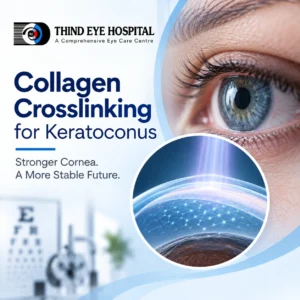
Collagen crosslinking is a treatment used to strengthen the cornea and slow the progression of keratoconus. Keratoconus causes progressive thinning and bulging of the cornea, which can distort vision and change spectacle power. Collagen crosslinking (CXL) does not usually reverse corneal changes that are already present.
What is collagen crosslinking?
The cornea is the clear front surface of your eye. Its shape and clarity determine much of the eye’s focusing power.
Keratoconus is a progressive thinning and bulging of the cornea. It usually starts in the teens or twenties. It can cause distorted vision and frequently changing spectacle power.
Persistent eye rubbing is a recognised risk factor. If your spectacle prescription keeps changing or your vision appears distorted, an eye examination helps determine the cause.
Collagen crosslinking is used to strengthen corneal tissue and slow the progression of keratoconus. It is therefore also called CXL treatment or crosslinking for keratoconus.
The main purpose of collagen crosslinking is to strengthen the cornea. It does not usually reverse changes that are already present.
Who may need collagen crosslinking?
Keratoconus is progressive, so timely assessment is important when changes in corneal shape or vision are suspected.
Your ophthalmologist, a medical doctor specialising in eye care, assesses your eyes before recommending treatment. The assessment helps determine the condition of the cornea and the appropriate management approach.
What symptoms should you get checked?
Arrange an eye examination if you notice:
- Distorted or unclear vision
- Frequently changing spectacle power
- Changes in the quality of your vision
- A history of persistent eye rubbing
These symptoms do not by themselves confirm keratoconus. A proper examination is needed to assess the cornea.
The American Academy of Ophthalmology provides patient information on eye conditions and treatment. You can also refer to the National Programme for Control of Blindness and Visual Impairment for information on eye health in India.
How does collagen crosslinking help keratoconus?
The goal of collagen crosslinking is to strengthen corneal tissue and slow the progression of keratoconus.
This distinction matters. CXL is not usually intended to reverse corneal changes that are already present. Its role is to strengthen the cornea and slow further progression.
For someone considering CXL treatment, the decision should follow an eye examination. Your ophthalmologist can assess the cornea and discuss whether collagen crosslinking is appropriate.
The management of keratoconus does not always involve only collagen crosslinking. Other corneal procedures have specific roles in selected cases.
What other treatments are used for keratoconus?
Crosslinking for keratoconus focuses on strengthening the corneal tissue. Other procedures focus on improving corneal shape or replacing affected corneal tissue.
CAIRS and corneal ring segments
CAIRS and corneal ring segments can help improve corneal shape in selected keratoconus patients.
These procedures have a different role from collagen crosslinking. The appropriate option depends on the condition of the cornea and the findings during assessment.
Corneal transplantation
Corneal transplant techniques include penetrating keratoplasty, also called PK, and lamellar techniques such as DALK and PDEK.
Lamellar techniques replace only the affected layers of the cornea. These procedures are different from CXL and are used for specific corneal conditions.
Other corneal conditions that need assessment
A cornea consultation can also identify conditions other than keratoconus.
Corneal ulcers
Corneal ulcers can follow injury, contact lens misuse or infection. Pain, redness, watering and a white spot on the cornea need same-day assessment.
Delay can cause permanent scarring. If these symptoms occur, seek an eye examination promptly rather than attempting to identify the condition yourself.
Pterygium
Pterygium is a fleshy growth on the surface of the eye. It is associated with sun, wind and dust exposure.
It is removed surgically when it affects vision or causes persistent irritation.
Dry eye
Dry eye is a common condition of the tear film. It causes burning, grittiness, watering and fluctuating vision.
Modern management includes tear film assessment, lubricants, lid hygiene, and treatments such as IDRA assessment and IRPL therapy.
If you are also looking for eye allergy treatment, a separate assessment can help identify the cause of your eye symptoms.
Collagen crosslinking at Thind Eye Hospital
At Thind Eye Hospital, Dr. Diksha, Consultant Ophthalmologist specialising in Cornea and Refractive Surgery, has experience in SMILE, LASIK, PRK, collagen crosslinking and CAIRS for keratoconus.
Dr. Diksha completed MBBS and MS Ophthalmology. Her work includes cornea, cataract and refractive surgery, including LASIK, SMILE and PRK. She has also published research in the Indian Journal of Ophthalmology.
She consults in Ludhiana daily. You can read more about Dr. Diksha and her speciality.
Thind Eye Hospital was founded in 1991 by Dr. Jaswant Singh Thind. The hospital brings more than 39 years of expertise in eye care and is a multi superspeciality eye hospital with branches in Jalandhar, Ludhiana, Hoshiarpur and Pathankot.
What should you do next?
If you are considering collagen crosslinking, start with a proper corneal assessment. This is especially relevant if you have distorted vision or frequently changing spectacle power.
Do not assume that every change in vision means keratoconus. An ophthalmologist needs to examine your eyes before a treatment decision is made.
You can book an appointment with Thind Eye Hospital for an eye consultation.
For someone researching collagen crosslinking, understanding its purpose is a useful first step. CXL strengthens corneal tissue and slows the progression of keratoconus, while other corneal procedures address different needs.
Collagen crosslinking is therefore a treatment focused on strengthening the cornea rather than reversing changes that have already occurred.
This article provides general information about eye health and eye care services. It is not medical advice and does not replace a consultation with a qualified ophthalmologist. Symptoms vary between individuals. Please consult a licensed eye specialist before acting on any information here.