


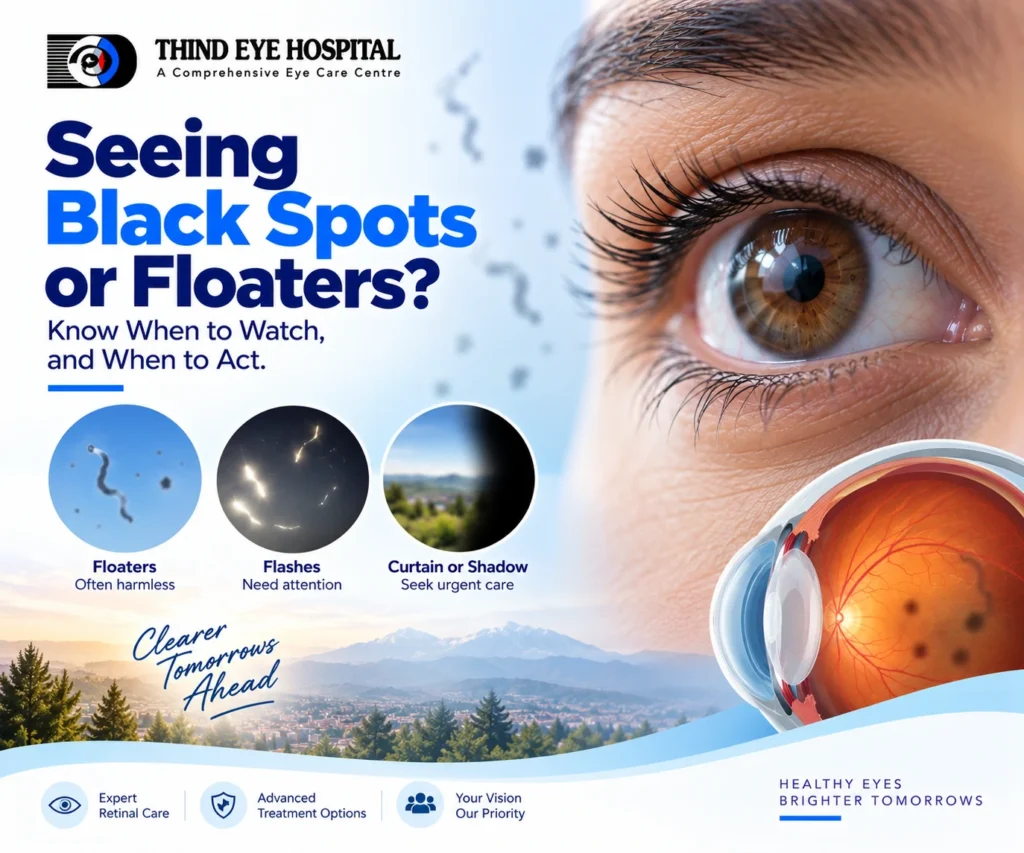
Black spots in eyes are often noticed as small dots, threads, cobwebs or shadows moving across your vision. These are commonly called eye floaters and are often harmless. However, a sudden increase in floaters, especially with flashes or a curtain-like shadow, needs urgent eye examination because it can signal retinal detachment.
What are black spots in eyes?
The term black spots in eyes often describes moving shapes that appear in your field of vision. You may notice dots, lines, threads or cobweb-like shapes, especially against a bright background.
These are commonly called eye floaters. Floaters are common and often harmless.
However, the pattern and timing of the symptoms matter. A sudden shower of new floaters, particularly when accompanied by flashes of light, needs urgent examination.
The retina is the light-sensitive layer at the back of your eye. Retinal disease is a leading cause of vision loss and often develops without pain.
This is why new black spots in eyes should not automatically be dismissed as harmless.
When are black spots in eyes an emergency?
Some changes in vision require same-day assessment. Retinal detachment is an eye emergency and needs prompt treatment.
Watch for these warning signs:
- A sudden increase in floaters
- Flashes of light
- A shadow moving across your field of vision
- A curtain-like area covering part of your vision
If these symptoms appear suddenly, seek same-day eye assessment.
A sudden change is particularly important. Even if you have had occasional floaters before, a sudden increase should be examined.
If your black spots in eyes appear with flashes or a curtain-like shadow, do not wait for the symptoms to settle.
Black spots in eyes and retinal disease
The retina plays a key role in vision. Retinal disease can develop without pain, which means you cannot rely on discomfort to decide whether your eyes need examination.
Diabetic retinopathy
Diabetic retinopathy is a complication of diabetes that affects the blood vessels of the retina.
It can be present without symptoms in its early stages. People with diabetes therefore need regular dilated retinal examinations.
If you have diabetes and notice new black spots in eyes, do not assume they are ordinary floaters. A retinal examination can help assess what is happening inside the eye.
What other retinal conditions affect vision?
Not every retinal problem presents in the same way. Some conditions affect central vision rather than causing moving spots.
Macular hole
A macular hole affects central vision. It can cause straight lines to appear distorted.
Epiretinal membrane
An epiretinal membrane can also affect central vision and cause distortion of straight lines.
Both conditions are assessed with optical coherence tomography, or OCT. They may be treated surgically.
These conditions show why new spots in vision deserve attention when they are persistent, changing or associated with other visual symptoms.
How are black spots in eyes assessed and treated?
An eye examination helps determine whether your symptoms are related to harmless floaters or a retinal condition requiring treatment.
Treatment options for retinal disease include:
- Retinal laser, including pan retinal photocoagulation and barrage laser
- Intravitreal injections, such as anti-VEGF and Ozurdex
- Pars plana vitrectomy
- Scleral buckling
The treatment used depends on the retinal condition identified during assessment.
Vision already lost to advanced retinal disease often cannot be restored. The aim of treatment is usually to preserve remaining vision. This makes early detection important.
Black spots in eyes in children
Retinopathy of prematurity affects the developing retina of premature babies. Screening is time critical and follows the paediatrician’s referral schedule.
Parents should follow the recommended screening schedule rather than waiting for visual symptoms.
Although the causes differ between children and adults, retinal assessment remains important whenever a retinal problem is suspected.
Retina care at Thind Eye Hospital
Thind Eye Hospital is a multi superspeciality eye hospital with branches in Jalandhar, Ludhiana, Hoshiarpur and Pathankot.
The hospital launched its fully equipped Vitreo-Retinal department in 1999.
Patients seeking assessment for black spots in eyes can consult Dr. Kanwaljeet H. Madan, Senior Vitreo-Retinal Surgeon. He is based in Jalandhar daily and also consults in Hoshiarpur on Wednesdays from 8:00 am to 5:00 pm, and Pathankot on Mondays.
Dr. Kanwaljeet H. Madan’s speciality is vitreoretinal surgery, which focuses on conditions affecting the retina and vitreous.
Thind Eye Hospital was founded in 1991 by Dr. Jaswant Singh Thind and provides eye care across its four Punjab branches.
What should you do about black spots in eyes?
If you have occasional, unchanged floaters, they are often harmless. However, a sudden shower of new floaters, especially with flashes, needs urgent examination.
A curtain or shadow moving across your field of vision is also an emergency warning sign.
If you are concerned about black spots in eyes, arrange an eye examination rather than trying to identify the cause yourself.
You can book an appointment with Thind Eye Hospital for an eye assessment.
For general information about eye health, you can also refer to the American Academy of Ophthalmology and the World Health Organization eye care information.
If you notice new black spots in eyes, particularly with flashes or a curtain-like shadow, seek same-day eye assessment.
This article provides general information about eye health and eye care services. It is not medical advice and does not replace a consultation with a qualified ophthalmologist. Symptoms vary between individuals. Please consult a licensed eye specialist before acting on any information here.